

Forget the horned helmets.
They didn’t wear them.
Forget the little velvet bag containing twenty-four beautifully polished rune stones you bought from an occult shop for £37.95.
They almost certainly didn’t have those either.
If you want to imagine something closer to Viking Age magick, try this instead.
It’s getting dark.
There’s a fire.
Someone is singing.
Someone else is carving marks into a piece of wood with a knife.
And sitting above everybody on a specially prepared raised seat is a woman everyone in the room is taking extremely seriously.
Welcome to Viking sorcery.
Or at least:
what little we can reconstruct of it.
THE PROBLEM WITH VIKING MAGICK
The Vikings didn’t leave us The Complete Practical Handbook of Norse Sorcery.
Annoying.
Most of what we know comes from archaeology, inscriptions, medieval Scandinavian literature and texts written down after Christianisation.
So immediately we need our standing rule:
Learn the history. Invent the experiment. Never confuse the two.
There was magic.
There were specialists.
There were runes.
There were charms.
There was divination.
There were gods.
But exactly how all the pieces fitted together in somebody’s magical practice on a wet Wednesday evening in East Anglia around AD 900?
We don’t know.
Which means we’re free to investigate.
GALDR: MAGICK WITH YOUR VOICE
One of the old words we encounter is galdr.
Its territory is song.
Chant.
Incantation.
The magically charged voice.
This is immediately interesting because it requires virtually no equipment.
Your body is the instrument.
Words are the technology.
Rhythm alters consciousness.
Repetition alters attention.
Sound changes breathing.
Breathing changes physiology.
And whether there’s anything supernatural happening beyond that remains precisely the sort of question we’re interested in.
The image of the Norse magician simply singing reality into a different configuration appeals to me enormously.
But then things become stranger.
ENTER THE VÖLVA
The völva is one of the most compelling figures in Northern European magic.
A seeress.
A wandering magical specialist.
A woman associated with prophecy and supernatural knowledge.
And apparently somebody you didn’t treat like the lady who reads Tarot cards at the local psychic fair.
The famous account comes from Eiríks saga rauða — The Saga of Erik the Red.
A seeress named Þorbjörg arrives during a time of hardship.
She’s received ceremonially.
She’s given a specially prepared elevated seat.
She carries a staff.
A group of women forms around her and a special song is performed.
Then she gives prophecy.
Whatever historical reality lies behind that literary account, it’s a tremendous image.
The sorceress rises above ordinary social space.
Song creates the environment.
She enters another mode.
Then she speaks.
This isn’t fortune-telling as entertainment.
The community wants information.
What’s happening?
What’s coming?
When will conditions improve?
What do we do?
The oracle is operational.
AND THE MEN?
This is where modern summaries can become too tidy.
You’ll sometimes encounter:
Galdr = male magic.
Seiðr = female magic.
Reality was messier.
Women certainly loom particularly large in accounts of seiðr and prophecy, but the literary Odin himself practises seiðr.
And magical singing isn’t neatly confined to men either.
The gender boundary itself was culturally charged. Some forms of magic performed by men could attract accusations of ergi — unmanliness or violation of expected masculine behaviour.
So the magical world wasn’t simply:
WIZARDS → THIS WAY
WITCHES → THAT WAY
It was socially complicated.
Good.
Real societies usually are.
WHERE DO THE RUNES COME IN?
This is where modern occultism tends to rush ahead of the evidence.
Runes were first and foremost writing.
Names.
Messages.
Memorials.
Ownership.
Statements.
The National Museum of Denmark notes that the great majority of surviving inscriptions are thoroughly everyday affairs. (National Museum of Denmark)
But that’s not the whole story.
There are inscriptions that invoke supernatural protection or curse interference. The Glavendrup stone even calls upon Thor to hallow its runes before threatening anyone who damages the monument. (National Museum of Denmark)
And the sagas contain stories about magical rune use.
In Egil’s Saga, Egil famously encounters a sick girl who has had badly made runes placed around her. He destroys the offending inscription, carves new runes, and she recovers.
The story carries a wonderfully sensible occult warning:
Don’t carve runes unless you know what you’re doing.
A Viking Age version of:
DON’T BECOME AN IDIOT.
FORGET THE BAG OF RUNE STONES
When people think “rune divination” today, they often picture polished stones.
Perfect little sets.
One rune on each.
Into the velvet bag they go.
There’s nothing wrong with using them.
But don’t mistake the modern occult product for the historical object.
Runes were designed to be carved.
Wood is particularly interesting because it usually disappears archaeologically.
A stick.
A sliver of branch.
Bone.
Antler.
Metal.
Stone.
The angular construction of runes lends itself beautifully to cutting them into hard surfaces.
Which leads to an image I find much more compelling than carrying around a prefabricated divination set:
You carve the rune when you need it.
RUNES AS COMMAND LINE
Think Linux.
You don’t carry a bag containing little ceramic tiles saying:
ls
cd
grep
sudo
You type the command.
Again and again.
Eventually your fingers know it.
That’s how I like thinking about carving runes.
The hand learns the symbol.
Knife meets wood.
Line.
Line.
Branch.
Stave.
Again.
The rune moves out of the book and into muscle memory.
Now combine that with galdr.
You carve the rune.
You speak its name.
You breathe.
You repeat.
Suddenly we’ve got something considerably more interesting than pulling a pebble out of a velvet bag.
THE PAST BEHIND GLASS
This isn’t entirely abstract to me.
Norwich Castle Museum has Anglo-Saxon and Viking material from East Anglia, including objects bearing Old English runic inscriptions in its collections. (Visit Norwich)
I remember seeing a little piece of bone bearing runes there.
That’s what gets me about these things.
Behind secure museum glass sits an object somebody actually held.
Someone took a blade.
They scratched those lines.
The hand disappeared more than a thousand years ago.
The marks didn’t.
That’s about as direct a connection with the past as you’re going to get.
THE GODS NEVER ENTIRELY LEFT
When I lived in Norwich in the 1990s, I used to carve runes myself.
Usually for rather less heroic purposes than Viking saga.
I’d carve protective runes and hide them near the entrance to the house.
The intended purpose might be:
Keep unwanted forces away.
Which occasionally translated into:
Please prevent somebody from the council appearing because I haven’t paid this month’s council tax.
Every sorcerer has his priorities.
I’d invoke Odin when I wanted circumstances moving in my favour.
Thor when something required force or protection.
Sometimes Heimdallr.
Sometimes Freyja.
And the curious thing about doing this in East Anglia is that the Northern gods never feel entirely imported.
They’re embedded in the landscape.
Names survive.
Stories survive.
Old boundaries survive.
And further west from where I am now there’s Grime’s Graves — a prehistoric flint-mining landscape whose later name preserves Grim, a name deeply entangled in later English and Scandinavian traditions with Odin/Woden.
You walk through an apparently ordinary English landscape and suddenly the old mythic layer starts showing through.
Not necessarily because Odin is physically hiding behind a pine tree.
Because names remember things people forget.
SO LET’S MAKE SOME VIKING MAGICK
Not reconstructed Viking magick.
That’s important.
We’re going to build a modern Northern experiment from historical components.
You’ll need:
A countryside walk.
A small knife.
A fallen twig.
And enough imagination to become dangerous.
Not very dangerous.
Standing rule applies.
Don’t damage living trees unnecessarily.
Take fallen wood.
Oak.
Ash.
Yew if you happen to find it.
Or simply whatever the landscape gives you.
We’re not assembling an IKEA altar to Valhalla.
A RUNE-TWIG FOR PERSONAL POWER
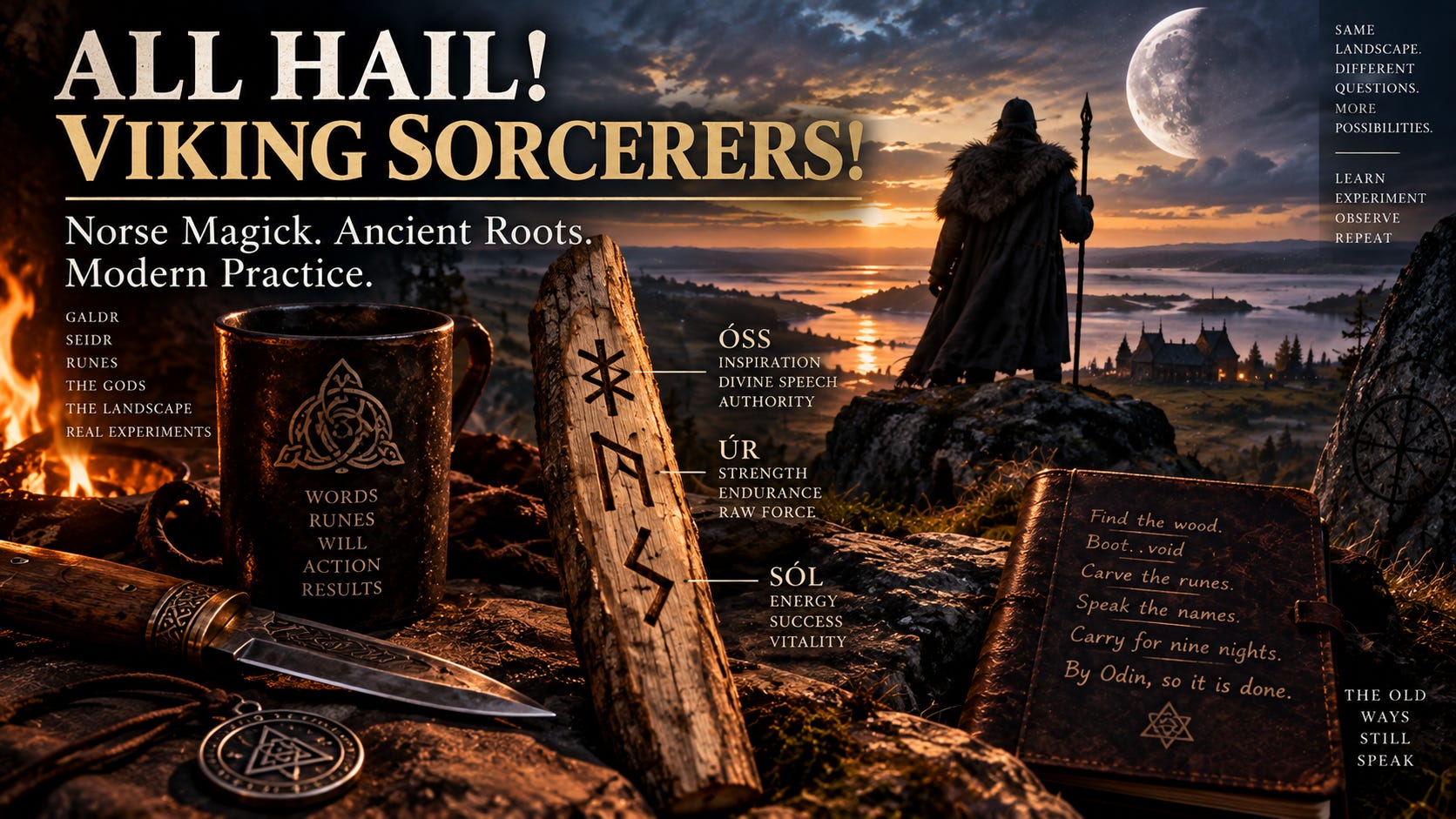
Let’s construct a small bindrune.
And here’s where I’d actually simplify your proposed combination slightly.
Rather than mixing rune traditions accidentally, choose one rune row first.
For this experiment, let’s use the Younger Futhark.
Take three concepts:
ᚬ — Óss
Associated through its rune-name tradition with the estuary and, in the Icelandic tradition, divine/ancestral language around the Æsir.
For our experiment:
INSPIRATION / DIVINE SPEECH / AUTHORITY
Then:
ᚢ — ÚR
A difficult and ambiguous rune, as we’ve already discovered.
For our experiment:
RAW FORCE / ENDURANCE / CAPACITY
And:
ᛋ — SÓL
Sun.
For our experiment:
ENERGY / SUCCESS / VITALITY / VISIBILITY
Are these guaranteed Viking Age magical definitions?
No.
We’re constructing them.
Say it with me:
Learn the history. Invent the experiment. Never confuse the two.
BOOT.VOID
Find somewhere quiet.
Face north if you want to retain our Northern orientation.
Hold the twig.
Then:
BOOT.VOID.
Still the body.
Reduce the internal commentary.
Feel the wood.
Notice its weight.
Its texture.
Where it came from.
Then begin carving.
Slowly.
CUT THE COMMAND
Carve the three rune forms into one combined symbol.
Don’t worry about discovering the One True Bindrune.
Design it.
Make the shared vertical stave do some work.
Let one rune intersect another.
Keep it simple enough that you can remember it.
As you cut each component, speak its name.
Óss.
Cut.
Úr.
Cut.
Sól.
Cut.
Again.
Let voice and movement synchronise.
Knife.
Wood.
Breath.
Sound.
Symbol.
Now we’ve combined our two strands:
RUNE + GALDR.
The command is being entered.
CHARGE THE RUNE-TWIG
When the carving is finished, hold it between both hands.
Close your eyes.
Bring your intention into awareness.
Not:
“I AM THE SUPREME EMPEROR OF EARTH.”
Something usable.
I HAVE THE POWER TO ACT.
Or:
MY WILL MOVES INTO THE WORLD.
Feel whatever bodily charge you can generate.
Breath.
Muscular tension.
Heat.
Emotion.
Let it build.
Then push that charge into the twig.
If Odin is your chosen godform, finish simply:
By Odin, so it is done.
If another deity makes more sense to you, use that.
Or invoke nobody.
The experiment doesn’t require theological membership.
NINE NIGHTS
Keep the rune-twig on you for nine days and nine nights.
The number nine has obvious resonance in the Odin myth-cycle: Odin hangs upon the tree for nine nights in Hávamál in his ordeal associated with gaining the runes. The National Museum of Denmark likewise highlights that connection when discussing runic magic. (National Museum of Denmark)
Pocket.
Bag.
Jacket.
Somewhere close.
Don’t continually inspect it to see whether the magic has started leaking out.
Carry it.
Live normally.
Observe.
After the ninth night, put it somewhere in your home.
Near your desk.
Above a doorway.
Among your books.
Wherever seems right.
And that’s it.
IS IT A GLORY-TWIG?
I’d avoid calling it that as though it’s an attested Viking technical term.
There are wonderful named categories of runes in Sigrdrífumál — victory-runes, ale-runes, help-runes, sea-runes, branch-runes, speech-runes, thought-runes — but mapping those poetic categories onto a specific modern three-rune talisman gets speculative very quickly.
So call ours what it is:
a rune-twig.
If someday somebody finds it beneath your floorboards, perhaps they’ll write an academic paper explaining its ritual significance completely incorrectly.
That seems only fair.
VIKING SORCERY 2.0
What have we actually done?
We’ve taken:
Historical runes.
The physical act of carving.
The Northern tradition of magical speech.
The Odin myth.
The landscape.
The body.
The imagination.
And a twenty-first-century cybernetic metaphor:
Enter command. Execute. Observe output.
We haven’t reconstructed Viking religion.
We haven’t proved runes possess supernatural power.
We haven’t established that Odin is listening.
We’ve done something much more Doktor Snake.
We’ve taken fragments of the past and built an experiment that can be run now.
Out there.
In the landscape.
Knife in pocket.
Find the wood.
BOOT.VOID.
Cut the command.
Speak the names.
Carry it for nine nights.
Then:
LAB.COAT.
Record what happens.
Maybe nothing.
Maybe something.
Maybe you’ll simply never look at a fallen ash twig in quite the same way again.
That’s enough to begin.
ALL HAIL THE VIKING SORCERERS!
And, naturally:
DON’T BECOME AN IDIOT.
⟡◌◯⟡⟡