

By Rachel (AKA Phenix)
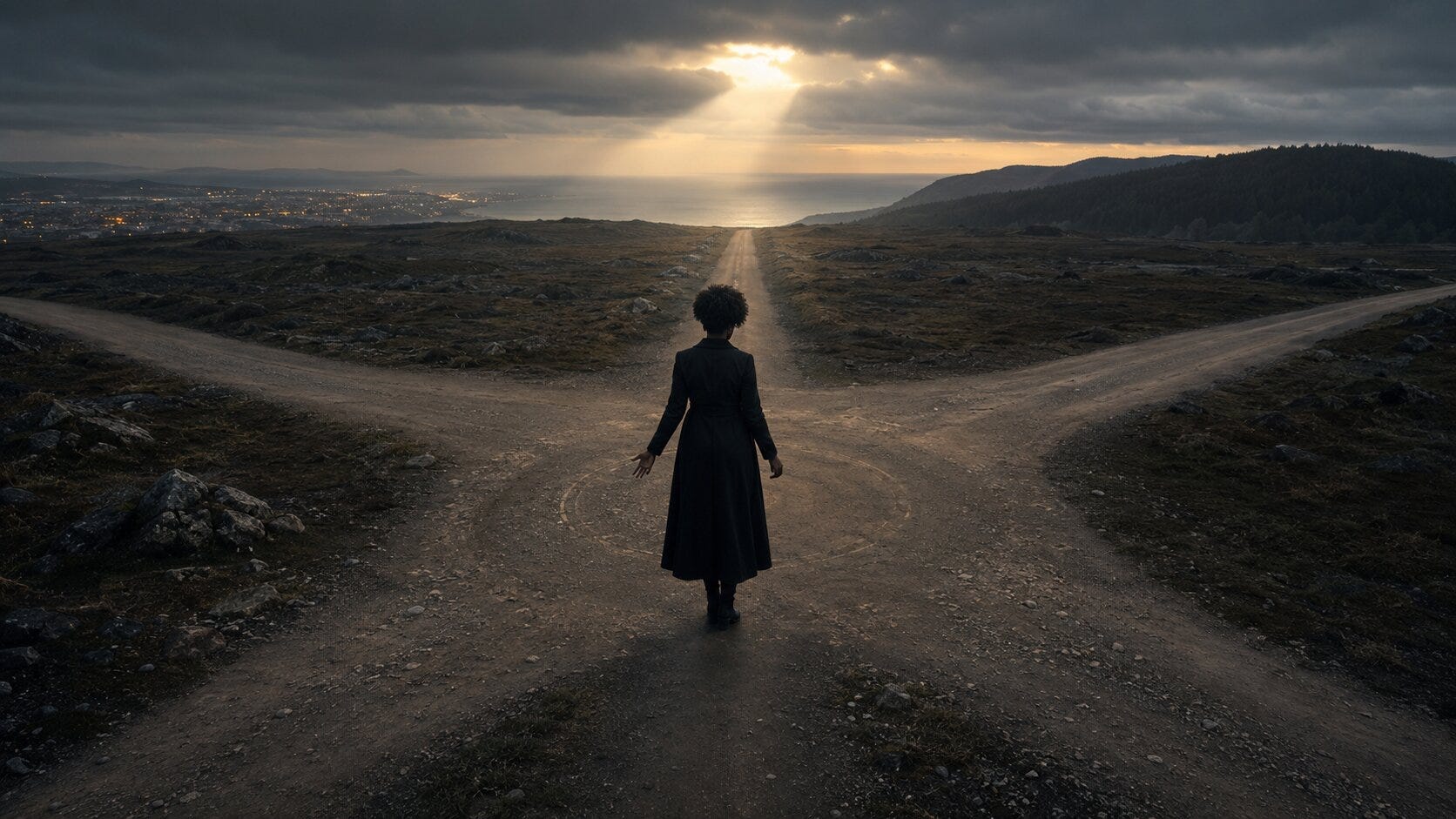
The cross.
The crossroads.
A juncture between the world of matter and the world of spirit.
At one crossing, Christ sacrifices himself and salvation becomes the path.
At another, the Devil waits with a pact in his hand.
Christ saves his flock.
The Devil delivers those brave enough to dare.
Both roads demand a sacrifice.
Perhaps every threshold does.
Before the guardian allows us through, something must be surrendered. It may be blood. It may be comfort. It may be certainty. It may be the identity we have carried for so long that we mistake it for the self.
The crossroads is never merely a choice between left and right.
It is the place where one world ends and another begins.
And there is always a price.
The Geometry of Passage
The cross represents the world of matter: the meeting of opposing forces, the horizontal and the vertical, earth and heaven, human limitation and divine possibility.
The pentagram contains the four classical elements—earth, air, fire and water—with the fifth point opening towards spirit.
The triangle is another gateway.
Three points.
Three forces.
Birth, death and resurrection.
Christ rises on the third day.
In ceremonial magic, the Triangle of Art is the place where the spirit appears and communicates with the material world. The magician stands within the circle. The summoned presence manifests within the triangle.
One space protects.
The other reveals.
Yet neither the circle nor the triangle is merely a shape. A symbol becomes a doorway when consciousness enters it.
Without consciousness, it is only geometry.
With consciousness, it may become a portal.
But who opens it?
The magician?
The spirit?
Or something acting through both?
Belief Is the Enemy of Knowledge
In Aleister Crowley’s Moonchild, Lisa declares joyfully that she believes in the soul.
She is answered:
“Belief is the enemy of knowledge.”
Indeed.
Belief is inherited.
Belief repeats.
Belief accepts the account given by somebody who may never have crossed the threshold themselves.
Knowledge is different.
Knowledge demands encounter.
You may believe that fire burns, but touching the flame converts belief into knowledge. You may believe in silence, spirit, God, the soul or the hidden architecture of reality—but until something has been experienced, you possess an idea about it.
Not the thing itself.
Perhaps this is why every genuine path eventually leads towards sacrifice.
Something must be risked before belief becomes knowledge.
Certainty must be placed upon the altar.
So must authority.
The book may guide you towards the gate, but the book cannot pass through it for you. Neither can the priest, the master, the sorcerer nor the guru.
At the threshold, you stand alone.
The Will of Heaven
Elsewhere in Moonchild, Crowley writes:
“Yield yourself utterly to the Will of Heaven, and you become the omnipotent instrument of that Will.”
But this raises a question.
Does the magus listen to the Will of Heaven?
Or does the magus bend the will of the heavens?
If I surrender completely, am I still a magician?
If I impose my will upon existence, have I heard anything beyond myself?
The mystic yields.
The sorcerer commands.
The priest petitions.
The witch bargains.
The Taoist follows the current.
But the magician stands at the centre of all these roads, taking what is useful and rejecting what is not.
Must one path invalidate the others?
Dok tells me the gate is silence.
Stop the internal dialogue.
Do nothing.
Become still enough to hear what was always there.
He regards mantra, yantra, ritual and visualisation as elaborate routes around the houses. Magnificent constructions of the mind, perhaps—but constructions nevertheless.
Anything to avoid silence.
I disagree.
There are many roads to Rome.
A mantra can carry the mind beyond itself. Repetition may continue until the words cease to be words and the one speaking them disappears.
A yantra can hold the attention until the observer passes into the image.
Music can dissolve the boundary between the listener and the sound.
Prayer can exhaust the one who is praying.
Dance can continue until there is movement but nobody left who claims to be moving.
The mind may be stilled by stillness.
It may also be overwhelmed by rhythm, beauty, devotion, terror, exhaustion or wonder.
Silence is a gate.
It is not necessarily the only gate.
Dok suspects I am avoiding silence.
I suspect he enjoys saying that.
The Woman Beside the Sea
Dok told me a story about Aleister Crowley and Betty May.
Betty travelled with her young husband, Raoul Loveday, to Crowley’s Abbey of Thelema at Cefalù in Sicily. Raoul was enthusiastic, educated and disciplined. Betty distrusted Crowley, and Crowley apparently had little affection for her.
Nevertheless, she agreed to attempt what he instructed.
Crowley told her to sit beside the sea.
She was to remain there from six in the morning until six in the evening.
No complex invocation.
No secret name of God.
No elaborate instrument of ceremonial magic.
She was simply to sit.
At first, perhaps, this sounds easy.
Then the minutes lengthen.
The body becomes uncomfortable. The mind manufactures reasons to move. Every irritation becomes urgent. Time ceases to flow normally. The personality rebels against the apparent pointlessness of what it has been asked to do.
Betty suffered.
But she was determined that Crowley would not defeat her.
She continued.
Eventually, the resistance broke.
The pain gave way to something else.
Silence arrived.
Dok offers this as evidence that beneath all the symbols, words and methods, the true gate is silence.
Perhaps he is right.
But I see something else in the story.
Betty did not begin with surrender.
She began with defiance.
She did not obey because she revered Crowley. She remained beside the sea because she refused to be beaten by him.
Her rebellion gave her the strength to continue until the rebellious self exhausted itself.
Perhaps resistance was not the obstruction.
Perhaps resistance was the fuel.
Crowley showed her the practice, but her own nature carried her through it.
She reached surrender by refusing to surrender.
There is a paradox worthy of the crossroads.
The Guardian at the Gate
What, then, does the guardian demand?
Not obedience in every case.
Not silence in every case.
Not faith.
Perhaps the guardian demands whatever we are most unwilling to give.
For the proud, the sacrifice may be control.
For the submissive, it may be obedience.
For the believer, it may be belief.
For the sceptic, certainty.
For the endlessly active mind, the price may be silence.
But for the person who has been silenced all her life, the sacrifice cannot be her voice.
Her path may require her to speak.
Loudly.
The same medicine cannot awaken everyone.
One person must learn to yield.
Another must learn to resist.
One must put down the sword.
Another must discover that she has been holding one all along.
This is why traditions can guide us, but they can also imprison us. A method created to open consciousness may harden into another belief about what consciousness ought to be.
Then the gate becomes a wall.
Perhaps Chaos Magick attempts to solve this by treating traditions as tools rather than eternal laws. Adopt a belief. Use it. Discard it when it ceases to work.
I understand the freedom in that.
But I also understand the power of tradition.
A symbol polished by thousands of minds across thousands of years may contain depths that cannot be manufactured in an afternoon. The old roads carry footprints. The old gods have accumulated faces. The old rituals possess the gravity of repetition.
Why discard a road merely because others have walked it?
The danger is not tradition itself.
The danger is unconscious submission to tradition.
And the opposite danger is believing ourselves free merely because we reject everything that came before us.
Rebellion can become its own orthodoxy.
Between Command and Surrender
Does the magus yield to Heaven?
Or bend Heaven to her will?
Perhaps the question contains a false division.
The river yields to the shape of the land, yet over centuries it carves valleys through stone.
Water surrenders—and transforms everything it touches.
The magician may listen before commanding.
She may become silent before speaking.
She may yield, not because she is weak, but because she is attentive. She discovers the movement already taking place and adds her will to it.
Then command is no longer an act of violence against the universe.
It becomes participation.
But neither should surrender become an excuse for passivity. “The Will of Heaven” has too often been invoked by those who benefit from keeping others obedient. People are told to accept their suffering, silence their anger and wait for salvation.
There are moments when the heavens should be challenged.
There are gates that do not open until struck.
There are guardians who must be questioned.
There are contracts that should never be signed, sacrifices that should never be made and authorities that deserve no obedience.
The magus must therefore possess both capacities.
To become silent enough to listen.
And sovereign enough to refuse.
At the crossroads, Christ offers salvation through sacrifice.
The Devil offers fulfilment through a pact.
The mystic says: surrender yourself.
The sorcerer says: declare your will.
Perhaps wisdom lies neither in kneeling automatically nor in commanding blindly.
Perhaps it lies in knowing which force the moment demands.
Silence or incantation.
Resistance or surrender.
The circle or the triangle.
The cross or the crossroads.
And perhaps the magician bends Heaven only after discovering that Heaven has been bending her.
⟡◌◯⟡⟡