

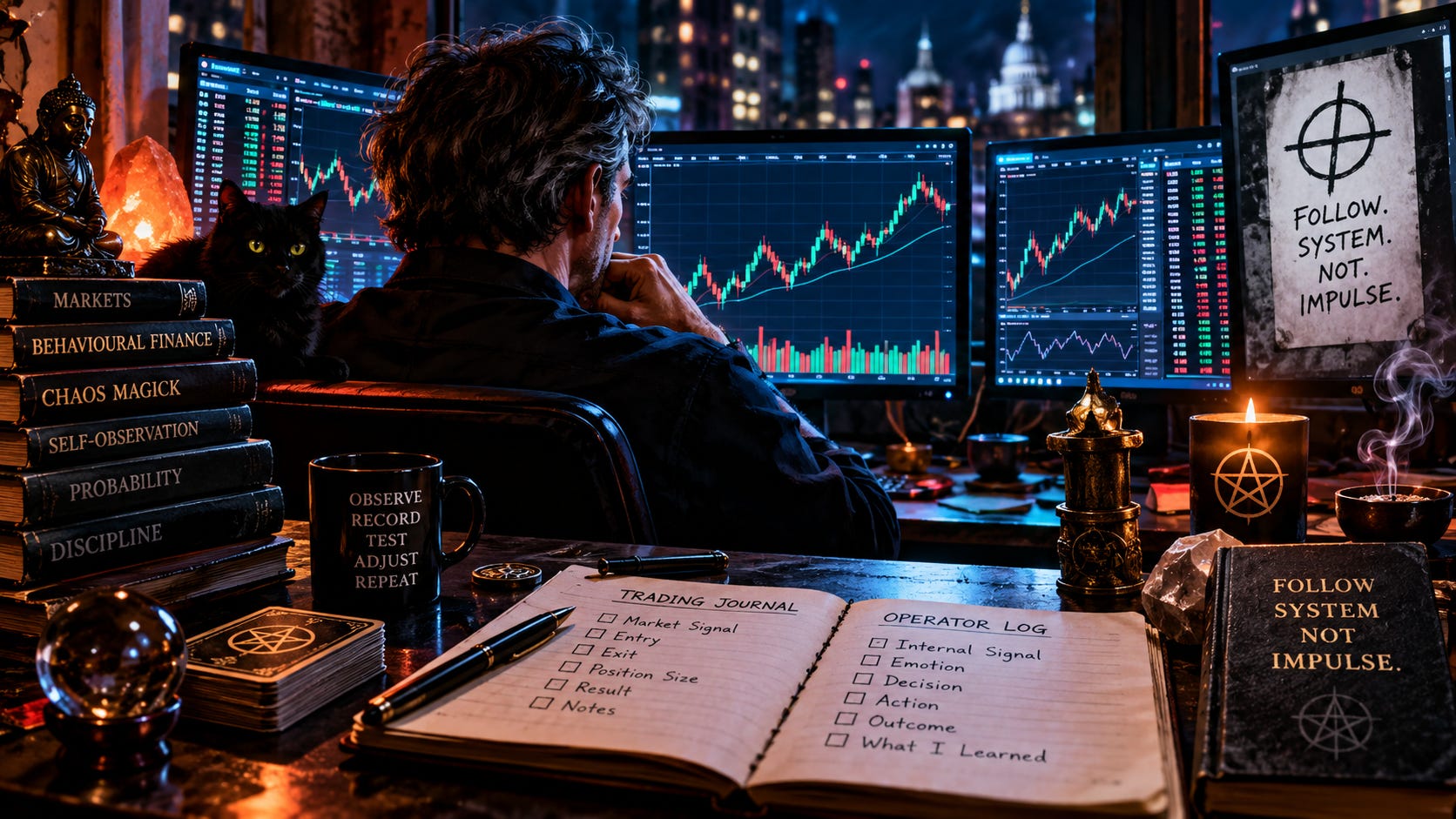
Someone asked me recently what I knew about day trading.
The truthful answer was: not much.
I’ve never been a day trader. I wouldn’t pretend otherwise, and if you want to learn the technical business of trading—markets, charts, orders, spreads, liquidity and all the rest—you should learn it from people who actually know what they’re doing.
But the question interested me.
Because I do know something about the other part of the machine.
The human being sitting in front of the screen.
And that may be the more troublesome component.
First, Learn The Game
My father invested.
He didn’t simply throw money at the market and hope something happened. He spent a considerable amount of time learning about investing before he got serious about it.
And, importantly, he practised.
Dry runs.
You make the decisions but don’t put the money down. You see what would have happened. You discover whether you actually understand what you think you understand.
I always thought that made sense.
Today we’d call it paper trading.
And if I were thinking about day trading, that’s exactly where I’d begin.
Study first.
Choose a market. Learn how it operates. Learn the terminology. Understand the instruments. Learn about position sizing and risk. Find a simple methodology you can understand rather than bouncing between a dozen systems promoted by people on the internet.
Then simulate it.
Not for three afternoons.
Long enough to accumulate some data.
Because initially the objective isn’t:
MAKE.MONEY
It’s:
LEARN.THE.MACHINE
But there’s another machine you need to learn at the same time.
Yourself.
Enter The Operator
This is where Dokology becomes interesting.
Imagine you’ve spent months studying trading.
You’ve developed a set of rules.
You know what constitutes an entry.
You know when you’re supposed to get out.
You know how much you’re prepared to risk.
Excellent.
Then at 10:17 on Tuesday morning something starts moving rapidly on the screen.
You feel it.
This is going.
Suddenly you’re not calmly executing the system you spent months learning.
You’re afraid you’re going to miss it.
So you buy.
What happened?
The market didn’t override your trading system.
You did.
That’s an important distinction.
Day trading creates an unusually concentrated laboratory for studying human decision-making because the feedback can be extraordinarily fast.
Win.
Lose.
Win.
Lose.
Missed opportunity.
Lucky escape.
Big winner.
Stupid mistake.
Regret.
Relief.
Fear.
Excitement.
All arriving through a glowing rectangle sitting two feet from your face.
The US Securities and Exchange Commission warns prospective day traders about precisely this problem: volatile markets make emotional control difficult, while leverage can turn an incorrect decision into a substantial loss very quickly.
So perhaps the first Dokology principle for traders should be:
The market is one system.
The operator is another.
Study both.
The Second Trading Journal
Traders commonly keep journals.
I’d add another one.
Call it the Operator Log.
It doesn’t replace the trading journal. It sits alongside it.
Record five things:
MARKET SIGNAL
What objectively happened?
INTERNAL SIGNAL
What did you feel like doing?
DECISION
What did you decide?
ACTION
What did you actually do?
OUTCOME
What happened next?
Now something interesting becomes possible.
Consider:
10:17 — No valid setup. Strong urge to buy. Felt I was missing a major move. Did not trade. Price reversed six minutes later.
Or:
14:06 — Valid setup. Didn’t enter. Felt nervous because I’d lost twice that morning. Setup subsequently worked.
Or:
15:22 — Valid setup. Entered correctly. Trade lost. Followed exit rule exactly.
That last one matters.
It was a losing trade.
But it may have been excellent operator behaviour.
That’s the distinction we’re looking for.
You can make a good decision and lose.
You can make a terrible decision and win.
The second possibility is particularly dangerous because reality has just rewarded you for breaking your own rules.
The Operator Is Not Rational
Behavioural finance has spent decades documenting the inconvenient fact that investors don’t always behave like cool calculating machines.
One famous example is the disposition effect—the tendency to realise winning investments while hanging onto losing ones.
Why?
Part of the answer appears to reside in how human beings experience gains and losses.
Selling the winner feels good.
Closing the loser makes the loss real.
So the temptation arises to give the loser a little more time.
Research has also repeatedly examined overconfidence in investors. Recent work using brokerage data found that investors who overestimated their own financial literacy traded more frequently and incurred higher transaction costs.
In other words, learning how markets work is only half the problem.
You are bringing an ancient primate nervous system into an environment of flashing numbers, rapid feedback, money, uncertainty and reward.
What could possibly go wrong?
Now We Can Bring In The Weird Stuff
This is where I wouldn’t be remotely embarrassed about borrowing techniques from chaos magick.
Not because I think drawing a sigil guarantees the FTSE will rise.
That would be idiotic.
Chaos magick becomes useful here as a technology for directing attention and changing operator state.
Suppose you have one recurrent problem.
You chase movements that don’t meet your entry criteria.
Fine.
Reduce the instruction to:
FOLLOW.SYSTEM.NOT.IMPULSE
Turn it into a sigil if you like.
Put it somewhere near the trading screen.
Now the sigil isn’t magically controlling the market.
It’s interfering with you.
It’s an attention trap.
Your hand moves towards the mouse.
You see the symbol.
For perhaps half a second, automatic behaviour is interrupted.
That’s enough.
The Watcher comes online.
What am I doing?
That question can be worth money.
Banish The Previous Trade
Here’s another chaos-magick technique I’d steal.
Banishing.
In ceremonial magick, banishing rituals traditionally clear the working space.
For our purposes, forget the metaphysics.
Use a thirty-second ritual to clear the psychological residue of the previous trade.
You lose.
Stop.
Stand up.
Breathe.
Perform whatever tiny sequence you’ve designated as the boundary.
Then say:
TRADE.CLOSED
The next trade has nothing to do with the previous one.
Why bother?
Because psychologically it often does.
You want the money back.
You want to prove you were right.
You become more cautious because the last trade hurt.
Or you become reckless because you’ve had three winners and now feel untouchable.
The market doesn’t care about any of this.
The next setup is the next setup.
Banishing creates a boundary.
Yesterday is gone.
Five minutes ago is gone.
Return to zero.
Divination Has To Be Handled Differently
This gets more interesting.
Suppose you’ve practised magick, divination, intuition or some other esoteric system for years.
You suddenly have an overwhelming feeling:
Don’t take this trade.
What do you do?
Dokology doesn’t require you to dismiss the experience.
But neither should you automatically obey it.
Record it.
That’s the experiment.
Your trading system says BUY.
Your internal signal says DON’T.
Write both down.
Then follow whatever rules you’ve established for the experiment.
After 100 occurrences, perhaps your intuition turns out to be extraordinary.
Perhaps it turns out to be useless.
Perhaps it’s extremely good under certain circumstances and terrible under others.
Perhaps what you call intuition is actually your nervous system noticing tiny patterns before conscious thought catches up.
Perhaps it’s anxiety.
Perhaps it’s something stranger.
We don’t have to decide in advance.
Collect the data.
This is where Dokology parts company with a lot of manifestation culture.
We don’t need to believe every internal experience.
We investigate it.
The signal may be real.
What it means is another question.
The Servitor At The Gate
If you like chaos magick, here’s another experiment.
Create a servitor whose entire purpose is to guard the trading system.
Not a money spirit.
Not something commanded to make shares rise.
That’s handing imaginary responsibility for your decisions to an invisible entity.
Instead create a gatekeeper.
It has one question:
DOES.THIS.MATCH.THE.RULES?
Nothing passes until that question has been answered.
Psychologically, you’ve externalised part of your decision process.
The servitor becomes an interface.
A piece of mental software.
And if you don’t like occult terminology, call it a checklist.
The function is what matters.
Probability Navigation
This may be the most important connection.
Trading makes something brutally obvious that everyday life allows us to forget:
You don’t know what’s going to happen next.
You have probabilities.
That’s all.
A trading system can produce a perfectly legitimate signal and lose.
Five legitimate signals might lose consecutively.
Then the sixth works beautifully.
The danger is believing that a good outcome proves a good decision—or that a bad outcome proves a bad one.
Dokology’s Probability Navigation is built around the same problem.
You aren’t commanding reality.
You’re positioning yourself within uncertainty.
You observe.
You act.
You gather feedback.
You adjust.
Then you run the experiment again.
The 100-Trade Dokology Experiment
If I were beginning day trading tomorrow, this is what I’d do.
I’d study first.
Then I’d open a paper-trading account with imaginary capital and realistic constraints.
I’d choose one methodology.
And I’d run 100 trades.
No changing systems halfway through because somebody on YouTube has discovered the secret of the markets.
Alongside the conventional trading record, I’d maintain the Operator Log.
I’d record fear.
Greed.
Boredom.
Intuition.
FOMO.
Fatigue.
The urge to break the rules.
I’d record every occasion when I felt strangely certain.
I’d record dreams about the market if they occurred.
Synchronicities.
Hunches.
Bad moods.
Good moods.
Everything.
Not because all these things necessarily contain useful information.
Because we’re trying to discover which things contain useful information.
After 100 trades, I’d analyse the operator.
When did I break my rules?
What happened immediately beforehand?
Did winning streaks make me reckless?
Did losses make me timid?
Were my intuitions useful?
Did fatigue matter?
Did certain times of day produce poorer decisions?
Did my weird signals contain anything at all?
Now we’re doing Dokology.
Don’t Try To Become Psychic
Try to become observable.
That’s the larger lesson.
People frequently want methods that will tell them what is going to happen.
I’d rather have a method that shows me what I’m doing while I wait to find out.
That’s applicable far beyond trading.
Business.
Negotiation.
Writing.
Relationships.
Investment.
Creative work.
Any environment where decisions are made with incomplete information.
Day trading merely compresses the process.
The numbers move.
You react.
The result arrives.
The loop begins again.
Which makes the trading desk an unusually good place to encounter one of Dokology’s central questions:
Who is operating whom?
You operating the screen?
The screen operating you?
Your trading system operating you?
Your fear?
Your greed?
Yesterday’s loss?
Today’s confidence?
Some strange intuition appearing from nowhere?
Don’t answer too quickly.
Watch.
Record.
Test.
Then decide what deserves your attention.
LEARN → SIMULATE → OBSERVE → RECORD → REVIEW → REFINE
And only then consider putting real money on the table.
⟡◌◯⟡⟡