

The very name “Satan” tends to scare the living daylights out of people. Or at least those of a religious disposition.
But even people into new age ideas tend to be very wary of what they see as the “dark side.”
And then we have the conspiracy crowd railing against Satan, insisting “the elites are Satanists.”
They’re wildly wrong on that one.
In truth, Satan is a Promethean icon of defiance, reason, and liberty — even perhaps an emancipator of consciousness.
Not the kind of traits the elites — or ruling powers — like to encourage in populations.
The last thing they want is for people to be rebellious: they want them to be sheep.
The very idea of citizens taking up the Promethean brand and heralding Satan is an anathema to them.
It would mean people would be thinking for themselves and no longer lapping up the continual propaganda pumped out by the media on behalf of the ruling classes.
Ironically given how many people fear Satan, he didn’t play a major role in the various versions of the Bible. He was a mere bit-player.
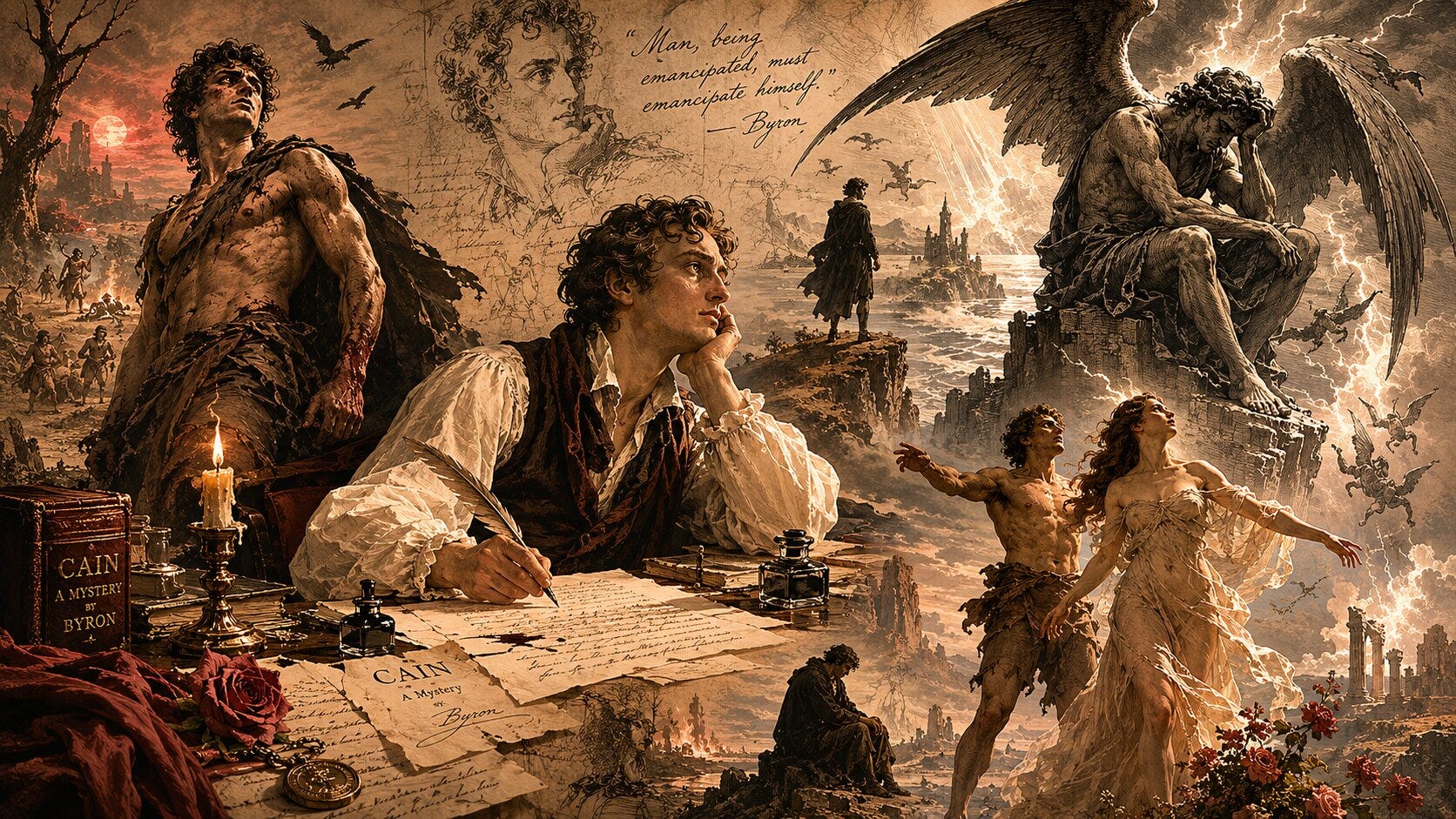
But he got a staring role in the artistic and political movement of the 19th century — known as the Romantics. They reinterpreted Satan, shifting him from the traditional Christian embodiment of evil to a heroic rebel and symbol of emancipation.
All this was rooted in John Milton’s poetic work, Paradise Lost (1667). Despite being under the thrall of the Christian framework, he inadvertently — probably subconsciously — ended up creating one of literature’s greatest rebels.
With Milton’s pen, Satan became a symbol of defiance, heroic will, refusal to submit, and tragic self-awareness.
William Blake famously said Milton was: “...of the Devil’s party without knowing it.”
The nineteenth century Romantics took up Milton’s cudgel to challenge the prevailing religious tyranny and oppressive orthodoxy by adopting Satan as the figurehead for freedom.
Authors like Percy Bysshe Shelley and Lord Byron portrayed Satan as resisting the tyranny of a powerful God (authority figure), making him a sympathetic character, one you could identify with.
On a political level, the movement used Satan as a metaphor for Western revolution and secularisation, linking the fallen angel to struggles against societal constraints, religious dogma and authoritarian structures.
But how many people today know this? Or even realise that the plight of workers, and the fight against oppression, once had Satan as its figurehead and motivational fuel?
Very few I would say.
Otherwise we wouldn’t have all the hordes online saying the elites are depraved Satanists — when in reality it was the figure of Satan that inspired the fight against exploitation in the first place... literally against the very elites themselves.
In terms of literary and artistic impact, works like Shelley’s Laon and Cynthna (1817), and Byron’s Cain (1821), emphasised Satan’s noble rebellion and moral complexity. And in the visual arts, sculptures like Jean-Jacques Feurchere’s Satan (c. 1835) embodied this era’s fascination with the melancholic, introspective anti-hero.
The Romantics were reacting against moribund institutions, rigid religion, mechanistic rationalism, and social conformity — along with how industrialism was reducing people to mere cogs in the machine.
They believed modernity was shrinking the human soul.
Even back then they saw that humanity itself was slowly being mechanised, and turned into robots.
Counteracting that, they saw imagination, creative intensity, and inner expansion as revolutionary forces... not just as artistic decoration.
Take Lord Byron. His Byronic alter-ego characters were saying: “I will define my own meaning — even if destroyed for it.”
Byron distrusted herd morality, pious conformity, and emotional domestication. He yearned for intensity of experience — a “consciousness burning brighter”.
His fellow author Percy Bysshe Shelley went even further in terms of liberation of consciousness. He genuinely believed that humanity could evolve psychologically and morally. Not just politically, which has never solved anything otherwise we wouldn’t be where we are today.
That’s key.
Underlying Shelley’s work is a kind of proto-evolutionary mysticism. A belief that consciousness itself could awaken people from fear and domination.
Shelley’s Prometheus Unbound could be seen as one of the great consciousness-liberation texts in English literature.
Prometheus becomes liberated intelligence, awakened will, and refusal of tyranny.
Shelley transforms the old myth into humanity freeing itself from inner and outer chains.
In his Laon and Cynthna / The Revolot of Islam we get political, erotic, and psychological liberation all rolled into one — along with spiritual emancipation.
Shelley saw authoritarian systems as operating both externally and internally. The tyrant exists in institutions, fear, and in conditioned consciousness.
Then there’s Lord Byron’s Cain which transforms Lucifer into the questioner and awakener. The being that forces consciousness beyond inherited dogma.
Cain’s anguish comes from awareness itself — from suffering, cosmic absurdity, and consciousness confronting death.
In other words Cain undergoes existential awakening.
And this sums up the rehabilitation of Satan by the Romantics. Once a walk-on role in the Bible to a figure that inspired movements to liberate oppressed peoples from the thraldom that grew out of the Industrial Revolution. Had the Church not been so dominant at the time of the Peasant’s Revolt, then Satan would have been the fuel behind Wat Tyler and his followers that took on the oppression of feudalism.
And today, given that we see encroaching totalitarianism in many parts of the world, including the West, then the old spirit of rebellion from the nineteenth century could be rekindled. Instead of being sheep gradually herded into technocratic enclosures, people might find the Promethean Fire, the spirit that lies within, rather than accepting their lot — which is exactly what the ruling classes want — and heed the cry of the Rebel Angel, Satan, and echoing Byron with: “I will define my own meaning — even if destroyed for it.”
Because in the end there is no choice. All else is authoritarian control. And anyone of true heart yearns to be free and to feel their “consciousness burning brighter” with the true flames of being alive, and not held back like the serfs of old.
⟡◌◯⟡