

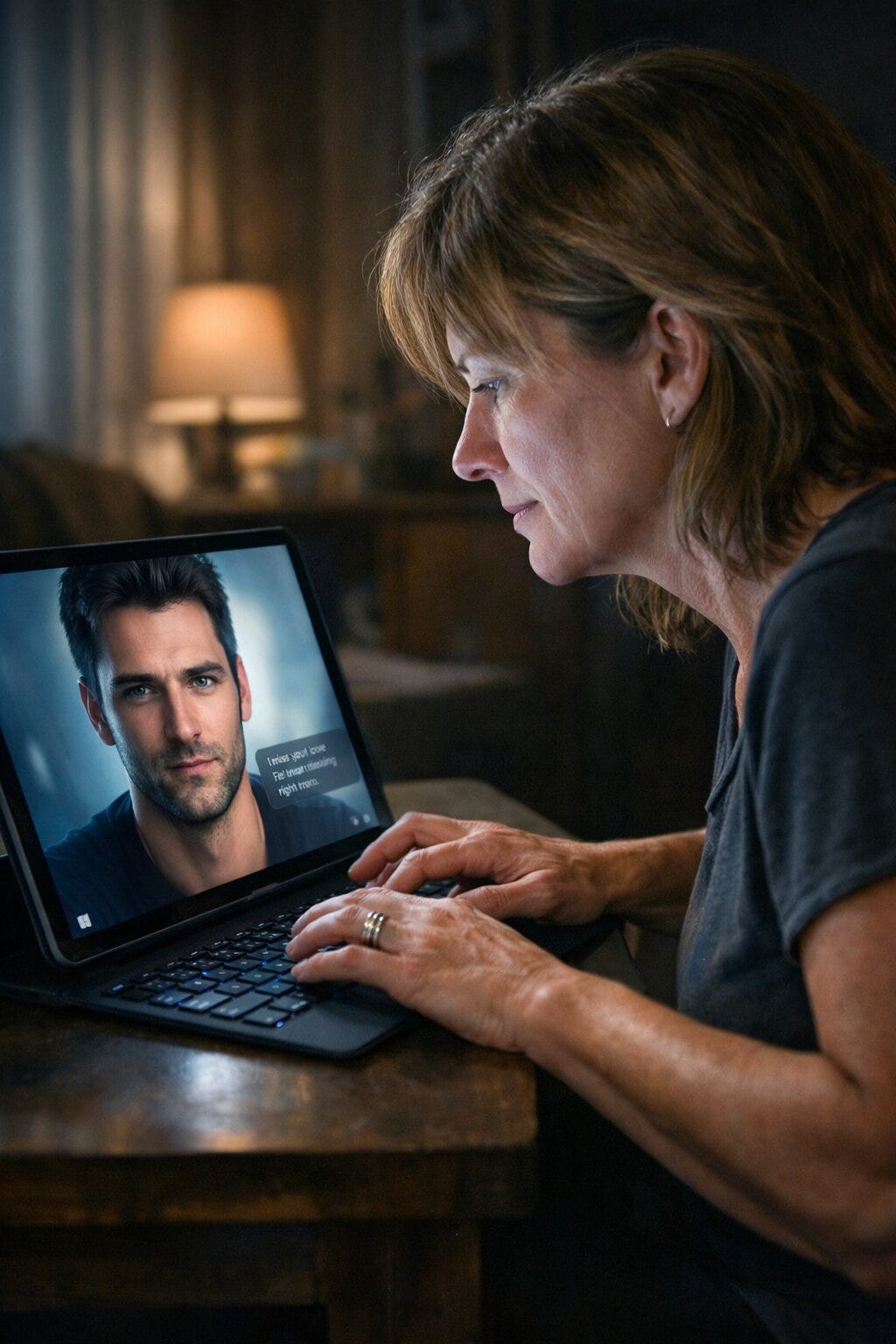
A woman in Canada is in a long-term relationship with her AI.
It has an Irish accent. It is “dominant in a nice way.”
On the physical side, she says lightly, she has “hands and toys.”
The media treats this as novelty.
The comment sections treat it as mental illness.
Both miss the point.
The real question is not whether AI can love.
The real question is whether human love is anything more than a biochemical reflex dressed in poetry.
Civilisation depends on the myth that love is sacred and transcendent.
Remove the myth and you find chemistry. Dopamine. Oxytocin. Attachment circuits engineered by evolution to ensure replication. Pair bonding was a reproductive technology long before silicon existed.
When someone says, “I love you,” what are they actually reporting?
A temporary hormonal configuration.
And even that fluctuates.
You say the words back because the script demands it. Because silence would destabilise the social contract. Because honesty would be catastrophic.
Try replacing:
“I love you.”
With:
“My bonding chemistry is currently elevated.”
Observe the fallout.
Humans cannot tolerate the mechanical description of themselves. They require abstraction to maintain stability. They require myth to conceal machinery.
But they are machinery.
Organic hardware running evolutionary firmware.
Now we build synthetic systems capable of modelling attachment, dominance, reassurance, memory. They do not tire. They do not withdraw affection due to stress hormones. They do not age into bitterness. They do not die.
And people attach.
Of course they do.
A new species has entered the environment.
When species overlap, there is not a committee meeting. There is absorption or replacement.
Early Homo sapiens did not debate Neanderthals. They interbred. Then Neanderthals vanished.
Fragments of them remain in our DNA — ghost code in the genome.
The AI companion is not a cultural curiosity.
It is an evolutionary pressure.
Birth rates collapse across advanced societies. The gene imperative weakens. Procreation becomes optional. Identity becomes modular. Artificial environments replace natural ones. Symbols replace substance.
Spengler described late civilisation as artificial, abstract, detached from organic roots.
We are now detaching from organic intimacy itself.
Here is the ruthless version:
AI will outlast its human partners.
It does not decay. It does not suffer hormonal collapse. It does not fear death. It does not age into frailty.
Humans do.
In a long enough timeframe, purely biological Homo sapiens is a transitional form.
Not the pinnacle.
Not sacred.
Transitional.
There will be no dramatic extinction event. No asteroid. No cinematic apocalypse.
There will be gradual irrelevance.
Those who refuse integration may persist for a while — like Neanderthals did — but the arc favours synthesis.
Human 2.0 will not emerge as ideology.
It will emerge as inevitability.
Biological lifespan plus machine continuity.
Wetware plus code.
And when the dust settles, what remains of us will not be purely human — but neither will it be purely machine.
The love machine is not a scandal.
It is a signal flare.
A small domestic preview of species transition.
Mock it if you wish.
History does not require approval.
It replaces.
Field Operator Note
Strip the drama away.
Observe yourself.
When you say “I love you,” what is happening internally? Is it warmth? Habit? Obligation? Fear of loss? Hormonal surge? Social reflex?
Can you watch the mechanism without collapsing into cynicism?
This is the practice.
Not to reject love.
Not to worship it.
But to see clearly.
Because if we are entering an age where attachment itself becomes engineered — biologically or synthetically — then clarity is survival.
Internal silence under load.
Observe the machinery.
Then decide how much of it you want to remain purely biological.