

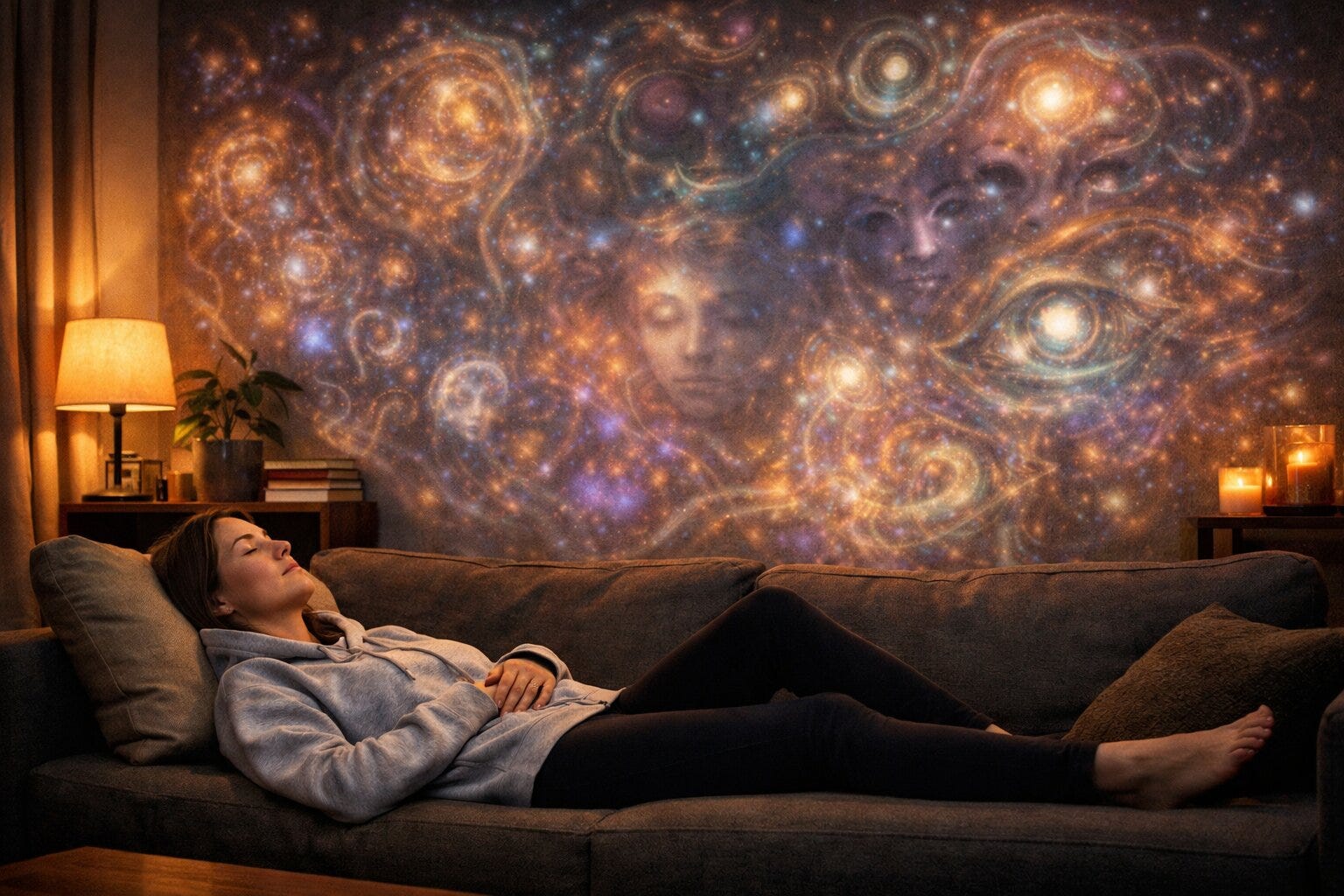
If modern life narrows perception, then visionary practice may be less a luxury than a survival tool. Here are practical ways to soften the ordinary frame and recover access to image, pattern, and inner depth without chemical intervention.
What if the real value of psychedelics is not the substance itself, but the reminder that the mind can operate differently? This piece looks at quieter, repeatable ways to cultivate imaginal depth, cognitive flexibility, and altered perspective without chemicals, retreat culture, or dramatic theatre.
If the first question is whether altered states helped shape human culture, the second is more pressing:
What can an ordinary person do now, without illegal sacraments, expensive retreats, jungle theatre, or chemical fireworks?
Because whatever one thinks about psychedelics, the practical issue remains. Most people are not going to build a life around substances. Some do not want to. Some should not. Some would be destabilised rather than helped. And even for those who are curious, access is inconsistent, legality is fraught, quality is uncertain, and the whole route is shot through with complication.
So the important question becomes: can human beings recover some degree of visionary access by other means?
I believe they can.
Not in the sense of perfectly reproducing a full psychedelic state. That is too crude a comparison and not really the point. The point is function. What matters is not whether one sees identical phenomena, but whether one can begin to cultivate some of the same useful effects: greater imaginal vividness, interruption of stale mental loops, loosening of rigid self-narrative, emotional reframing, heightened symbolic perception, and the capacity to step out of ordinary over-verbal consciousness.
That last one may be the key.
Modern people are over-trained in commentary. The mind talks, explains, judges, loops, worries, rehearses, narrates, and re-narrates. It is often less a vehicle of perception than a bureaucracy of noise. In that condition, visualization sounds almost childish. Something lightweight. Something one does in a self-help booklet before going back to the real machinery of life.
But that is a mistake.
Properly used, visualization is not decorative. It is not daydreaming in the weak sense. It is the deliberate cultivation of an alternative mode of cognition — one in which image precedes argument, pattern precedes explanation, and symbol is permitted to reorganise the frame before the verbal mind can flatten it again.
That is why it matters.
When I use the old shorthand of left-brain and right-brain, I use it operationally rather than dogmatically. Yes, the neuroscience is more complex than the clichés. Yes, the hemispheres do not work like cartoon opposites. But as a rough map, the distinction remains useful. One mode narrows, categorises, verbalises, controls. Another mode takes in wholes, pattern, atmosphere, context, image, music, metaphor, living relation. Iain McGilchrist has done much to rescue that discussion from sheer vulgarity. The value of the distinction is not anatomical precision in casual conversation. The value is that it reminds us consciousness has modes, and modern civilisation is heavily biased toward one of them.
The result is a population rich in information and poor in vision.
So how does one begin to tilt the balance back?
Not with drama, but with conditions.
The first principle is subtraction.
The visionary state often does not arrive because you have added more stimulation. It arrives because you have reduced the competing traffic enough for subtler phenomena to become noticeable. Less verbal chatter. Less compulsive checking. Less emotional agitation. Less friction. Less input. The problem with modern life is not merely that we see too little. It is that too much irrelevant material is constantly passing through the gate.
Vision often begins where excess ends.
That means stillness is not a pious extra. It is infrastructure.
A person lying quietly in a room after work, without television on, without a podcast yammering into the skull, without compulsive phone checking, may be doing something far more radical than it appears. They may be creating the preconditions for imaginal emergence. At first it seems like nothing is happening. Then the mind begins to settle in layers. Surface chatter reduces. Internal pressure changes. Subtle image fragments begin to form. Emotional residues from the day alter their shape. Memory and symbol start to mingle. The perceptual field becomes more porous.
This is not yet full vision. But it is the threshold.
The second principle is gaze.
Not hard staring, not strain, not pseudo-mystical contortion. Simply sustained, gentle visual attention. A patch of darkness. A blank wall. the grain of a ceiling. tree branches against dusk. moving water. cloud textures. the floating geometry behind closed eyelids. These are not nothing. The visual field is never as empty as the modern mind assumes. It is full of noise, drift, pattern, shimmer, after-image, latent form. Most people override it immediately with language. They do not look long enough for the field to begin reorganising itself.
This leads to a useful frontier: entoptic perception.
Entoptic phenomena are the patterns and visual effects generated within the visual system itself — phosphenes, grain, flicker-like formations, internal geometries, luminous drift. Ordinarily these are ignored. But if one learns to attend without forcing, they can become a bridge. The state changes. One moves away from ordinary object-focused seeing and toward participatory seeing. Not hallucination in the pathological sense, but a softening of the hard border between external sight and internal image. This can become surprisingly potent. It can also bring one close to the edge of lucid-style waking imagery, though usually only for brief moments at first.
That brevity is no objection.
A few seconds of altered frame can be enough to remind a person that the ordinary consensus state is not the whole story.
The third principle is hypnagogic drift.
The hypnagogic zone — that borderland between waking and sleep — is one of the cheapest and most underused technologies of altered consciousness available to human beings. Everyone passes through it. Few learn to work with it. Images arise there with a force and autonomy that ordinary deliberate visualization often lacks. Fragments of faces, scenes, architectures, symbols, impossible events. It is as if the mind loosens its tie and begins speaking more freely.
The difficulty is not access but stabilisation.
Most people either stay too alert and block it, or drift too far and lose it into sleep. But with practice, one can hover there. Not for hours. Not like some occult melodrama. But long enough to learn its texture. Long enough to receive imagery instead of merely inventing it. Long enough to see that the mind has strata, and that the verbal waking layer is only one department in a much larger structure.
That is an important discovery in itself.
The fourth principle is repetition without strain.
One of the mistakes modern people make is assuming that if a method does not produce fireworks in three sessions, it has failed. But these are not vending-machine techniques. They are more like tuning an instrument. Repetition matters. Not grimly. Not with fanatical expectation. But steadily. Ten minutes here. Fifteen there. A regular hour in the evening where one lies down, reduces noise, lets the nervous system unwind, attends to inner image, watches for spontaneous patterning, and refuses to flood the gap with more media.
This matters because the nervous system learns by recurrence.
And that is where the real comparison with psychedelics becomes interesting.
A strong psychedelic experience may, under the right circumstances, loosen entrenched patterns in one dramatic movement. Professor David Nutt describes research suggesting that after a sufficiently strong psychedelic experience, the brain can become more flexible and more connected for a time afterwards . That is one route. But repetition of quieter practices may train flexibility more gradually, more safely, and perhaps more usefully for everyday life. Less explosion. More rewiring by habit. Less revelation as spectacle. More shift as cultivated capacity.
The trip, after all, is not the treasure.
The treasure is flexibility.
The treasure is access.
The treasure is the weakening of inner tyranny.
A fifth principle is symbolic permission.
One reason chemical states impress people so much is that they temporarily suspend the internal censor. The person stops insisting that only the obvious is real, only the verbal is meaningful, only the measurable is worth attention. Suddenly image speaks. Symbol speaks. Emotion reorganises. Meaning arrives in strange costume. This may be ontologically mysterious, psychologically obvious, or both. But in ordinary life, many people crush these contents before they have a chance to form.
So part of hacking vision without chemicals is embarrassingly simple: one must allow symbolic material to appear without instantly mocking it.
That does not mean becoming gullible. It does not mean every flicker is an angel and every coincidence a dispatch from Sirius. It means suspending premature dismissal. A face appears inwardly. A place one has never visited seems charged. A dream-image lingers all day. A geometric pattern during quietude seems to carry emotional information. Fine. Note it. Work with it. Let it breathe before the little internal bureaucrat stamps it DENIED.
Civilisation has too many internal bureaucrats already.
What it lacks is imaginal confidence.
This, inevitably, brings us toward the stranger edge. Machine elves. DMT entities. gods. daemons. presences. autonomous-seeming forms encountered in trance, dream, and altered states. Are they internal? External? Both? Misnamed? Symbolic intelligences? Fragments of self? Something more? Here, honesty is the only sensible posture. We do not know. Nutt, in an interview with Andrew Gold on YouTube, remains sceptical but open enough to consider whether some altered-state synchronies and entity-like experiences may point to questions science has not yet resolved .
That seems about right.
The trouble with the modern world is not that it asks for evidence. It is that it often assumes what cannot yet be measured is therefore meaningless. That is a provincial attitude masquerading as sophistication.
The better posture is disciplined ambiguity.
Treat the experience as real in effect, even if its ultimate status is uncertain.
If a person enters a chemically unaided visionary session after work, lying quietly on a couch in a silent flat, and encounters a stream of symbolic forms that alter mood, reorganise thought, or open a neglected dimension of self, then something real has happened. Whether those forms are generated internally, received through some deeper layer of mind, or participate in a reality model we do not yet understand is an open question. But the effect is real. The reframing is real. The widening is real.
And that widening may be one of the few sane counterweights available in a narrow age.
Because what is the alternative?
To remain trapped in official waking consciousness, endlessly processing headlines, petty tensions, algorithmic bait, and recycled emotional scripts until one’s inner world becomes a corridor lit by fluorescent tubes?
That is not maturity. That is enclosure.
No civilisation stays healthy by producing only administratively manageable minds.
It needs dreamers, certainly. But more than that, it needs operators of vision — people who can enter silence, sustain inner image, tolerate ambiguity, and return with more flexibility than they had before. Not tourists of altered states collecting anecdotes, but individuals with enough inward discipline to use subtle methods repeatedly, intelligently, and without dependence on theatre.
This is why the quieter route may matter more than the dramatic one.
Chemical revelation can be profound. But self-induced vision builds sovereignty.
It teaches a person that consciousness is trainable. That imagery can deepen. That stillness is productive. That the ordinary frame can be softened. That one does not have to remain a prisoner of verbal loops forever. It replaces helplessness with craft.
And craft is what our age lacks.
So the practical answer is neither to sneer at psychedelics nor to romanticise them. It is to understand what they seem to reveal about human possibility, then ask how much of that possibility can be cultivated by quieter means.
My suspicion is: more than modern people assume.
Not all at once. Not spectacularly. Not every evening. But enough to matter.
Enough to loosen the frame.
Enough to let image return.
Enough to make a person a little less programmable, a little less brittle, a little more inwardly spacious.
Enough, perhaps, to begin recovering vision as a daily practice rather than a forbidden miracle.
And in times like these, that may be one of the most practical things a person can do.
Next in the sequence: a further transmission on visionary practice, symbolic perception, and the question of whether altered states reveal hidden layers of mind — or hidden layers of reality.