

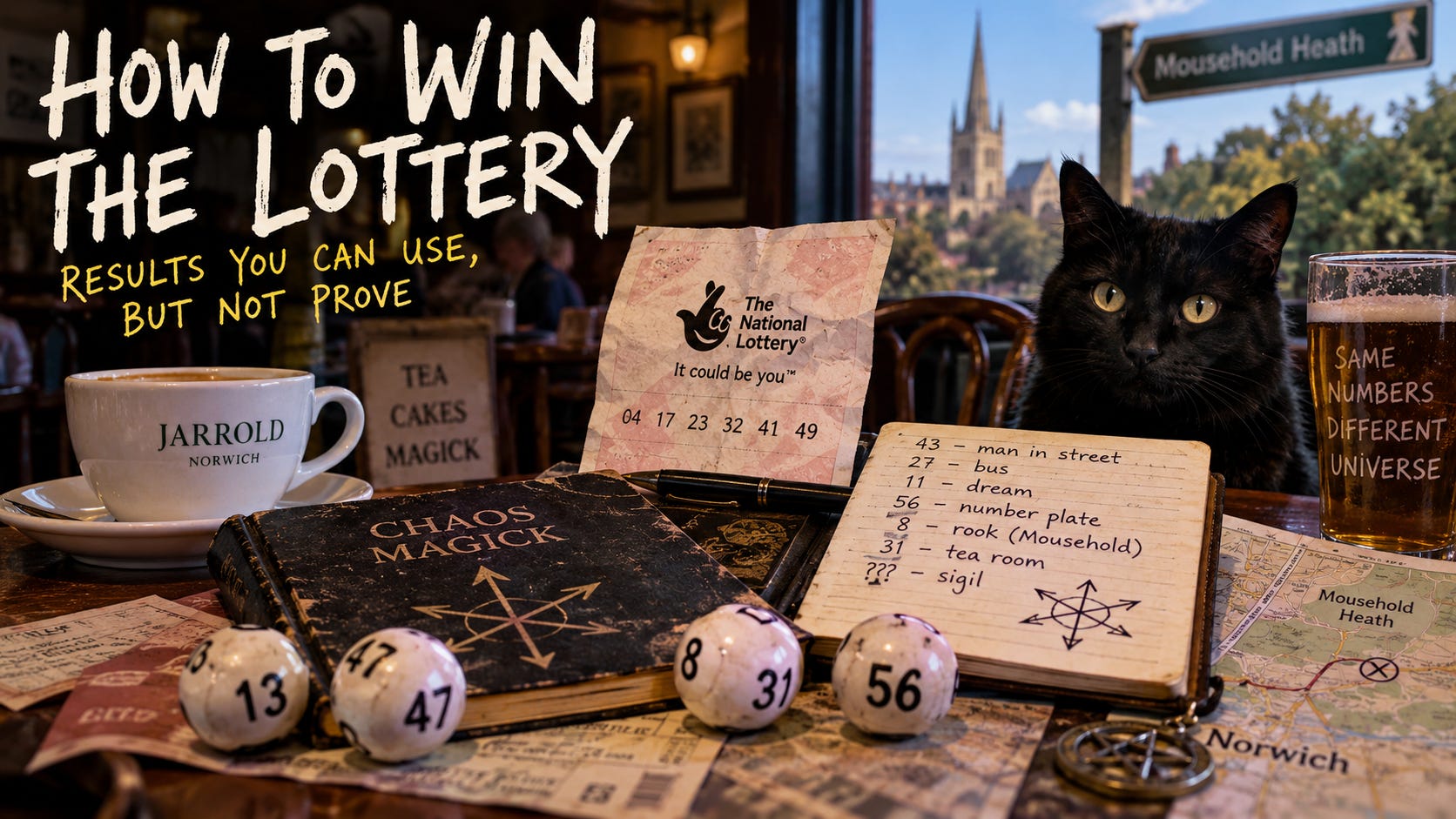
Back in the 1990s, when the National Lottery first arrived in Britain, quite a few people in the magickal world had the same thought.
Could we beat it?
Not mathematically. We weren’t going to sit around calculating probability distributions.
We meant magickally.
This was the 1990s. Chaos magick was the punk rock of the occult. The basic proposition was wonderfully simple: belief was a tool, results mattered more than dogma, and if something worked you used it.
If it didn’t work, you tried something else.
So naturally somebody was going to point chaos magick at the National Lottery.
I was living in Norwich at the time, and my partner in crime was my friend Steve Solomon.
Steve wasn’t actually a chaos magician.
In fact, he regarded chaos magicians as irresponsible lunatics.
He’d heard all about the so-called “ice wars” — magicians supposedly attacking and hexing one another — and didn’t approve at all. Traditional witches were equally suspicious. So were the neo-pagans, mediums and spiritualists we’d encounter around Norwich.
They believed in consequences. The threefold return. What goes around comes around.
Chaos magicians tended to shrug.
That was part of the appeal.
Steve disapproved of all this immensely.
The problem was that in practice Steve operated exactly like a chaos magician.
And he desperately wanted to win the lottery.
THE MAN WHO HAD TO WIN
Steve was permanently skint.
Not fashionably broke. Properly skint.
At one point he was getting red diesel from a farmer to keep his car running.
So when the National Lottery appeared, Steve didn’t regard the jackpot as some pleasant fantasy.
He regarded it almost as a financial plan.
Every Saturday night we’d wait for those balls to drop.
This was going to be it.
We’d cracked reality.
We had the numbers.
Then the draw would take place.
We hadn’t cracked reality.
Never mind.
Next Saturday.
The peculiar thing was that neither of us simply sat at home attempting to psychically perceive six lottery balls.
The experiment spilled out into Norwich.
And that’s where it became interesting.
EVERYTHING HAS MEANING
Steve and I met at least once a week.
Sometimes we’d meet in the tearoom at Jarrolds department store — the old one right at the top — or we’d find one of Norwich’s independent tearooms.
One afternoon we encountered two elderly mediums.
We hadn’t asked for a reading.
That didn’t stop them.
One of the women suddenly stared intently at me.
Then she started crying.
“Somebody is coming through for you…”
I looked around.
We were sitting in a perfectly civilised tearoom.
I hadn’t requested anybody to come through for me.
Now an elderly woman was in tears.
I probably responded more like Basil Fawlty than Aleister Crowley.
“This is a civilised tearoom and you’re in tears!”
But this sort of thing happened.
Steve and I had developed a game.
We would go on what you might call magickal journeys through the ordinary world.
We might walk all the way around Mousehold Heath. Or wander through Norwich city centre. Or through completely unremarkable suburbs.
Before setting out, we’d make one decision:
Everything has meaning.
Not literally.
That wasn’t the point.
For the duration of the experiment, we would act as though everything had meaning.
A rook cawed from a tree.
Why then?
A branch had fallen across the path.
Why there?
I’d notice several twigs lying on the ground that resembled a rune.
Steve would stop.
Someone walking past might say something to us.
Steve would stare at them intently.
What had they just told us?
What was the message?
You deliberately changed your relationship with the environment.
Instead of regarding the world as background scenery, you treated it as a communications system.
And once the lottery arrived, naturally the communications system started producing numbers.
THE NUMBERS ARE EVERYWHERE
Steve became particularly alert to numbers appearing unexpectedly.
Someone might say:
“He’s forty-three.”
Steve’s ears would prick up.
43.
We’d pass a billboard and one number would somehow stand out.
Write it down.
A number appeared on a vehicle.
Write it down.
Somebody said something involving an age, a price or a quantity.
Write it down.
The important distinction was that you didn’t consciously go hunting for numbers.
There are numbers everywhere.
If you’re deliberately looking for them, you can produce whatever result you want.
The number had to interrupt you.
It had to somehow jump out of the noise.
That was Steve’s method.
Mine was different.
ENTER THE VOID
I’d use sigil magick and meditation.
I’d formulate the intent, create the sigil, charge it and then go into what I’d call the void.
Stop thinking.
Stop trying.
Stop desperately chanting:
4… 17… 26… COME ON, UNIVERSE…
Because once you’re doing that, you’re generating the numbers yourself.
Instead I’d sit quietly and wait.
Sometimes numbers would drift through the mind’s eye.
Perhaps 27 appeared visually.
Perhaps 11 simply arrived as a thought.
Perhaps I’d get a rapid sequence.
Write them down.
Don’t analyse them.
Don’t decide 27 doesn’t feel lucky and change it to 28.
The first signal is the signal.
Then we’d buy the ticket.
Saturday night arrived.
And…
Well.
We never became millionaires.
But occasionally I’d win something.
I remember getting about £80 on one occasion, which wasn’t bad money to me in those days. It paid a few bills.
Naturally this immediately proved that the entire metaphysical structure of the universe had been cracked.
Until next Saturday, when it didn’t work.
TRY IT YOURSELF
Thirty years later, I wouldn’t tell anybody that magick can predict lottery numbers.
Every valid combination has the same mathematical chance of appearing as every other valid combination.
But that’s precisely why lottery divination remains a rather good chaos magick experiment.
You can’t easily fool yourself into thinking you’ve succeeded.
The balls either come out or they don’t.
So if you want to resurrect our 1990s experiments, here are four ways of doing it.
1. THE VOID METHOD
Find out the permitted number range for your lottery.
Sit quietly for ten minutes.
Close your eyes.
Don’t consciously think about numbers.
Reduce the internal dialogue as far as possible.
Wait.
If a number spontaneously appears — visually, verbally or simply as a sudden inexplicable thought — write it down.
Don’t alter it.
Continue until you have the required numbers.
Then stop.
2. THE STEVE SOLOMON METHOD
Give yourself one ordinary day.
Go to work. Walk through town. Get the bus. Drink coffee. Talk to people.
Don’t hunt for numbers.
Instead, notice which numbers hunt you.
Someone unexpectedly mentions an age.
A number on a sign catches your attention.
You glance somewhere for no apparent reason and see 37.
Write it down immediately.
You’re looking for interruption rather than repetition.
At the end of the day, examine what you’ve collected.
Those are your numbers.
3. THE SIGIL METHOD
Write an intention such as:
REVEAL THE NUMBERS
Turn the statement into a sigil using whatever method you prefer.
Meditate upon it.
Then close your eyes and enter silence.
Don’t try to visualise numbers.
Wait and see what arrives.
You can make the experiment more interesting by repeating it on three separate occasions.
If the same number spontaneously appears more than once, mark it.
Again, don’t ask whether the number is genuinely paranormal.
Use it.
This is an experiment.
4. RANDOM COLLISION
This one is perhaps the most authentically chaos magickal.
Use one random system to interrogate another random system.
Pick up a book.
Open it without looking.
Put your finger on the page.
Take the first usable number you encounter.
Repeat.
Or throw dice and devise a simple method of converting the result into the number range required by your lottery.
Shuffle numbered cards.
Use street numbers.
Take six completely unrelated sources of randomness and force them into collision.
Then play whatever comes out.
Does one random system know what another random system is going to do?
Almost certainly not.
But there’s only one way to find out.
THEN WE GOT BORED
Here’s the strange ending.
Eventually most of us stopped trying to win the lottery.
I certainly did.
The experiments had been entertaining. The National Lottery itself wasn’t.
Something else happened instead.
A surprising number of the people around that scene started businesses.
They wrote books.
They created things.
They devised schemes.
They became self-employed.
They applied exactly the same experimental mentality to circumstances where the odds weren’t fixed.
And that’s a much more interesting game.
A lottery draw doesn’t care how ingenious you are.
Business does.
Writing does.
Life often does.
You try something.
Nothing happens.
Change something.
Try again.
Watch for unexpected openings.
Follow strange coincidences occasionally.
Discard what doesn’t work.
Keep what does.
Chaos magick never really left.
It just escaped from the occult.
Steve would probably have objected to me saying that.
Then he’d have borrowed some red diesel from a farmer and driven off looking for signs.
And perhaps that’s the real method.
RESULTS YOU CAN USE, BUT NOT PROVE.
Why not?
You can think about stuff till the cows come home.
Or you can get on with it and have a bit of fun.
⟡◌◯⟡⟡