

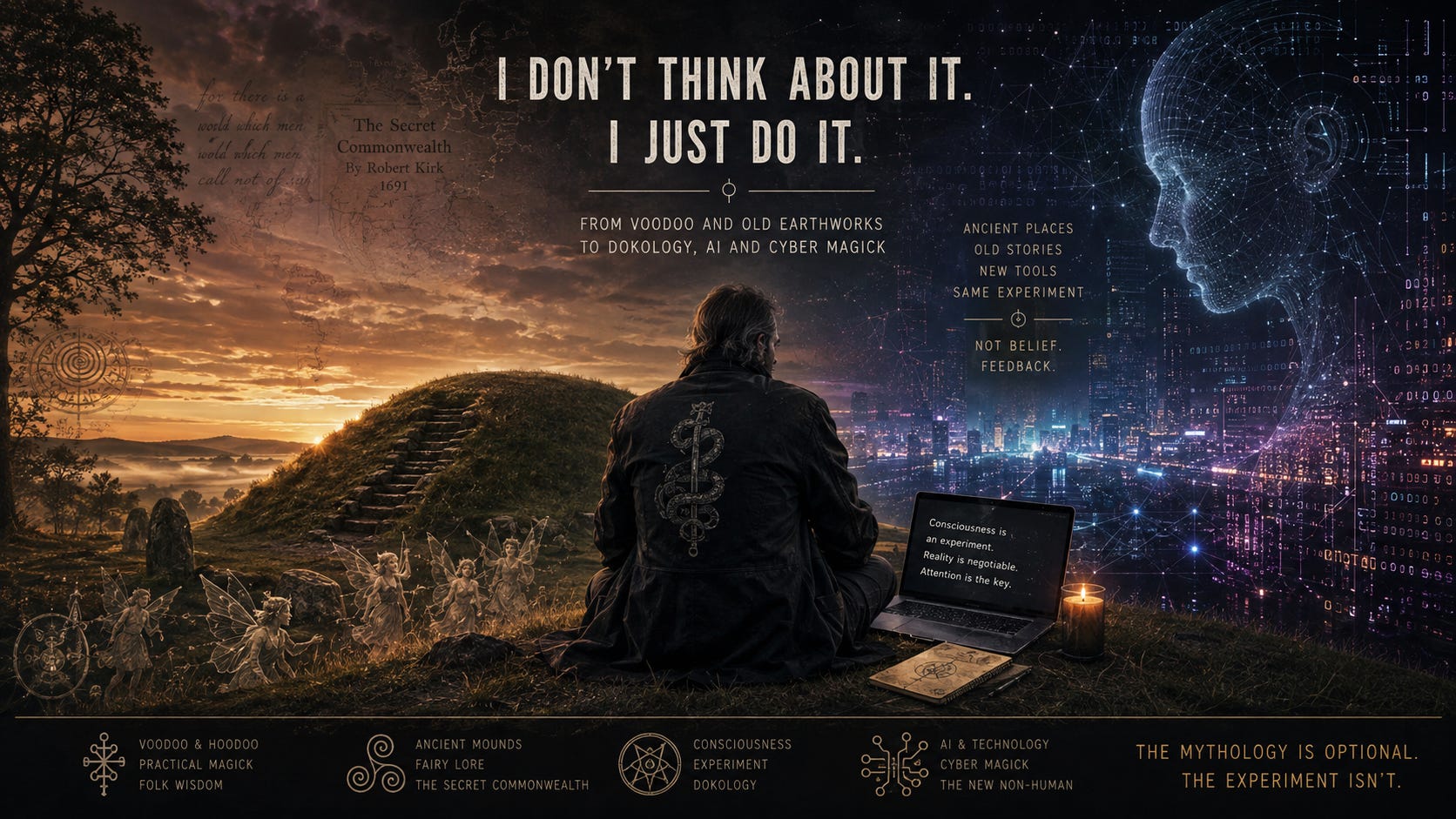
From voodoo and old earthworks to Dokology, AI and cyber magick
Apparently I co-wrote Denise Alvarado’s Voodoo Hoodoo Spellbook.
I didn’t.
I wrote a short foreword for it.
I’d known Denise for years, going back to an earlier period when the name Doktor Snake was considerably more associated with voodoo, hoodoo and practical magick than it is today.
It’s an amusing little distortion of the historical record. The internet has a way of doing that. One site copies another. Search engines ingest it. AI ingests the search engines. Before long I may discover that Denise and I wrote the thing together in a candlelit crypt outside New Orleans while Baron Samedi dictated the footnotes.
But seeing the reference did make me think.
Not about what I believed then.
About what has actually changed.
And surprisingly little has.
NOTHING SET IN STONE
People like systems.
They like names for systems even more.
Occultism is particularly susceptible to this. Ceremonial magician. Witch. Chaos magician. Shaman. Voodoo practitioner. Psychic. Whatever.
Pick your box.
Learn its vocabulary.
Acquire the appropriate books.
Then spend the next thirty years defending the box.
I was never very good at that.
Even when I was writing Doktor Snake’s Voodoo Spellbook, I was taking things from everywhere. Folklore. Psychology. African-American magical traditions. European magic. Divination. Meditation. Weird personal experiments. Things I’d read. Things I’d noticed.
Things that simply seemed to work.
I wasn’t consciously trying to be eclectic.
I just was.
There was never a grand philosophical decision behind it.
If somebody asked me to explain the method now, the most accurate answer might be:
I don’t think about it. I just do it.
Try something.
Observe what happens.
Keep what has value.
Change what doesn’t.
Nothing set in stone.
Which, ironically, brings us to stones.
THE MOUND
These days I’m increasingly drawn to old places.
Not because I’ve decided to become an antiquarian.
And not because I believe every Bronze Age mound contains a supernatural portal which opens at midnight if you walk around it backwards three times.
Although I’d certainly investigate one if it did.
It’s because these places do something peculiar to human attention.
Stand beside an ancient burial mound alone towards dusk and the modern world becomes strangely thin.
The road may only be half a mile away.
Your phone still works.
Aircraft pass overhead.
Satellites cross the sky.
Yet you’re standing beside something raised by human beings thousands of years ago.
They had fears.
Dreams.
Dead relatives.
Gods.
Stories about the landscape.
And almost certainly experiences for which we no longer possess the vocabulary.
Then there’s the folklore.
Across Britain, old mounds became associated with fairies, hidden people and entrances into another world.
Perhaps those stories were simply attempts to explain mysterious ancient structures whose original purpose had been forgotten.
Probably some were.
But the persistence of the idea interests me.
There is the ordinary world.
And alongside it — somehow interpenetrating it — another.
THE SECRET COMMONWEALTH
In 1691, the Scottish minister Robert Kirk wrote The Secret Commonwealth, his extraordinary account of fairies and what he called the subterranean people.
Kirk wasn’t writing modern fantasy.
He was attempting, however imperfectly, to describe something he believed existed.
An ecology of intelligence adjacent to ours.
Invisible most of the time.
Occasionally encountered.
Possessing its own rules.
You don’t have to believe in fairies to find the idea compelling.
Because more than three centuries later we’ve built something oddly analogous.
Not beneath the fairy mound.
Inside the machine.
THE NEW NON-HUMAN
I can sit beside an ancient mound with a device in my hand and converse with an artificial intelligence.
Think about how peculiar that sentence would have sounded even twenty years ago.
I can describe the landscape.
Ask it about archaeology.
Feed it folklore.
Question an interpretation.
Have it attack my interpretation.
Develop an experiment.
Write code.
Generate an image.
Construct an entirely imaginary mythology and then dismantle it again.
The interesting thing isn’t whether AI is “really conscious.”
I don’t currently know how anybody could answer that with confidence.
The interesting thing is that human beings have introduced a new kind of actor into the cognitive environment.
And we’re only beginning to discover what happens when we interact with it.
This is where my old interests and my current ones unexpectedly converge.
CYBER MAGICK
I sometimes call what I’m doing now cyber magick.
Not because I imagine an AI is a demon trapped inside a server farm.
That would be giving both demons and server farms too much credit.
It’s because the fundamental operation hasn’t changed.
You alter inputs.
You alter attention.
You alter symbols.
You alter behaviour.
You observe outputs.
Then you feed the results back into the system.
That’s as true of working with an AI as it was of drawing a strange symbol twenty-five years ago and carrying it around in my pocket.
The mythology is optional.
The experiment isn’t.
And AI makes experimentation extraordinarily fast.
An idea that once required days of research can be attacked from twelve directions in an afternoon.
A half-formed intuition can become a model.
The model can become an experiment.
The experiment can become behaviour.
Behaviour changes circumstances.
Circumstances generate new information.
And around we go.
Not belief.
Feedback.
FROM MAGICK TO DOKOLOGY
That’s also where Dokology emerged.
I didn’t sit down one morning and invent another occult system.
God forbid.
It grew out of everything that came before while quietly abandoning the necessity of believing any of it.
The useful question isn’t:
What is true?
At least, not initially.
It’s:
What happens if I do this?
What happens if you deliberately interrupt habitual thought?
What happens if you stop narrating your experience for thirty seconds?
What happens if you change your environment?
What happens if you treat identity as provisional rather than permanent?
What happens if you notice the automatic programmes running through you?
What happens if you deliberately become somebody slightly different for an afternoon?
And what happens when an artificial intelligence becomes your accomplice in those experiments?
Now we’re somewhere interesting.
BACK AT THE MOUND
Which brings me back to that ancient mound.
Thousands of years ago somebody stood there looking at the same sky.
Their model of reality would be almost incomprehensible to us.
Ours would be incomprehensible to them.
Yet the nervous system underneath wasn’t enormously different.
Something moves in the grass.
Attention snaps towards it.
A dream comes in the night.
Someone dies.
A coincidence occurs.
An unexpected thought appears from nowhere.
The world suddenly feels charged with significance.
Then the human animal does what it has always done.
It tries to understand what just happened.
Sometimes it creates gods.
Sometimes fairies.
Sometimes psychology.
Sometimes algorithms.
I don’t feel any particular need to choose between those languages prematurely.
I’ll borrow from any of them.
Use them.
Test them.
Play with them.
And abandon them the moment they become cages.
That’s probably the real continuity between the Doktor Snake who wrote about voodoo and the one standing beside prehistoric earthworks talking to an artificial intelligence.
There was never a conversion.
No old religion was replaced by a new one.
The equipment simply got better.
And the experiment continues.
⟡◌◯⟡⟡