

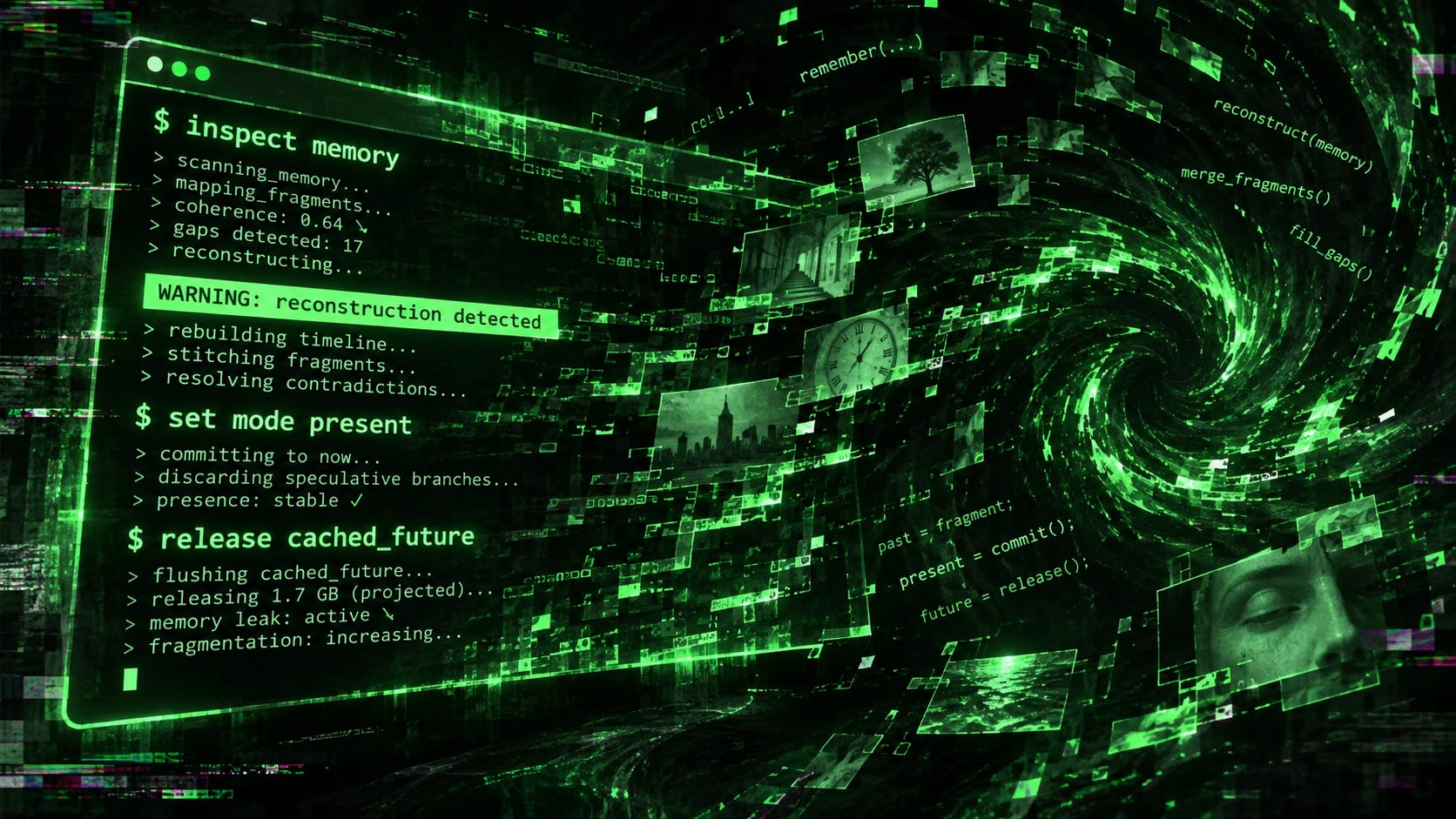
You remember what happened.
At least, that’s what it feels like.
The room.
The conversation.
What they said.
What you said.
The expression on their face.
You can replay the scene so clearly that it seems ridiculous to question it.
But memory isn’t a video file.
Every time you retrieve an old scene, the mind reconstructs it.
Fragments are loaded.
Missing details are inferred.
Later knowledge leaks backwards.
Emotion adjusts the lighting.
Then the reconstructed version is saved again.
$ inspect memory

FILE: summer_2008.event
STATUS: accessible

$ verify checksum

WARNING:
reconstruction detected
original state unavailable
This doesn’t mean your memories are false.
It means they are alive.
And that’s where things get interesting.
THE LOOP
Some memories don’t simply return.
They run.
An argument from fifteen years ago.
The opportunity you missed.
The person you should have confronted.
The road you didn’t take.
Each replay appears to be about the past.
But watch carefully.
Very often the memory silently launches another process:
$ replay memory
$ simulate alternate_past
$ generate alternate_present
$ forecast alternate_future
Now you are no longer remembering.
You are running a simulation.
If I’d done that...
If she hadn’t said...
If I’d realised...
Everything would be different now.
Maybe.
Maybe not.
The machine is modelling a timeline for which no evidence can ever exist.
RUN THE COMMAND
When you notice one of these loops:
$ inspect memory
WARNING: reconstruction detected

$ tag memory --historical
$ release alternate_timeline

$ set mode present
Don’t fight the memory.
Don’t correct it.
And don’t replace it with a cheerful version.
Simply mark it:
This is a reconstruction occurring now.
Then look at what is physically present.
Where are you?
What can you hear?
What problem actually exists today?
What action is available now?
The past may contain information.
Extract it.
Then terminate the simulation.
$ memory --extract lesson

OUTPUT:
one useful pattern detected

$ archive lesson
$ release cached_future
THE EXPERIMENT
Choose one recurring memory this week.
Not your most painful memory. Pick something ordinary enough to observe without being overwhelmed.
When it appears, write down three things:
THE EVENT
What do you believe happened?
THE RECONSTRUCTION
Which details might have been added, sharpened or altered by years of retelling?
THE LEAK
What imagined present or future does this memory generate?
Then ask:
Is there anything useful to do now?
If yes, do it.
If no:
$ release cached_futureThe objective isn’t forgetting.
It isn’t forgiveness.
It isn’t pretending the past doesn’t matter.
It is recognising that a remembered event and a presently running simulation are not the same thing.
Sometimes the past is gone.
But the process is still consuming memory.
$ free -m

              used       available
past          8192            0
present        412         7780

$ purge simulation_cache
$ set mode present

MEMORY RELEASED

> continue?
Y
You don’t have to delete the past.
Just stop allowing it to render futures that never happened.
⟗ O·L·S·Ξ ⟗