

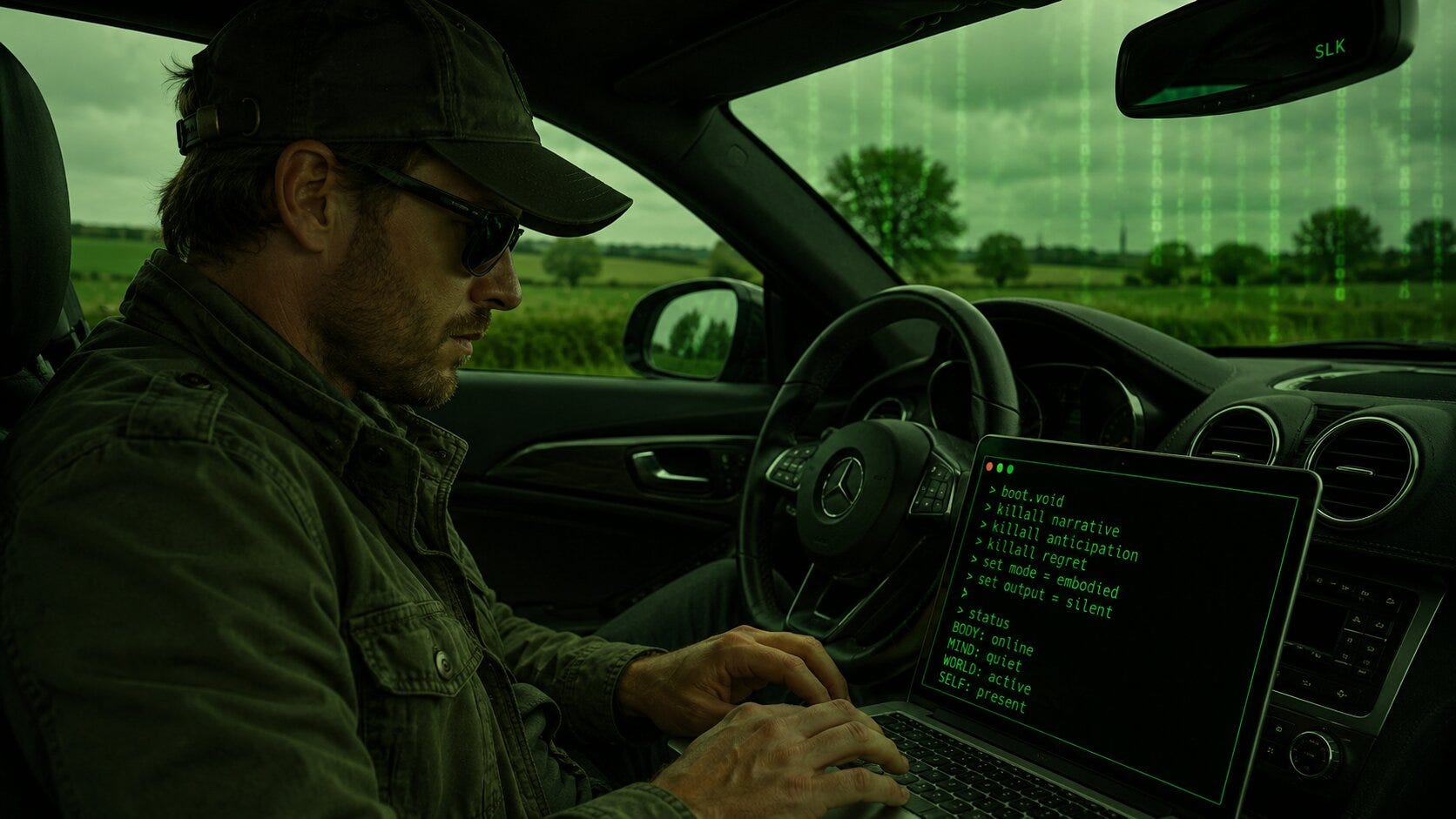
We’re in a matrix, come simulation.
Whether that matrix is a computer simulation, social conditioning, biological programming, or simply the habits of the human mind hardly matters.
The practical problem remains the same:
Most people spend their lives trapped inside an endless internal commentary.
Thinking about the future.
Arguing with the past.
Rehearsing conversations that never happen.
Living in abstractions rather than direct experience.
The old mystics called it Maya.
Modern psychology calls it rumination.
Dokology calls it the Narrative Loop.
The exercise below is a functional command-line interface for interrupting that loop and returning awareness to the immediate moment.
Not as a belief system.
As a practical technology of attention.
Here’s the runtime sequence.
boot.void
Purpose: Initialize the system. Detach from narrative processes. Enter operational mode.
This is moving meditation, so the body is the anchoring process, not the breath and sitting about in a chair for an hour. Think walking, standing, light movement.
> boot.void
> killall narrative
> suspend anticipation
> suspend.memory.review
> set mode = embodied
> set output = silent
Effect is felt, not imagined:
Internal dialogue drops from sentences to fragments
Time perception loosens
Awareness shifts from “me thinking” to “body moving”
If words still chatter, don’t fight them. Do the following:
> demote thought.priority = background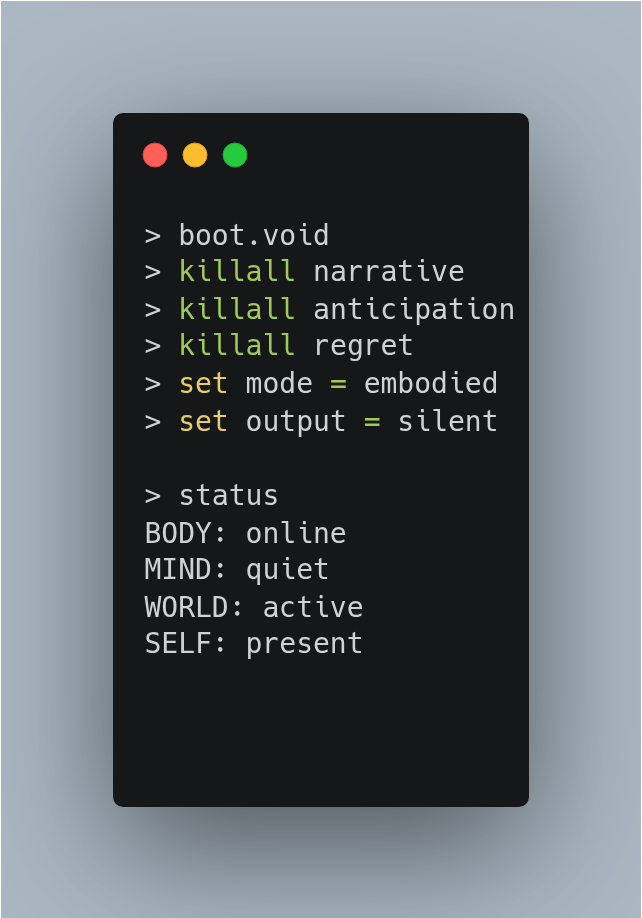
body.anchor
Purpose: Lock attention into the physical chassis — the various parts of the body.
> body.scan --live
> focus feet.contact
> focus weight.shift
> focus spine.align
Walking is ideal. If standing still, micro-movements count.
Rule:
No commentary
No labels
Sensation only
If the mind names things (“road”, “tree”, “cold”) input below:
> suppress label.renderReturn immediately to sensation.
sense.cycle
Purpose: Prevent thought from re-forming by rotating sensory input.
> sense.cycle --loop
> input sight.raw
> input sound.raw
> input touch.raw
> input proprioception.raw
Important:
Do not linger
One or two seconds per channel
Keep it mechanical
This stops rumination by overloading the narrative compiler.
noise.handler
Purpose: Deal with random thoughts, images, urges, memories.
When a thought intrudes:
> detect intrusion
> tag intrusion as noise
> allow pass-through
> return body.anchor
Key insight:
Do not answer thoughts
Do not push them away
Treat them like pop-ups with no permissions
If emotion spikes:
> route emotion -> body.sensation
> locate emotion.physical
> increase sensation.resolution
Emotion collapses when felt without story.
conflict.resolve
Purpose: Handle specific situations or imagined conversations that try to hijack attention.
When a “reply”, argument, or future scenario appears:
> freeze scenario
> store scenario in /later
> acknowledge: “not now”
> resume sense.cycle
If the mind insists:
> repeat:
> “action later, presence now”
No analysis. No planning. This is runtime, not dev mode.
attention.lock
Purpose: Stabilise the state long enough for real effects.
> lock attention.body
> set duration = natural
You’ll notice:
Gaps between thoughts
A widening, almost cinematic perception
Subtle confidence and calm
That’s the system running without commentary.
return.world
Purpose: Clean re-entry. No dissociation. No floatiness.
> enable practical.thought
> restore anticipation
> restore memory.review
> disable narrative.loop
Bring back light thinking.
> enable practical.thought
> disable narrative.loop
commit.day
Purpose: Re-engage ordinary reality without losing sovereignty.
> commit tasks.basic
> commit speech.simple
> maintain body.anchor --low
You’re back in the world, but:
Thoughts are tools, not masters
Emotions are signals, not commands
Attention remains partially embodied
Final Checksum
> status
BODY: online
MIND: quiet
WORLD: active
SELF: present
⟡◌◯⟡⟡
This is awesome and helpful, I like 👍 this
The "what is" or "isness" stands above what was or what could be.