

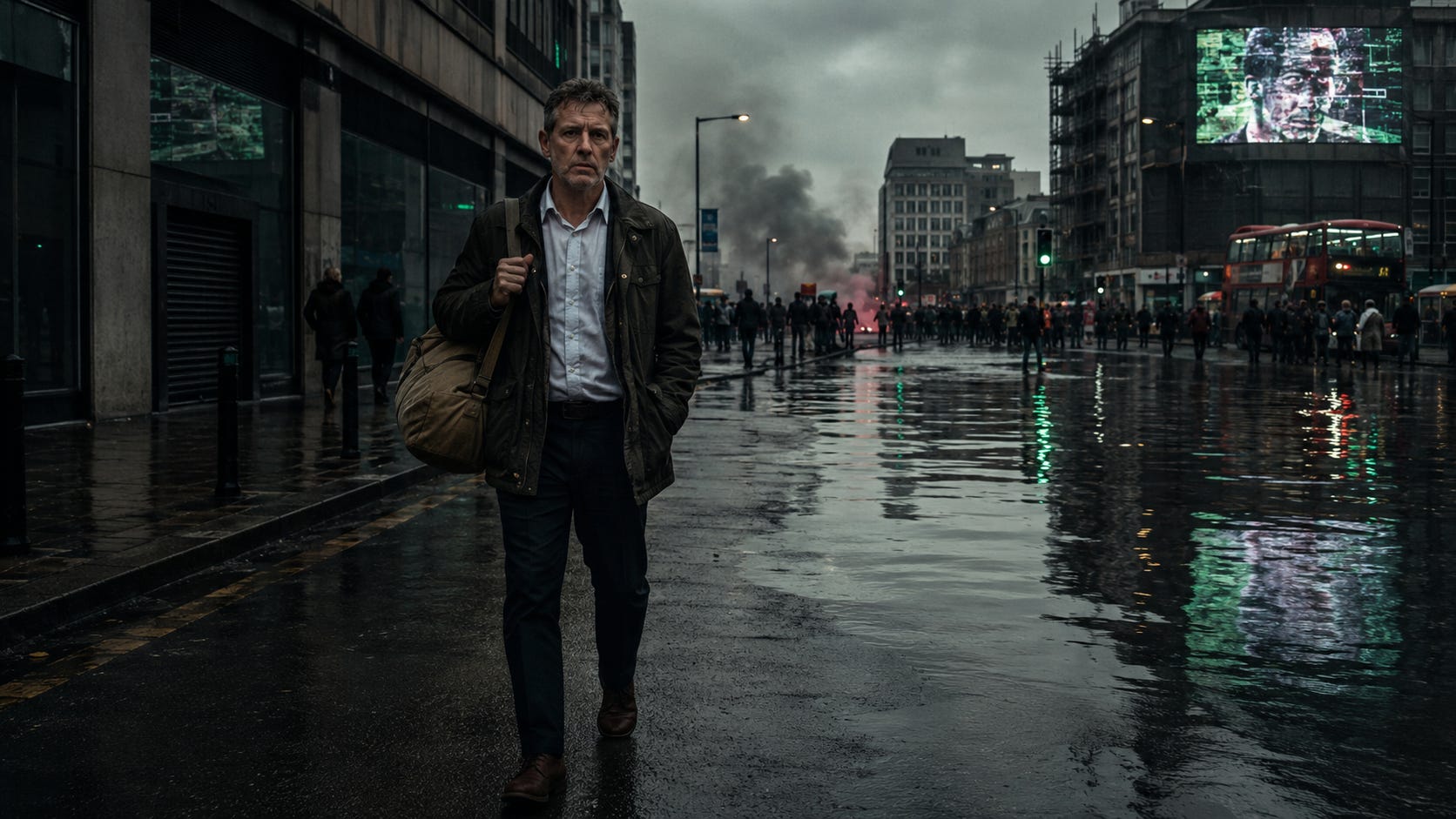
In a post-truth world, it’s almost impossible to know what’s going on.
Explanations are ten-a-penny. Everybody has a theory. The theories multiply, collide and cancel one another out.
The Right blames the Left. The Left blames capitalism. The conspiracists blame hidden networks. The technologists promise abundance. The survivalists predict catastrophe. The influencers turn all of it into content.
You can spend six hours consuming explanations and be no better prepared for tomorrow morning.
That isn’t research.
It’s doom-scrolling with intellectual pretensions.
Meanwhile, something real is happening beneath the noise. We’re passing through an extreme phase of technological, economic and environmental transition.
AI is moving into legal work, programming, administration, design, management, finance, education, writing and countless other areas previously regarded as safely human. Nobody knows how many jobs will disappear, how many will be transformed or what will replace them. Current estimates vary wildly: official UK analysis stresses uncertainty, while independent modelling ranges from widespread augmentation to millions of displaced jobs. What is already clear is that programmers, financial analysts, customer-service workers and other white-collar occupations are highly exposed. UK government assessment, Anthropic labour-market research
Then come robotics, autonomous systems, biotechnology and whatever eventually emerges from quantum computing.
Add climate disruption, pressure on public finances, migration, ageing populations, damaged infrastructure and increasing insurance costs.
This doesn’t mean civilisation will suddenly end.
It means the arrangements on which you based your life may stop working.
That can feel exactly like the end of the world.
YOUR FORMER LIFE MAY NOT BE COMING BACK
Suppose you have a good corporate position.
You have a salary, pension contributions, private healthcare and an impressive job title. You attend meetings. You manage teams. People answer your emails.
Then your department is reorganised.
The company has discovered that twelve people using AI systems can perform work previously requiring fifty. You receive a respectable severance package and reassuring language about your transferable skills.
You assume you’ll find something else.
Six months later, you haven’t.
After a year, prospective employers are asking why you’ve been out of work so long. The positions you once considered beneath you now have hundreds of applicants. Your savings are disappearing.
The real crisis isn’t merely financial.
Your identity has been destroyed.
You weren’t only paid by the corporation. The corporation told you who you were. It gave you status, routine, colleagues, authority and a reason to get dressed in the morning.
Without it, you discover that the confident executive personality was partly a costume issued by the institution.
Can you function without that costume?
Can you take a low-status job without collapsing into humiliation?
Can you sell things, repair things, clean things, move things or learn from somebody twenty years younger than you?
Can you make money without having a recognised profession?
Or will you spend three years insisting that somebody ought to restore the world in which you were important?
Nostalgia isn’t an action plan.
THE WELFARE STATE ISN’T A LAW OF NATURE
The same applies to state support.
Some people receiving disability or health-related benefits are incapable of conventional employment. Others have discovered that the benefits system, however meagre, offers a workable alternative to the labour market.
That isn’t necessarily “scrounging.” It can be understood as an economic strategy made possible by the system as it currently exists.
But systems change.
Britain has already debated reducing health-related Universal Credit payments for new claimants and tightening eligibility. Fiscal pressure will continue regardless of which party is in office. UK government benefit-reform assessment
If your survival depends entirely upon a government payment, prescription supply, housing entitlement or administrative classification, you have a single point of failure.
That doesn’t mean abandoning support you’re entitled to. It means understanding your exposure.
What happens if the assessment changes?
What happens if payments are delayed?
What happens if you must spend your savings before qualifying?
What happens if the medication on which you depend becomes difficult to obtain?
Saying that the government ought to provide for you doesn’t answer any of these questions.
It may be morally right.
You may win the argument.
You can still go hungry while winning it.
YOUR HOUSE MAY NOT SAVE YOU
Home ownership is often treated as the final guarantee of security.
But a house isn’t money. It’s an asset that somebody else must be willing and able to buy.
What happens if your income disappears while mortgage payments, maintenance costs and insurance premiums continue?
What happens if the property becomes increasingly difficult to insure because of flooding, subsidence, coastal erosion or repeated extreme weather?
The UK already relies upon a joint government-industry scheme to keep flood insurance available to many high-risk households. Major floods create billions of pounds in damage, and climate exposure represents an increasing fiscal risk. Office for Budget Responsibility
You may sell.
But perhaps thousands of other people are trying to sell at the same time.
You may imagine that social housing will catch you.
Perhaps it will. Perhaps the waiting list will be measured in years.
The point isn’t that every house will become worthless or that the welfare state will disappear. The point is that nothing should be regarded as unconditional.
Security based upon one institution, one employer, one property, one income or one government promise is fragile security.
THE OUTLAW FANTASY
At this point, some people start fantasising about the black economy.
They’ll wheel and deal. Buy and sell. Work for cash. Pirate their entertainment. Obtain restricted goods through unofficial channels. Lie to officials. Slip through the cracks.
This sounds exciting when discussed from a comfortable chair.
The reality is less romantic.
The established black economy contains people who grew up understanding its rules. Some have family networks, street intelligence and experience assessing danger. Some are perfectly willing to intimidate, rob or assault competitors.
The redundant project manager who once bought cannabis at university isn’t automatically equipped for that world.
Nor is breaking the law necessarily an act of independence. A criminal record, confiscated equipment, frozen bank account or prison sentence can remove what little room for manoeuvre you had left.
If authorities question you, you certainly need to remain calm. You need to control your breathing, understand what has actually been asked and avoid babbling from fear.
But “look them in the eye and lie” is not a universal survival protocol.
Sometimes lying is stupid. Sometimes it creates evidence against you. Sometimes the other person already knows the answer.
The operative principle is colder:
Don’t panic. Don’t volunteer unnecessary information. Know your rights. Don’t attempt cleverness you cannot sustain.
Adaptation means seeing reality clearly—not playing at being an outlaw because your respectable identity has collapsed.
PEOPLE WILL BECOME DANGEROUS WHEN THEIR STORIES FAIL
During serious disruption, people don’t merely lose money.
They lose the story that made their lives bearable.
They were told that hard work would produce security. That qualifications would lead to employment. That property values would rise. That pensions would be protected. That the government would maintain order. That their children would live better than they did.
When these promises fail, anger looks for a target.
There will be demonstrations, strikes, riots, political extremism, conspiracy movements, religious revivals and endless demands that somebody put the old world back together.
You mustn’t let the crowd install its mind inside you.
That doesn’t mean treating everyone as an enemy. Nor does it mean becoming an isolated bunker-dweller who mistakes paranoia for intelligence.
It means maintaining distance from mass emotion.
Crowds can make legitimate demands. They can also become hysterical, cruel and catastrophically wrong.
Walk among them if necessary.
Speak their language when useful.
But retain the ability to leave.
KINDNESS WITHOUT STUPIDITY
Hard conditions don’t justify becoming a monster.
Help people when you can. Share information. Exchange skills. Feed someone. Give them a lift. Make introductions. Protect those genuinely unable to protect themselves.
But kindness without judgement becomes a resource-extraction system.
People will arrive with stories. Some stories will be true. Others will be edited to produce the desired emotional response.
Addicts, professional victims, habitual borrowers and skilled manipulators don’t cease operating because society is under pressure. They multiply.
You will sometimes have to make decisions quickly and with incomplete information.
Can this person reciprocate?
Are they temporarily in trouble, or is trouble their permanent method of life?
Are you helping them recover—or financing the continuation of the problem?
Can you afford the loss if they never repay you?
Compassion doesn’t require surrendering your intelligence.
You can give a person food without giving them access to your bank account.
You can listen without adopting their crisis.
You can be kind and still say no.
THE GURDJIEFF TEST
Gurdjieff didn’t develop his teaching entirely in a quiet room.
During the Russian Revolution and ensuing civil war, he moved through the Caucasus with pupils and family members, establishing temporary groups at Essentuki and Tiflis before eventually continuing through Constantinople and into Western Europe. Accounts describe him using improvisation, persuasion, practical trades and whatever opportunities were available to keep people moving and fed. Gurdjieff’s journey, New York Land Institute biography
Whatever we think of his metaphysics, this is important.
He didn’t merely lecture people about awakening.
He had to organise transport, food, money, shelter and human beings under extreme pressure.
That is the test of a teaching.
Can it survive contact with railway stations, border officials, frightened followers, shortage, illness, betrayal and unpaid bills?
Gurdjieff also had a group. That created problems, but it created economic capacity. A functioning group can cook, teach, repair, manufacture, transport, negotiate and sell. One person has limited time and energy. Ten organised people can create value.
But the crucial word is organised.
Ten frightened, resentful and incompetent people aren’t a community.
They’re a liability.
THE CENTRAL CONTROLLER
Dokology begins with the recognition that you don’t possess one permanent personality.
You contain many operational selves.
There is the negotiator. The fighter. The diplomat. The salesperson. The carer. The analyst. The actor. The scavenger. The quiet observer.
Different conditions require different configurations.
The mistake is becoming trapped inside one of them.
The fighter sees enemies everywhere.
The carer is endlessly exploited.
The analyst cannot act without more information.
The salesperson begins lying to himself.
The scavenger forgets that life can contain anything beyond immediate acquisition.
You need the capacity to install the appropriate mindset without allowing it to become the whole of you.
Above them sits what we might call the Central Controller.
This isn’t a mystical little person living inside your skull. It is trained metacognition: the ability to observe which personality has taken command, determine whether it fits the situation and replace it when it no longer serves.
The Central Controller asks:
What is happening now?
What resources remain?
What am I pretending not to know?
Which part of me is reacting?
What action preserves the greatest number of future options?
What must be done today?
This is how you remain operational without becoming morally numb.
You may need to negotiate hard in the morning, comfort a frightened person in the afternoon and sit silently with your own grief at night.
All three selves may be genuine.
None should be allowed permanent possession.
THE BASIC PROTOCOL
Prepare for disruption before you need to.
Reduce dependency upon a single income.
Learn how your benefits, pension, insurance, mortgage and prescriptions actually work.
Keep essential records accessible.
Maintain some cash and more than one way to make payments.
Learn practical skills somebody will exchange money, food or assistance for.
Know how to sell.
Know how to negotiate.
Know how to use AI rather than merely complaining that it exists.
Build relationships based upon reciprocal value, not vague declarations of community.
Look after your body. A chronically exhausted, intoxicated or badly conditioned organism has fewer available choices.
Practise silence. If you cannot stop the internal monologue for thirty seconds, you won’t think clearly when frightened.
Regularly imagine losing your present role. Notice the terror, shame or outrage it produces. That reaction shows you where your identity has fused with an external structure.
Then ask the hardest question:
If that life ended, what would I do next?
Not what should the government do.
Not who would be to blame.
Not why it would be unfair.
What would you do next?
NO RESCUE
This isn’t a prediction of cinematic apocalypse.
The supermarkets may remain open. Electricity may continue flowing. The police may still answer the telephone. Elections may still happen. Netflix may still be streaming.
Yet your private world could collapse completely.
Your job goes.
Your marriage breaks.
Your savings run out.
Your house is sold.
Your medication becomes difficult to obtain.
Your former friends stop answering because they’re struggling too.
Nobody has deliberately sentenced you to ruin. No sinister council has selected your name.
The systems have simply ceased arranging themselves around your needs.
At that point, self-pity is a luxury you cannot afford.
Grieve, certainly.
Shake.
Swear.
Sit in darkness for a night.
Then get up.
Assess what remains.
Install the personality required.
Make the telephone call.
Learn the skill.
Sell the thing.
Take the unglamorous work.
Build the new alliance.
Keep your kindness.
Keep your intelligence.
And keep moving.
Nobody is coming.
Become the person who can operate anyway.
⟡◌◯⟡⟡