

The machine wants everything to have a purpose.
You work to earn.
You exercise to become fitter.
You meditate to become calmer.
You walk to reach somewhere.
You read to acquire information.
You rest so that you can work more efficiently afterwards.
Even the moments that once belonged to nobody have been recruited. They must now improve you, advance you, heal you, entertain you—or become content.
Nothing is permitted simply to exist.
This is why making a cup of tea can become an act of rebellion.
Not because tea is sacred.
Not because the cup possesses hidden powers.
Not because the ritual will make you healthier, wealthier, wiser or more productive.
You make the tea because you are making the tea.
Nothing follows.
The First Interference
Before beginning, notice the internal voice.
It may be thinking about something that happened yesterday.
It may be rehearsing a conversation that will never take place.
It may be making plans, defending its actions, inventing enemies, composing messages or explaining you to yourself.
This is the internal dialogue.
Most of the time, we don’t notice it. We mistake it for ourselves.
But there are many internal “I”s.
One wants tea. Another wants coffee. One wants to work. Another wants to escape. One wants silence. Another is terrified of what might appear if the noise stops.
You don’t have to defeat any of them.
You don’t have to argue with them.
For the duration of this ritual, they are relieved of command.
The Ritual
Put your phone somewhere out of reach.
Don’t use it as a timer. Don’t photograph what you are about to do. Don’t select a podcast to accompany it.
Fill the kettle.
Listen to the water entering it.
Feel the weight change in your hand.
Put the kettle down.
Switch it on.
Now wait.
Don’t fill the interval.
The mind will try to leave the room while the body remains behind. It will move towards the next task, the next problem, the next fragment of entertainment.
Bring your attention back to the kettle.
Not with violence.
Just return.
Take out the cup.
Put the tea in it.
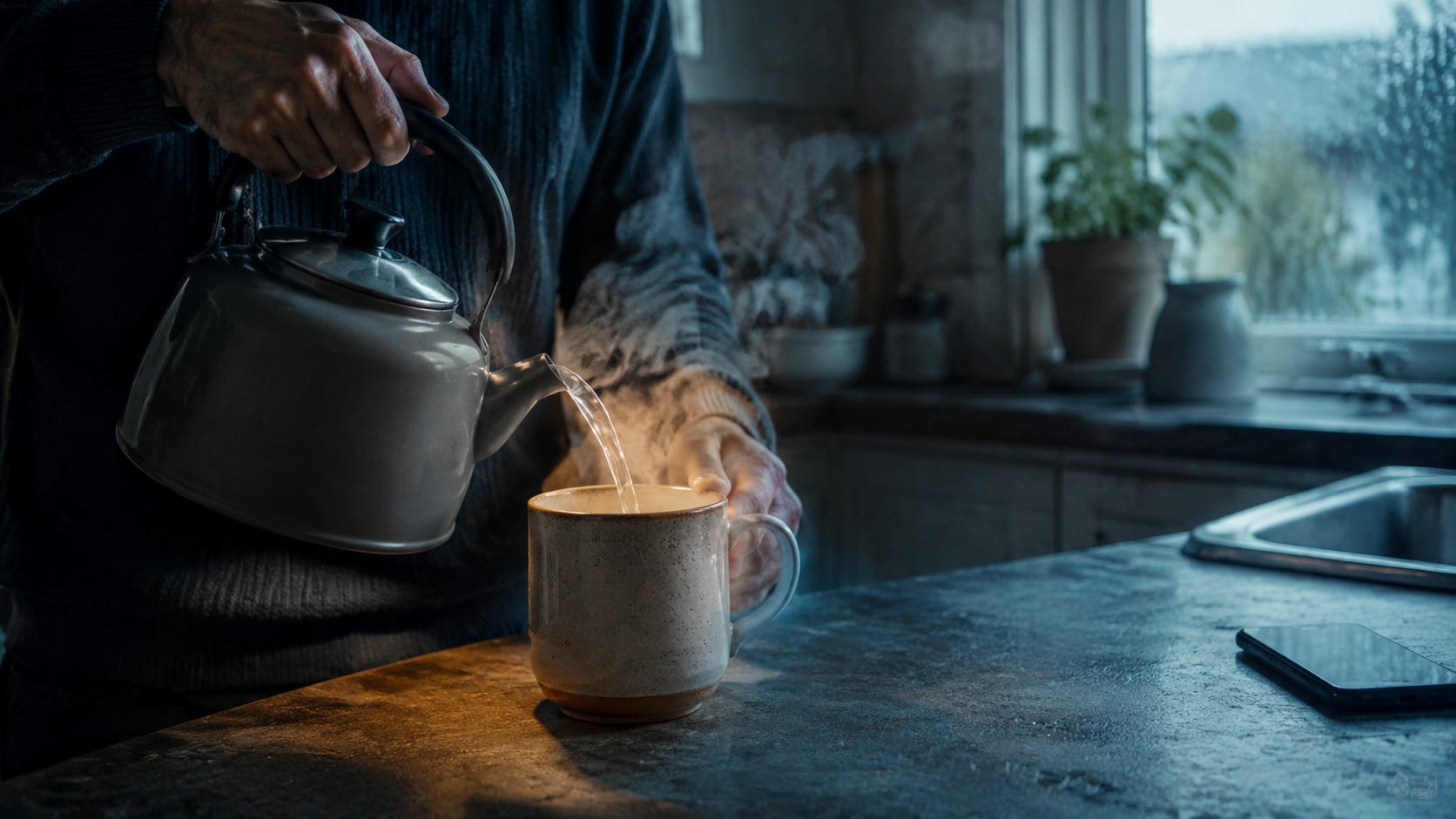
When the water is ready, pour it.
Watch what happens.
Steam rises. Water changes colour. The ordinary world reveals that it was never entirely ordinary.
Add milk if you take milk.
Add sugar if you take sugar.
There is no correct ceremonial method. Precision matters, but correctness doesn’t.
Carry the tea somewhere and sit down.
Don’t read.
Don’t watch.
Don’t listen to anything deliberately.
Hold the cup.
Take the first drink.
Purpose? There Is No Purpose.
At some point, an internal “I” may ask:
What is this supposed to achieve?
The answer is:
Nothing.
This isn’t a relaxation technique.
It isn’t mindfulness for increased workplace performance.
It isn’t a morning routine used by billionaires.
It isn’t preparation for the important part of the day.
This is the important part of the day.
For these few minutes, the means and the end are the same thing.
You aren’t drinking tea in order to become something else.
You aren’t producing an improved version of yourself.
You have temporarily stopped manufacturing the person you think you’re supposed to be.
There is tea.
There is drinking.
There is the room.
The Void
The mind works by dividing.
Useful or useless.
Success or failure.
Sacred or profane.
Work or leisure.
Self or world.
It presents its binary divisions and demands that we choose.
But you don’t have to choose.
You can step outside the question.
In the space beyond the question, there may be silence. There may be thoughts. There may be irritation, boredom or the sudden appearance of an image you didn’t consciously summon.
Leave it alone.
Don’t interpret it.
Don’t ask what it means.
Don’t convert the silence into another assignment.
This is the Void—not a black abyss, but a moment that hasn’t yet been turned into language.
The system cannot tolerate such a moment.
It cannot measure it.
It cannot advertise inside it.
It cannot award you points for completing it.
It cannot tell whether you succeeded.
Neither can you.
Nothing Follows
Finish the tea.
Put the cup down.
The ritual is complete.
There is no need to write down what you experienced.
There is no score.
There is no consecutive-day target.
You haven’t begun a programme.
You don’t have to do it again tomorrow.
If something unusual occurred, let it remain unusual.
If nothing occurred, nothing was supposed to.
You made the tea.
You drank it.
For a few minutes, you stopped producing yourself.
Nothing follows.
This ritual series was partly prompted by Roger Hallam’s prison-recorded talk, The Hidden Power of Rituals, itself influenced by Byung-Chul Han’s The Disappearance of Rituals.
⟡◌◯⟡⟡