

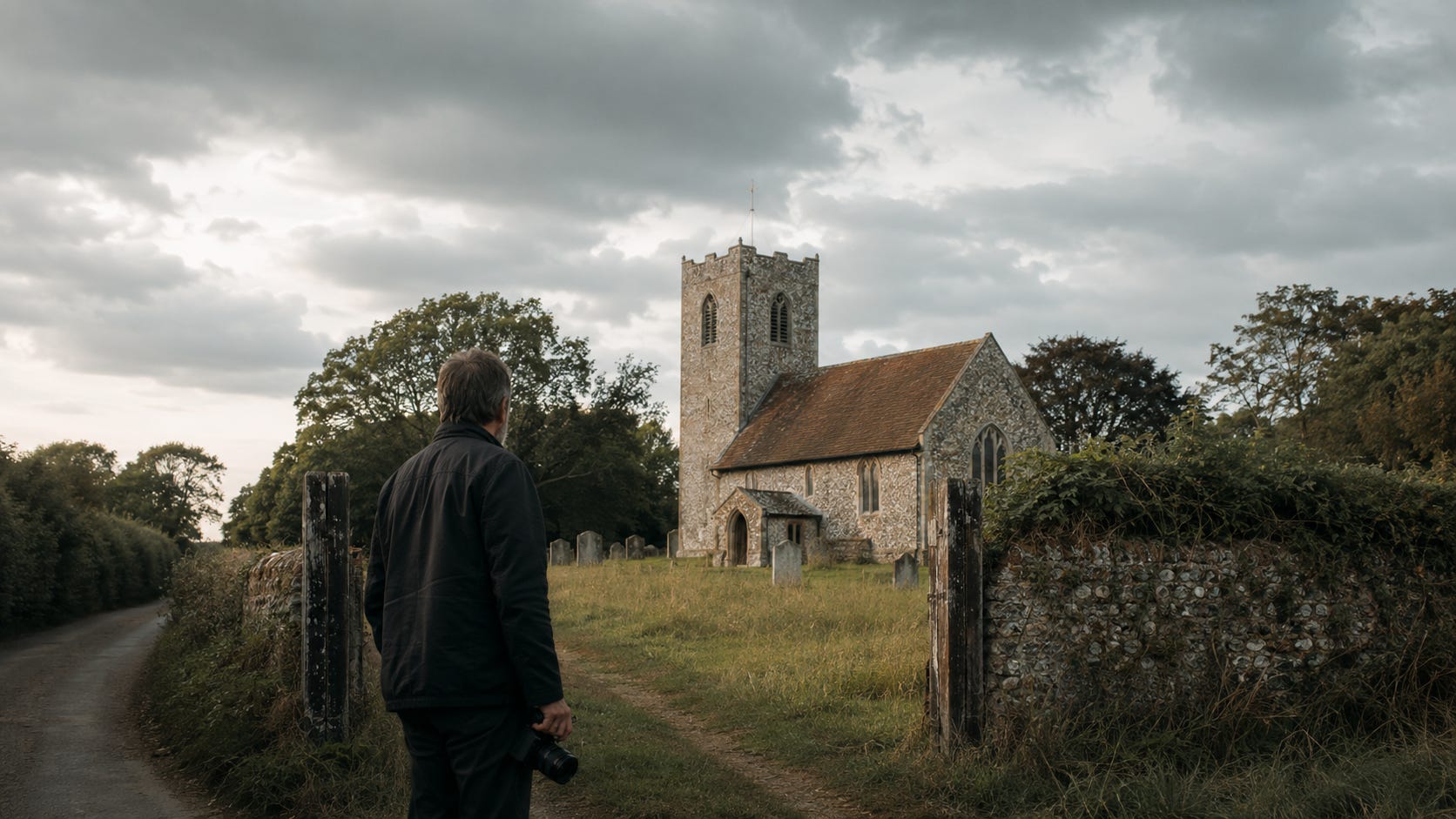
Tomorrow, I may drive out to East Walton.
Or Cranwich.
There are old churches there. Empty roads. Fields. Trees. Fragments of human history still protruding through the modern surface.
I’ll probably take a camera.
This would appear to defeat the purpose of visiting The Unphotographed Place.
But the unphotographed place isn’t necessarily somewhere no camera has ever recorded.
It is the place that exists before you turn it into a picture.
The Captured World
We no longer merely go somewhere.
We document ourselves going there.
The meal must be photographed before it is eaten.
The landscape must be captured before it is seen.
The experience must be given a caption, assigned a meaning and presented to an invisible audience.
Otherwise, did it really happen?
The camera creates a peculiar division.
There is the place itself—and there is the image we expect to produce from it.
Once that anticipated image enters the mind, we begin looking through it.
We seek the right angle.
The best light.
A compelling detail.
Something atmospheric.
Something that will make other people stop scrolling.
The place becomes raw material.
This doesn’t make photography bad. A camera can intensify attention. It can reveal arrangements of light, form and coincidence that the unaided eye might have missed.
But it can also get there before we do.
The body arrives at the church.
The mind arrives at the post.
The Journey
Choose somewhere minor.
Not a famous monument. Not somewhere that promises transformation. Not one of the official places you are supposed to find beautiful.
An old church will do.
A neglected track.
A riverbank.
A layby beside a road that has lost its importance.
A village you have passed many times without entering.
Go alone if practical.
Don’t announce the journey in advance.
Don’t tell the world you are “taking time for yourself.”
You don’t need to transform the drive into a podcast, a lesson or an inspirational narrative.
Drive.
Notice the road.
Allow the ordinary sequence of roundabouts, hedges, junctions and settlements to carry you out of your usual mental territory.
You aren’t travelling towards revelation.
You are travelling towards a place.
The Threshold
When you arrive, don’t immediately begin recording.
Leave the camera in its bag.
Leave the phone in your pocket.
Stand beside the car for a moment.
Listen.
There may be birds, farm machinery, distant traffic or nothing you can readily identify.
Walk towards the place.
Don’t decide what it means.
If it is an old church, don’t immediately think about history, architecture, pagan survivals, forgotten graves or the generations of dead beneath your feet.
Those things may come later.
First, allow the church to be a building.
Allow the trees to be trees.
Allow the stones to possess no message for you.
You have entered the interval before interpretation.
The First Encounter
Spend a little time without taking anything.
Five minutes will do.
Ten might be better.
Don’t count them.
The internal commentator will soon begin its work.
That would make a good opening shot.
I could talk about this.
People would find that interesting.
There’s an article in it.
The commentator isn’t wrong.
But it can wait.
Continue walking.
Notice where your attention goes before you direct it.
Perhaps towards a blocked doorway.
A piece of broken masonry.
A beer can in the grass.
A plastic flower beside a grave.
A dead branch knocking against a window.
Perhaps nothing arrests you.
Don’t manufacture atmosphere merely because you came looking for it.
A strange place is under no obligation to perform its strangeness.
The Unphotographed Place
For this first interval, you aren’t producing evidence.
Nobody else can see what you see.
No audience is looking over your shoulder.
The place doesn’t need to become beautiful, eerie, historic or significant.
It isn’t required to justify the petrol.
It doesn’t need to provide a story.
This is the unphotographed place.
It exists between your arrival and your first attempt to possess it.
You may discover that without the camera, the place becomes less dramatic.
That is useful.
You may also discover that it becomes more difficult to name.
The eye wanders where it likes. Time loses its sequence. Details appear without arranging themselves into a narrative.
For a few moments, you aren’t a presenter, writer, photographer, researcher, pilgrim or occultist.
You are a living organism standing beside other arrangements of matter.
Stone.
Grass.
Wood.
Cloud.
Bone.
Breath.
Nothing has yet been converted into meaning.
Then Take Out the Camera
If you came to make a video, take out the camera.
Begin.
But notice whether anything has changed.
Perhaps you now film the place you actually encountered rather than the place you expected to find.
Perhaps the crooked drainpipe matters more than the medieval tower.
Perhaps the sound of the road belongs in the recording.
Perhaps you discard the introduction you rehearsed in the car.
Perhaps you say:
I don’t know what this place means.
That may be the most accurate field report you have ever made.
The camera is no longer a barrier between you and the landscape. It becomes an instrument carried back across the threshold.
You aren’t pretending the place can never be photographed.
You are acknowledging that something always escapes.
The wind that stopped before you pressed record.
The thought that vanished when you tried to phrase it.
The movement at the edge of perception.
The particular density of the afternoon.
The person you were before you began performing yourself.
Leave Something Behind
Not an offering.
Not litter.
Not a sigil concealed beneath a stone.
Leave behind the demand that the journey must repay you.
You may return with good footage.
You may produce a talk, an article or a series of images.
The journey can enter your work.
But the first encounter remains outside it.
Nobody else was there.
Even the recording cannot retrieve it.
This is the real ritual: not refusing the camera, but refusing to let the camera arrive first.
Go somewhere.
Cross the threshold.
See it before you capture it.
Then, if you wish, show us what remains.
⟡◌◯⟡⟡
Awesome information, I understand what you're saying and I like this.