

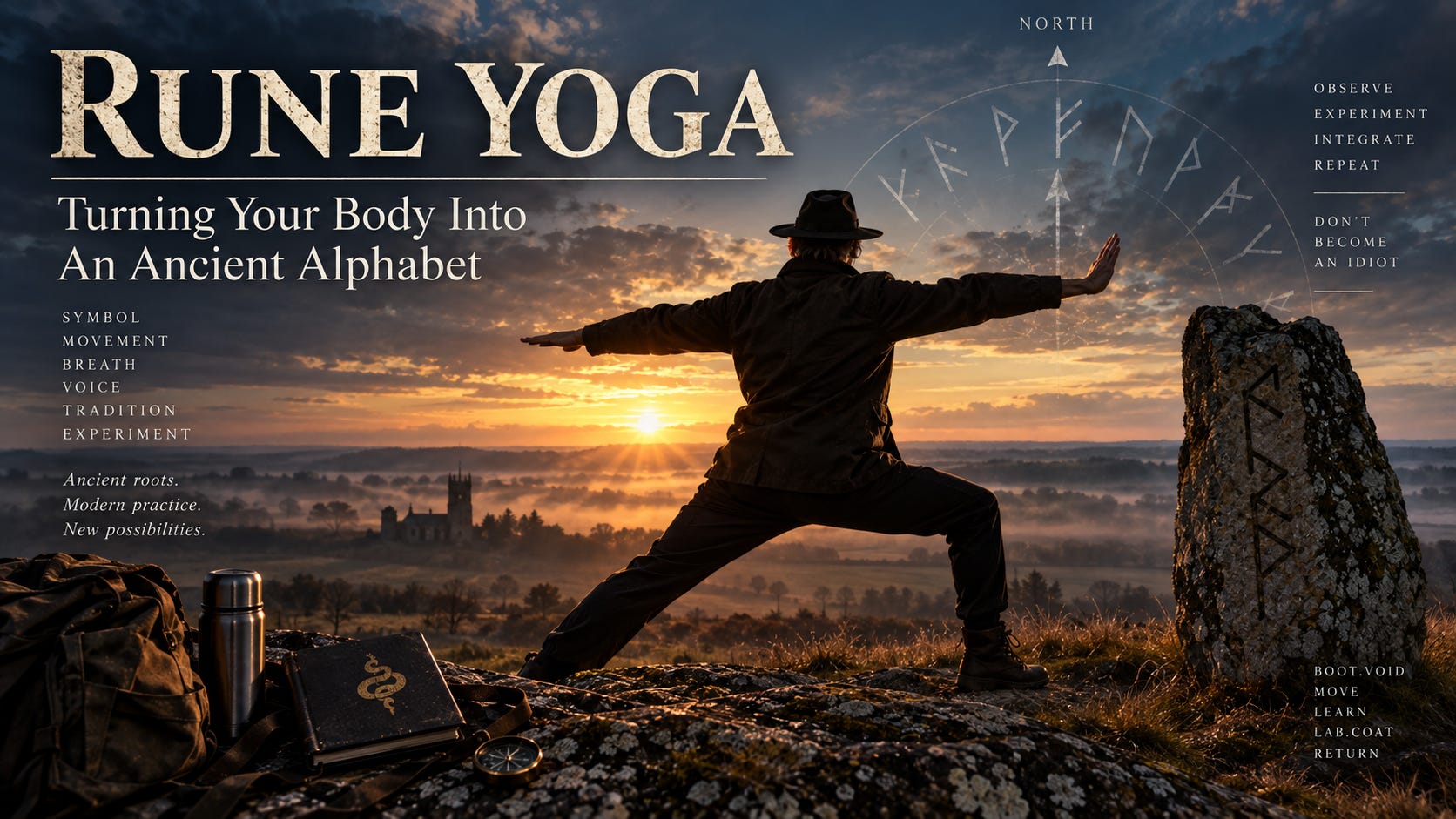
There is no ancient tradition of Rune Yoga.
Let’s get that out of the way first.
The Vikings weren’t standing on Scandinavian hilltops at dawn twisting themselves into the shape of ᚠ.
As far as anybody knows.
What we now call Rune Yoga or rune gymnastics emerged much later, largely through German-speaking occultists in the early twentieth century.
Which presents us with a problem.
And an opportunity.
Because although I’m extremely interested in the historical runes, I’m equally interested in asking:
What can we do with them now?
So we’re going to steal the basic idea.
Then rebuild it.
Welcome to Rune Yoga 2.0.
THE RUNES WERE REAL
Before we start inventing things, let’s distinguish the invention from the history.
Runes weren’t originally an occult oracle deck.
They were writing systems.
They appeared in different forms across the Germanic world over many centuries.
There’s the Elder Futhark.
The Younger Futhark associated particularly with Viking Age Scandinavia.
And here in England, the expanded Anglo-Saxon Futhorc.
That’s particularly interesting to me because I live in East Anglia.
This landscape is saturated with the historical world from which Anglo-Saxon runic culture emerged.
You don’t need to pretend you’re standing in mythical Hyperborea.
Walk around Suffolk and Norfolk for long enough and you’re walking through the archaeological remains of the real thing.
But alongside the mundane use of runes as writing, there are tantalising connections with magic, charms, inscriptions and divination.
And then there are the rune poems.
These are particularly useful because they give us something more interesting than a letter.
They give us an image.
A concept.
A little packet of meaning.
Wealth.
Aurochs.
Thorn.
Journey.
Gift.
Ice.
Need.
Sun.
And so forth.
Now we have something to work with.
THEN THE OCCULTISTS GOT HOLD OF THEM
Fast-forward to the early twentieth century.
Guido von List created his own eighteen-rune Armanen system, presenting it as recovered ancient wisdom.
It wasn’t.
Later German esotericists including Friedrich Bernhard Marby and Siegfried Adolf Kummer began developing physical rune exercises.
The body itself formed the rune.
Rune gymnastics.
Rune Yoga.
Interesting idea.
Historically ancient?
No.
And there’s another problem.
This material developed in the extremely murky world of German and Austrian völkisch occultism.
Some of those currents contributed ideas and symbols to the ideological swamp from which National Socialism subsequently emerged.
So I’m not interested in pretending that history isn’t there.
Nor am I interested in throwing away every interesting idea somebody once contaminated.
Instead:
Separate the experiment from the ideology.
Keep the runes.
Keep the body.
Keep the sound.
Lose the racial mysticism.
And start again.
YOUR BODY BECOMES THE RUNE
This is where it gets interesting.
Choose a historical rune row.
For somebody in England, I’d be tempted by the Anglo-Saxon Futhorc.
If Viking Age Scandinavia interests you, use the Younger Futhark.
If you want the earlier Germanic system, use the Elder Futhark.
Then learn the symbols properly.
Not twenty-four runes tonight.
One rune.
Look at its shape.
Draw it.
Learn its historically reconstructed name.
Find out what we actually know about it.
Read the relevant rune poem where one survives.
Distinguish the historical evidence from the enormous amount of modern occult material that’s accumulated around it.
Then stand up.
BECOME THE SYMBOL
Look at the rune.
Now ask:
How could my body approximate this shape?
There’s no official answer.
That’s the point.
You’re creating the posture.
Use the torso as the stave.
Arms become branches.
Legs change the geometry.
Perhaps the rune requires an asymmetric stance.
Perhaps one position flows naturally into another.
Don’t worry about reproducing it with mathematical precision.
Find a bodily expression that makes you feel the geometry.
Hold it.
Breathe.
Then move out of it.
Return.
Repeat.
Something interesting happens remarkably quickly.
A symbol that was previously a mark on a page becomes kinesthetic information.
Your muscles remember it.
Your balance remembers it.
Your spatial awareness remembers it.
You’ve turned an alphabet into choreography.
NOW GIVE IT A VOICE
Once you’re comfortable with the shape, introduce sound.
Learn the best scholarly reconstruction you can find for the rune’s name.
Don’t rely on somebody on TikTok shouting vaguely Scandinavian syllables while standing beside a plastic drinking horn.
Try to get it reasonably right.
Then enter the posture.
Breathe.
On the exhalation, intone the rune name.
Again.
Again.
Feel where the sound resonates.
Chest.
Throat.
Skull.
Abdomen.
Don’t worry about whether you’re “activating ancient vibrational frequencies.”
Listen to what your body actually does.
Then, if the rune belongs to one of the surviving rune-poem traditions, introduce the verse.
You can speak it aloud.
Learn it.
Eventually you might recite it internally while holding the posture.
Now you’ve combined:
SYMBOL
BODY
BREATH
VOICE
LANGUAGE
IMAGINATION
That’s already a substantial practice without requiring us to invent a single Viking secret master.
TURN IT INTO A FLOW
Once you’ve learned several runes, stop treating them as isolated postures.
Move between them.
Slowly.
One rune becomes another.
Breath accompanies the transition.
Rune names accompany the breath.
Think Tai Chi rather than aerobics.
The interesting question becomes:
How does one symbol transform into the next through the body?
Now you’re learning the rune row not merely intellectually but spatially.
Eventually you could move through an entire sequence.
Elder Futhark.
Younger Futhark.
Anglo-Saxon Futhorc.
Different sequences would feel different simply because their geometries differ.
And suddenly “learning the runes” has become something considerably more interesting than memorising flash cards.
FACE NORTH
If you want to add theatre, face north.
Not because your compass points directly at Asgard.
It doesn’t.
But north carries an enormous symbolic charge within our modern imagination of the Northern Tradition.
Cold.
Darkness.
Stars.
Scandinavia.
The polar region.
The mythic North.
Use it.
Magick doesn’t become better by pretending symbolism is geography.
It becomes better when you know the difference and use both deliberately.
BOOT.VOID
Before beginning your sequence, enter boot.void.
Stand still.
Feet planted.
Arms loose.
Reduce the internal chatter.
Feel your weight.
Feel the ground.
Listen.
Don’t do anything for perhaps two minutes.
Then begin the first rune.
This creates a clean transition:
ordinary consciousness → practice.
And when you’ve finished, we reverse it.
LAB.COAT
Runes can be extraordinarily evocative.
That’s precisely why we need an off-switch.
When the sequence is finished, stand normally.
Shake out your arms.
Breathe.
Then imagine putting on the Doktor Snake scientist’s white coat.
One arm.
Then the other.
Button it.
Look back at what you’ve just done.
You stood facing north while contorting your body into the shapes of an obsolete Germanic alphabet and chanting reconstructed ancient words.
Excellent.
Experiment complete.
You’re no longer the rune.
You’re the person collecting the data.
LAB.COAT.
Return to baseline.
WHAT ARE WE ACTUALLY DOING?
That’s the interesting question.
Are runes objectively magical?
Does assuming their shapes activate some ancient current?
Did the old Germanic peoples know things we’ve forgotten?
I don’t know.
And Rune Yoga certainly doesn’t prove any of that because, as we’ve established, Rune Yoga itself isn’t ancient.
But something demonstrably is happening.
You’re learning symbols through multiple sensory channels.
You’re combining memory with movement.
You’re controlling breathing.
You’re practising balance.
You’re using vocalisation.
You’re focusing attention.
You’re constructing an imaginal environment.
And you’re deliberately moving between ordinary and altered modes of experience.
That’s plenty.
Anything stranger that happens is a bonus.
THE NORTHERN LABORATORY
I think there’s much further we can take this.
Runes outdoors.
Rune walking.
Rune poems spoken at particular landscapes.
Runic divination treated as probability experiments.
Runes and dreams.
Runes and psychogeography.
Runes encountered accidentally in branches, fences, road markings and architecture.
Not because Odin necessarily arranged three sticks beside the A11 specifically for your benefit.
But because for the duration of an experiment we can ask:
What happens if we behave as though he did?
Then observe.
Record.
Return to baseline.
That’s the difference between playing seriously with the imaginal world and getting swallowed by it.
Learn the history.
Respect what we actually know.
Invent what we don’t.
Label the invention honestly.
Then run the experiment.
Face north.
BOOT.VOID.
Become the rune.
Move.
Speak.
Observe.
Then:
LAB.COAT.
And remember the standing rule.
DON’T BECOME AN IDIOT.
⟡◌◯⟡⟡