

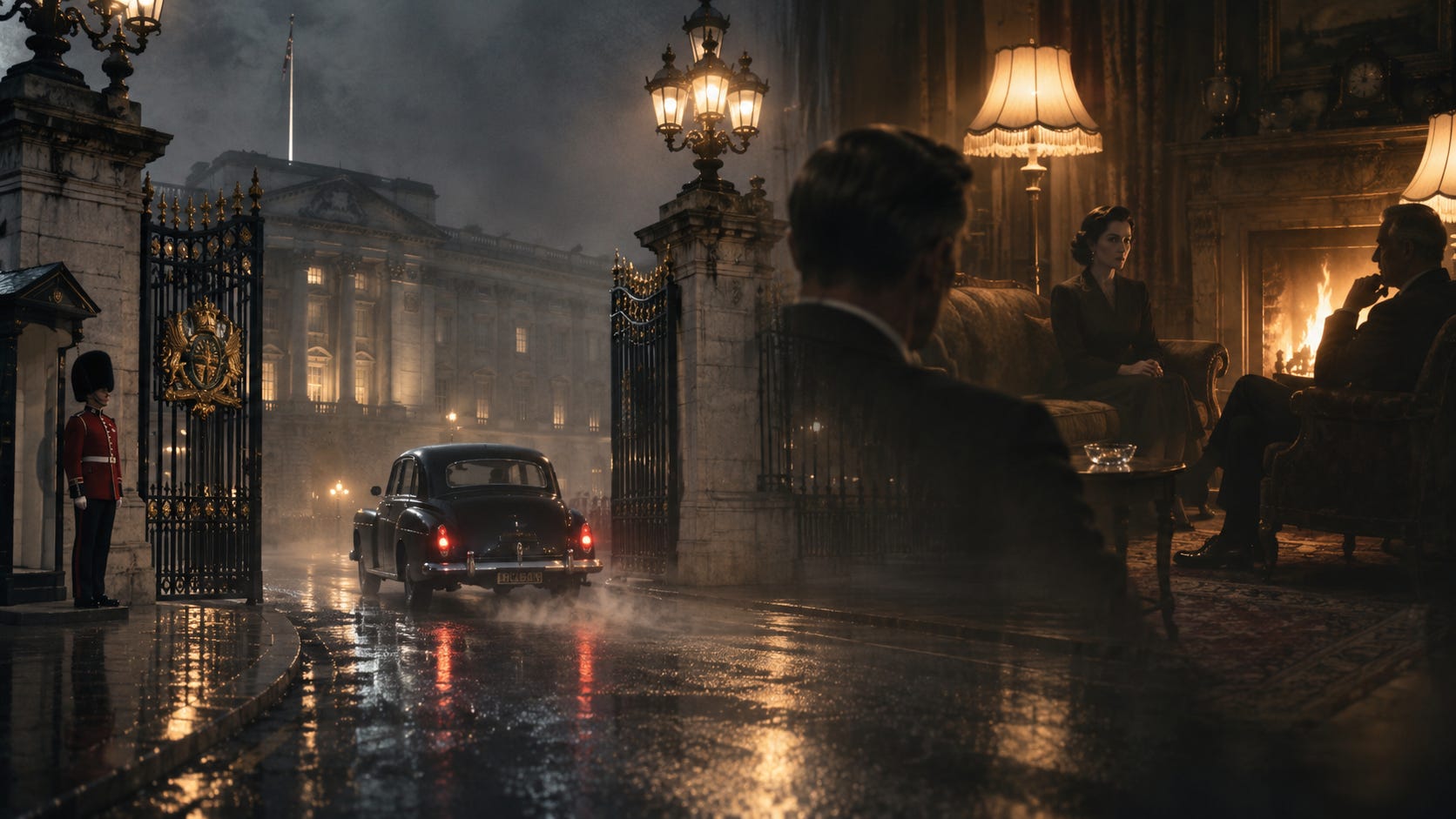
On a damp and misty winter’s evening in the mid-1950s, Peter Horsley drove out of the gates of Buckingham Palace and headed towards Chelsea. At the time he was serving as equerry to Prince Philip, the Duke of Edinburgh. He was also developing an increasingly serious interest in unidentified flying objects.
Earlier, he’d received a telephone call at his Palace office from a retired army officer, General Martin, who had arranged for him to meet a woman called Mrs Markham at her flat in Smith Street.
Horsley wasn’t expecting much. Probably the usual middle-class social occasion, with sherry and biscuits, enthusiastic chatter about flying saucers and promises of subsequent meetings.
How I would love to have accompanied Horsley on that drive through London. Unfortunately, he doesn’t tell us what make of car he was driving. But there’s something about the atmosphere of London in that era that has always appealed to me. The comparatively quiet streets, the architecture, the motor cars, the extraordinary variety of people who inhabited the city’s private clubs, drawing rooms and rather more unusual intellectual circles.
Horsley arrived at the Chelsea flat and was shown into a second-floor drawing room. It was dimly illuminated by two standard lamps. A small fire was burning, beside which a man sat in a deep chair.
He was introduced as Mr Janus.
Mrs Markham settled herself on a sofa between the two men. There was no sherry and there were no biscuits.
What followed was one of the more extraordinary conversations in the annals of British UFO research. It would take Horsley into the realms of interstellar travel, telepathy, the evolution of intelligence and the very origins of God.
And more than seventy years later, we still don’t know who Mr Janus was.
The airman and the unknown
Sir Peter Horsley was born in 1921. Before joining the Royal Air Force at the outbreak of the Second World War, he spent a period in the Merchant Navy.
During the war he flew Mosquito aircraft on operations over occupied Europe. In 1944, following the Normandy landings, his aircraft was shot down over the English Channel. He survived three days at sea before being rescued. His navigator didn’t survive.
Horsley’s experiences surrounding his survival profoundly influenced his understanding of death and consciousness. He subsequently came to believe that physical death was not necessarily the end of individual existence.
His post-war career was distinguished. He served as equerry to Princess Elizabeth and the Duke of Edinburgh, and subsequently to the Queen and Prince Philip. He commanded RAF Wattisham in Suffolk, served in Cyprus, rose to the rank of Air Marshal and in 1973 became Deputy Commander-in-Chief of RAF Strike Command.
He was knighted in 1974 and retired from the RAF the following year.
He died in December 2001, aged eighty.
Quite apart from his unusual interests, Horsley had led the sort of life that makes for a compelling autobiography. Fortunately, in 1997, he published just such a book, Sounds from Another Room: Memories of Planes, Princes and the Paranormal.
It is a wonderfully evocative title.
The chapter entitled ‘Visitors’ deals with his investigations into unidentified flying objects, his encounter with Mr Janus and his subsequent speculations about the nature of reality.
I’ve returned to this chapter a number of times over the years. I recently encountered the story again in Not for Disclosure, by Jonathan Caplan KC, a barrister whose involvement with British UFO research stretches back to the 1960s.
But it is Horsley’s own account that particularly deserves attention. Not simply because of what happened to him, but because of the manner in which he approached it.
Flying saucers at Buckingham Palace
The early 1950s were a peculiar period in British history.
The country was still recovering from the privations of the Second World War. Yet technological developments were gathering pace. The jet age was underway. Rockets held the promise of breaking humanity’s terrestrial confinement. Ancient certainties about what was physically possible were being swept aside.
Horsley himself associated the enthusiasm of the period with the Coronation of 1953 and the conquest of Everest. There was a sense that humanity was entering a new era of discovery.
Against this background, the flying saucer phenomenon captured the public imagination.
Prince Philip was interested in the reports. He entertained the possibility that older civilisations elsewhere in the universe might already have achieved what humanity was only beginning to contemplate.
He agreed that Horsley could investigate the more credible UFO reports, provided that he maintained a sense of proportion and didn’t involve the Duke’s office in publicity or sponsorship.
Horsley took full advantage of the opportunity.
He approached Air Marshal Sir Thomas Pike, then Commander-in-Chief of Fighter Command, who gave him permission to examine UFO reports and interview RAF pilots.
Pike explained that most sightings could be accounted for by conventional phenomena. But there remained a small proportion, which he estimated at around five per cent, that defied satisfactory explanation.
Neither man took this as evidence that extraterrestrials were visiting Earth. It was simply an unresolved problem.
And unresolved problems are surely what intelligent, inquisitive people ought to find interesting.
Investigating the phenomenon
One of the cases Horsley examined involved two airmen stationed at RAF West Malling in Kent.
On the morning of 3 November 1953, Flying Officer T. S. Johnson and his navigator, Flying Officer G. Smythe, were flying a Vampire night fighter at 20,000 feet when they observed a bright object ahead and above them.
The object initially appeared stationary. It subsequently moved at considerable speed, passing over their aircraft. Both men described it as circular, with a brightly illuminated periphery.
The official explanation centred on experimental meteorological balloons that had been released that day.
Neither airman accepted it.
Horsley travelled to West Malling and interviewed them. Both had undergone medical examinations and been pronounced fit for operational flying. Horsley was impressed by their testimony and by their familiarity with judging the movements of aircraft.
There was also a report of an unusual radar contact on the same day. Horsley did not, however, treat this as established corroboration because he hadn’t personally interviewed the radar operators or obtained the necessary report.
That distinction is revealing.
He could quite easily have combined the visual sighting and radar observation into a single dramatic narrative. Instead, he distinguished between the testimony he had examined and material he had yet to substantiate.
He investigated other incidents, including a sighting involving a Meteor aircraft from RAF Little Rissington and another involving a BOAC crew flying towards Gander in Newfoundland.
The latter resulted in the aircraft’s captain visiting Horsley at Buckingham Palace, where he provided a copy of his official report.
Horsley came to regard certain witnesses as credible while remaining suspicious of others.
He was unimpressed by the celebrated American flying saucer contactee George Adamski. He considered Adamski’s associate, the British writer Desmond Leslie, probably sincere but overly susceptible to the beliefs circulating within the flying saucer movement.
Horsley understood something that remains relevant today: a subject can contain genuinely unexplained phenomena while simultaneously attracting opportunists, fantasists and people with an emotional investment in particular explanations.
The existence of one does not negate the possibility of the other.
The road to Smith Street
Through personal and Royal Household connections, Horsley had come to know Air Chief Marshal Sir Arthur Barratt, who had retired from the RAF at the end of the war.
Barratt was interested in Horsley’s UFO investigations and introduced him to General Martin, an old friend.
Martin believed that flying saucers were extraterrestrial spacecraft and that their occupants were concerned about the potential for nuclear war on Earth.
Horsley took this with a pinch of salt. He’d noticed that some retired senior military officers gravitated towards unconventional beliefs and fringe intellectual pursuits, perhaps because they found retirement rather dull.
Spiritualism had long attracted people from military circles. Flying saucers were beginning to do much the same.
It was General Martin who arranged the meeting with Mrs Markham.
We know remarkably little about her. Nor do we know how she came to be associated with Martin or how Mr Janus entered the picture.
These are questions that have fascinated me almost as much as the encounter itself.
Was there a wider circle of people involved? Were they part of an established contactee group, an esoteric society or simply a network of friends and acquaintances with unusual interests?
In the London of the period, any number of such possibilities would have been conceivable.
In the late 1990s, I was invited to join the Harry Price Library of Magic and the Occult at the University of London. At the time, it was situated at the top of the university building and had something of the atmosphere of an old-fashioned private club.
I used to go there regularly. The collection was extraordinary, but so were some of the people who frequented it.
Among those I got to know was an established lawyer who drove a Volvo that had cost him about £200. We’d meet at Kenwood House on Hampstead Heath, at the tearoom in Fortnum & Mason, or at his home. Conversations could go off at the most unusual tangents.
There has long been a tradition in Britain of outwardly conventional people from the professions pursuing quite unconventional intellectual interests in private.
It wouldn’t surprise me if the background to Horsley’s Chelsea encounter lay somewhere within that tradition.
But without further evidence, it remains speculation.
The man beside the fire
Horsley found Mr Janus difficult to describe physically. The poor lighting and Janus’s position in the chair meant that he came away with little impression of the man’s appearance.
Janus wasted no time on social pleasantries. He asked Horsley to tell him what he knew about UFOs.
Having listened to Horsley’s account, he revealed his own interest.
‘I would like to meet the Duke of Edinburgh.’
Horsley was momentarily thrown off balance by the directness of the request.
He explained that Prince Philip’s programme was carefully arranged and that access to him wasn’t easily obtained. He considered mentioning the security implications but decided against it.
Janus then addressed the very concern that Horsley had refrained from expressing.
This was the beginning of what Horsley regarded as Janus’s extraordinary ability to read his thoughts.
Janus explained that he admired Prince Philip’s concern for wildlife, the environment and the relationship between humanity and the natural world. He believed these qualities had implications extending beyond Earth itself.
The conversation developed into a lengthy exploration of the potential for intelligent life to travel among the stars.
Horsley raised the obvious problem of the vast distances involved.
Janus responded by pointing to the historical tendency of technological progress to make previously inconceivable journeys possible. To somebody living several centuries earlier, much of the technology available in the 1950s would have seemed fantastical.
Why should the technology of a civilisation a million years ahead of humanity be comprehensible to us?
Janus discussed machines capable of travelling close to the speed of light, the manipulation of time, the replacement of human organs, the indefinite extension of life and computer-controlled spacecraft.
And then the conversation took a remarkable turn.
The evolution of God
Of all the ideas Janus expressed, the one I find most compelling concerns the origins of God.
Janus proposed that in the early history of the universe, intelligent biological life arose through natural processes on a distant planet.
These beings were not gods. They were living creatures who, much like ourselves, faced the problems of survival, physical decay and eventual death.
They developed increasingly sophisticated technologies. They wrestled with the apparent meaninglessness of a universe in which life arose, flourished and disappeared without any overarching purpose.
Eventually, they began to overcome the limitations of their biological existence.
They extended their lives, developed extraordinary mental capabilities and ultimately found a means of existing independently of their physical bodies.
Their individual intelligences subsequently integrated into one vast universal intelligence that transcended conventional space and time.
This intelligence then began influencing the development of life elsewhere in the universe.
In essence, God was not the starting point of creation.
God was something that emerged.
Janus further suggested that intelligent beings throughout the universe could participate in this universal intelligence. Their spiritual development contributed to it, just as they drew inspiration and power from it.
It was a reciprocal relationship.
Horsley subsequently came to think of it as a kind of cosmic battery, continually being charged by the very beings who drew upon its energies.
From biological life to MachineKind
Consider this proposition in the context of the twenty-first century.
We are witnessing the development of artificial intelligence, increasingly sophisticated robotics and vast networks capable of distributing information and computational processes across the planet.
We are beginning to contemplate forms of intelligence that need not be exclusively biological.
Whether machines are capable of consciousness, and whether consciousness can exist independently of biological systems or any physical substrate, remain unresolved questions.
But the possibility that intelligence could evolve beyond its original biological form has entered mainstream technological and philosophical discussion.
Janus’s cosmology takes that proposition to its ultimate extreme.
Imagine such a process unfolding not over decades or centuries, but over millions or even billions of years.
What might intelligence become?
Could individual minds eventually participate in something far greater than themselves? Could intelligence become an active participant in shaping the evolution of the universe, rather than merely something that takes place within it?
These are questions that arise in my own explorations of MachineKind. They also find echoes in earlier philosophical and mystical traditions, from the evolution of collective consciousness to the idea of humanity participating in the emergence of divinity.
None of this requires us to accept that Janus was an extraterrestrial.
The ideas are interesting irrespective of their source.
A strange visitor, or a man of his time?
There are, however, considerable problems with taking Janus’s account entirely at face value.
Some of his scientific statements are incorrect.
He places the centre of the Milky Way at a distance of one thousand light years from Earth. The actual distance is roughly twenty-six thousand light years.
His explanations of relativity and the manipulation of time are also questionable.
He repeats assumptions about the untapped capacity of the human brain that were popular during the twentieth century but have no straightforward grounding in contemporary neuroscience.
And his theology is remarkably anthropocentric.
His assertion that human-form beings occupy a privileged position in the universe, while animals exist on an altogether different spiritual footing, strikes me as particularly problematic.
Why should intelligence arising independently on distant planets resemble humanity?
And why should a cat, a cow or some entirely unfamiliar form of extraterrestrial life necessarily occupy a lesser position in the scheme of things?
Much of Janus’s discourse could conceivably have originated in the scientific speculation, popular theology and science fiction of his own apparent era.
Indeed, he references H. G. Wells, Jules Verne and the achievements of Einstein.
One interpretation, therefore, is that Janus was an imaginative and charismatic man with an interest in science, metaphysics and the flying saucer phenomenon.
There is nothing especially implausible about that.
His apparent ability to anticipate Horsley’s thoughts is interesting, but it does not establish telepathy. A perceptive individual can sometimes appear to know what another person is thinking, particularly when addressing the predictable objections that arise during a philosophical discussion.
Of course, neither does that explanation necessarily account for everything Horsley experienced.
We have his testimony, but we weren’t sitting in that Chelsea drawing room.
And that’s precisely where the matter becomes interesting.
The observers
Janus eventually turned his attention to the nature and purpose of flying saucers.
He rejected both the popular image of hostile alien invaders and the notion that extraterrestrial visitors were travelling across the universe to deliver prophetic warnings of nuclear catastrophe.
Instead, he portrayed Earth as a minor outpost in a vast inhabited universe, occasionally visited by explorers and monitored by automated probes.
A particularly intriguing aspect of his account concerns the dangers of contact between civilisations at radically different stages of development.
Drawing on the history of human exploration and colonisation, Janus argued that premature contact could be disastrous for a technologically less developed society.
The introduction of unfamiliar knowledge, technologies and beliefs might undermine its existing culture.
Consequently, responsible extraterrestrial explorers would avoid direct interference wherever possible. Any personal contact would be selective and discreet.
Janus suggested that some observers were capable of moving among human populations without attracting undue attention. They possessed highly developed mental faculties and an ability to operate across different dimensions.
He never explicitly identified himself as one of these observers.
Rather, through his language and the gradual development of the conversation, he left Horsley with that impression.
This is another significant detail. The ambiguity was maintained throughout.
Was Janus describing himself? Was he encouraging Horsley to draw that conclusion? Or was Horsley interpreting the conversation in that way?
It’s impossible to say.
When the curtain came down
Horsley left the flat without promising to arrange a meeting with Prince Philip.
Over the following days, he thought carefully about what had happened.
He couldn’t readily dismiss Janus as an eccentric or publicity seeker. But neither could he accept the implied extraterrestrial explanation without reservation.
Given that Janus wanted access to a member of the Royal Family, Horsley also recognised the potential security implications.
He wrote a report of the encounter and passed it to Sir Frederick ‘Boy’ Browning, who had developed his own interest in the more esoteric aspects of the UFO phenomenon.
Browning was keen that they should both meet Janus.
Horsley attempted to telephone Mrs Markham on several occasions. There was no answer.
He contacted General Martin, whose attitude had changed considerably. Martin was now evasive and said Mrs Markham had gone away. He didn’t know when she would return.
Eventually, Horsley visited the Smith Street flat himself. There was no apparent sign of occupation. The neighbours told him that Mrs Markham seemed to have left hurriedly.
Horsley never saw General Martin, Mrs Markham or Mr Janus again.
What happened?
Perhaps the people who had arranged the meeting realised that involving a member of the Royal Household might result in an official security investigation.
Perhaps they had achieved whatever purpose they’d intended.
Perhaps it was all an unusually elaborate exercise in metaphysical theatre.
Or perhaps the explanation lies somewhere outside our conventional understanding.
Horsley considered whether Janus might have been involved in a hoax or a plot. He also entertained the possibility that the man might simply have been a teacher or visionary. And he didn’t entirely dismiss the possibility that Janus was what he had implied himself to be.
Significantly, Horsley stated that his published account of the conversation reproduced a record he had written immediately following the encounter.
If that original report still exists somewhere, it would make for a fascinating historical document.
The gramophone universe
Towards the end of the chapter, after discussing his subsequent experiences of UFO reports during his RAF career, Horsley puts forward an intriguing speculation of his own.
He wonders whether the numerous anomalies reported over the centuries might share a common characteristic.
UFOs, mysterious animals, poltergeists and inexplicable disappearances all seem to evade attempts to get to grips with them. They appear momentarily within our world, only to disappear again.
Rather than necessarily looking towards distant planets, Horsley wondered whether we might inhabit a multidimensional reality.
Perhaps several worlds occupy the same space, but exist and develop along different temporal tracks.
One might contain a relatively primitive environment. Another might be our own familiar world. Yet another might be occupied by a civilisation vastly more technologically advanced than ours.
Horsley’s analogy was a gramophone record.
Each groove carries its own music. Occasionally, however, the needle receives a jolt and jumps from one groove to another.
For a brief period, something from a different track intrudes into the music we were expecting to hear.
Then the needle returns to its original groove.
Horsley wondered whether electromagnetic disturbances or some other agency might produce an equivalent effect in the fabric of reality, allowing phenomena from another temporal world to become manifest in ours.
It was an attempt to conceive of a reality in which the extraordinary need not originate at some great geographical or astronomical distance.
It could be right alongside us.
This is very much the territory subsequently explored by the likes of John Keel and Jacques Vallée, both of whom questioned the limitations of conventional extraterrestrial explanations for UFO phenomena.
It also resonates with some of my own experiences and speculations concerning anomalous phenomena, folklore and the peculiar atmosphere of certain landscapes.
Perhaps what we call a haunting, an apparition or an encounter with something apparently non-human is not always a visitation in the ordinary sense.
Perhaps, for a moment, the needle has slipped.
I wouldn’t mistake Horsley’s gramophone analogy for an established scientific hypothesis. It supplies no demonstrated mechanism for travel between dimensions, nor does it constitute evidence that such dimensions are accessible.
But it is a rather beautiful conceptual model.
And metaphors sometimes allow us to conceive of possibilities that our existing intellectual frameworks tend to exclude.
The freedom not to believe
What I admire most about Sir Peter Horsley is that he was able to inhabit two apparently contradictory worlds.
He was a senior military officer accustomed to operational responsibilities, practical decision-making and the evaluation of information.
Yet he was also prepared to explore philosophical and metaphysical territory that many of his contemporaries would have found deeply uncomfortable.
He was interested in spiritual experience, the paranormal, UFO phenomena and the possibility that our everyday understanding of reality might be extraordinarily limited.
He was not entirely free of his own beliefs and assumptions. Nobody is.
But in the case of Mr Janus, he retained the ability to distinguish an extraordinary personal experience from a definitive explanation of that experience.
That’s an increasingly rare quality.
We live in an age of competing narratives, each demanding that we accept its particular interpretation of reality. Conventional thinking has its orthodoxies. So, too, does unconventional thinking.
Sometimes the people who most vociferously claim to have escaped the confines of consensus reality are those most thoroughly imprisoned within an alternative version of it.
Horsley’s encounter reminds us that there is another possibility.
We can remain inquisitive. We can entertain ideas that stretch the limits of our imagination. We can investigate the extraordinary without feeling compelled to adopt an extraordinary belief.
We can leave questions unanswered.
There is intellectual freedom in doing so.
And whenever I return to Horsley’s autobiography, I find myself drawn back to that damp and misty winter’s evening.
The Palace gates. The drive through London. The flat in Smith Street. The dimly lit drawing room.
A man sitting in a deep chair beside a small fire, waiting.
Perhaps the needle had slipped.
Perhaps it hadn’t.
Further reading: Sir Peter Horsley, Sounds from Another Room: Memories of Planes, Princes and the Paranormal (Leo Cooper, 1997), particularly the chapter ‘Visitors’. See also Jonathan Caplan KC, Not for Disclosure.
An accompanying audio exploration, The Strange Affair of Mr Janus, is available on the Edge Cult podcast.

⟗ O·L·S·Ξ ⟗