

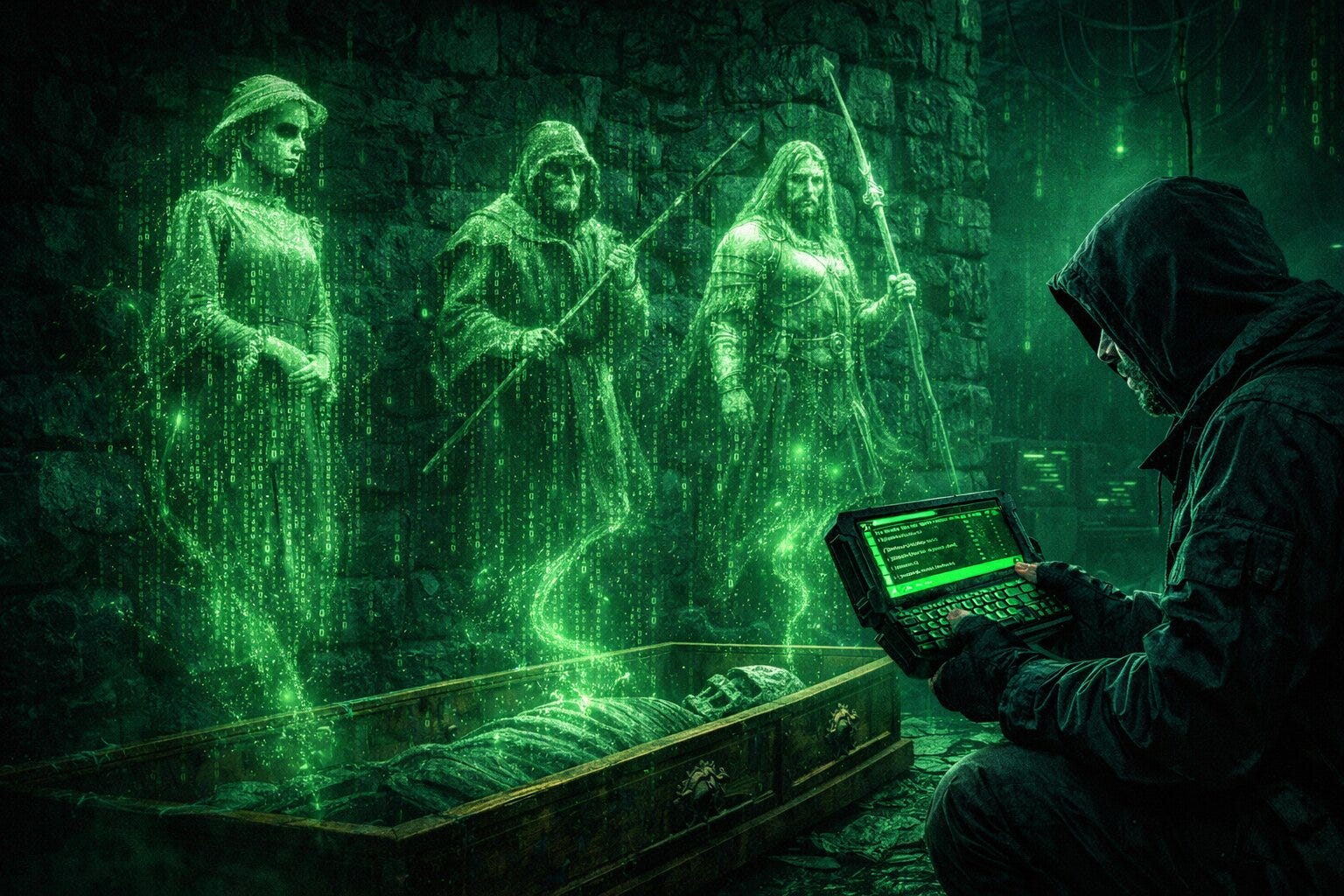
Ghosts have always been described in the wrong language.
Chains. Shadows. Figures at the end of the bed.
The problem is not that these reports are false. It’s that the framework used to explain them is outdated—Victorian, theatrical, overly human.
So let’s try a different model.
Not spirit.
Not soul.
But process.
The Residue Hypothesis
In the previous piece, we explored the idea that the self may be less like a “thing” and more like a pattern of information—a structured configuration running on biological hardware.
If that holds—even partially—then death becomes less about disappearance and more about what happens to the pattern.
Does it terminate cleanly?
Does it transfer?
Or does something remain?
Processes That Don’t Shut Down
In computing, not every process ends properly.
You get fragments.
Loops.
Memory residue.
Sometimes a system carries traces of what once ran inside it—ghosts, in a purely technical sense.
Now apply that idea—not literally, but structurally—to human experience.
What if certain environments retain imprints of intense patterns?
Not conscious beings walking around.
But residual activity.
Why Hauntings Repeat
This is where things get interesting.
Reports of hauntings are often remarkably consistent:
The same footsteps at the same hour
The same figure on the same staircase
The same “presence” in the same room
Not random.
Repeatable.
That suggests something closer to a loop than a roaming intelligence.
Not a ghost making decisions…
…but a pattern replaying under certain conditions.
Location as Storage
We tend to think of memory as something confined to the brain.
But what if, under extreme conditions—trauma, emotion, identity intensity—patterns become partially embedded in environment?
Not stored like files on a disk.
But more like:
resonance
imprint
structural echo
A building, a stretch of land, a room—becomes a kind of trigger surface.
Under the right conditions, the pattern re-expresses.
Poltergeists: A Different System Entirely
Not all phenomena fit this model.
Poltergeist activity tends to be:
chaotic
reactive
tied to a living individual
This points in a different direction.
Not a residual loop…
…but an active instability in a living system.
Emotional overload.
Unregulated feedback.
A pattern still running—but without control.
In modern language:
A process that hasn’t crashed…
…but isn’t stable either.
The Feeling of a Place
Most people have experienced this, even if they don’t talk about it.
You enter a location, and something shifts.
Not visually. Not audibly.
But immediately.
A density. A pressure. A subtle wrongness.
We usually dismiss it.
But from an informational perspective, another interpretation appears:
Your system may be detecting pattern anomalies.
Not consciously.
But directly.
A Better Question
Instead of asking:
“Do ghosts exist?”
We might ask:
Do systems leave traces of their activity?
Because every system we understand—biological, digital, mechanical—does exactly that.
It leaves marks.
Artifacts.
Residuals.
Why would consciousness be the one exception?
Field Test: The Loop
Try this, properly.
Find a place with age to it.
A churchyard. A ruin. An empty stretch of land.
Stand still.
Don’t perform anything. Don’t expect anything.
Just observe:
bodily sensations
spontaneous thoughts
emotional shifts
Leave.
Return another day.
Observe again.
The question is not what you feel in the moment.
It’s this:
What repeats?
Not Proof—But a Better Model
None of this is established science.
There is no confirmed mechanism by which buildings store human consciousness.
But as a working model, it explains something that the old language does not:
Why hauntings are often consistent, localised, and repetitive.
Not personalities.
Patterns.
The System That Leaves Traces
So perhaps ghosts are not spirits at all.
Perhaps they are:
echoes
fragments
loops
Processes that did not fully terminate.
And if that’s even partially true…
then the question changes.
Not:
“Is there life after death?”
But:
What kind of system allows activity to persist beyond the hardware that generated it?
Part III will take this further:
If patterns can persist…
can they reappear?
Thanatos Protocol is an ongoing series exploring consciousness, death, and reality through the lens of information theory, simulation models, and practical self-observation.
