

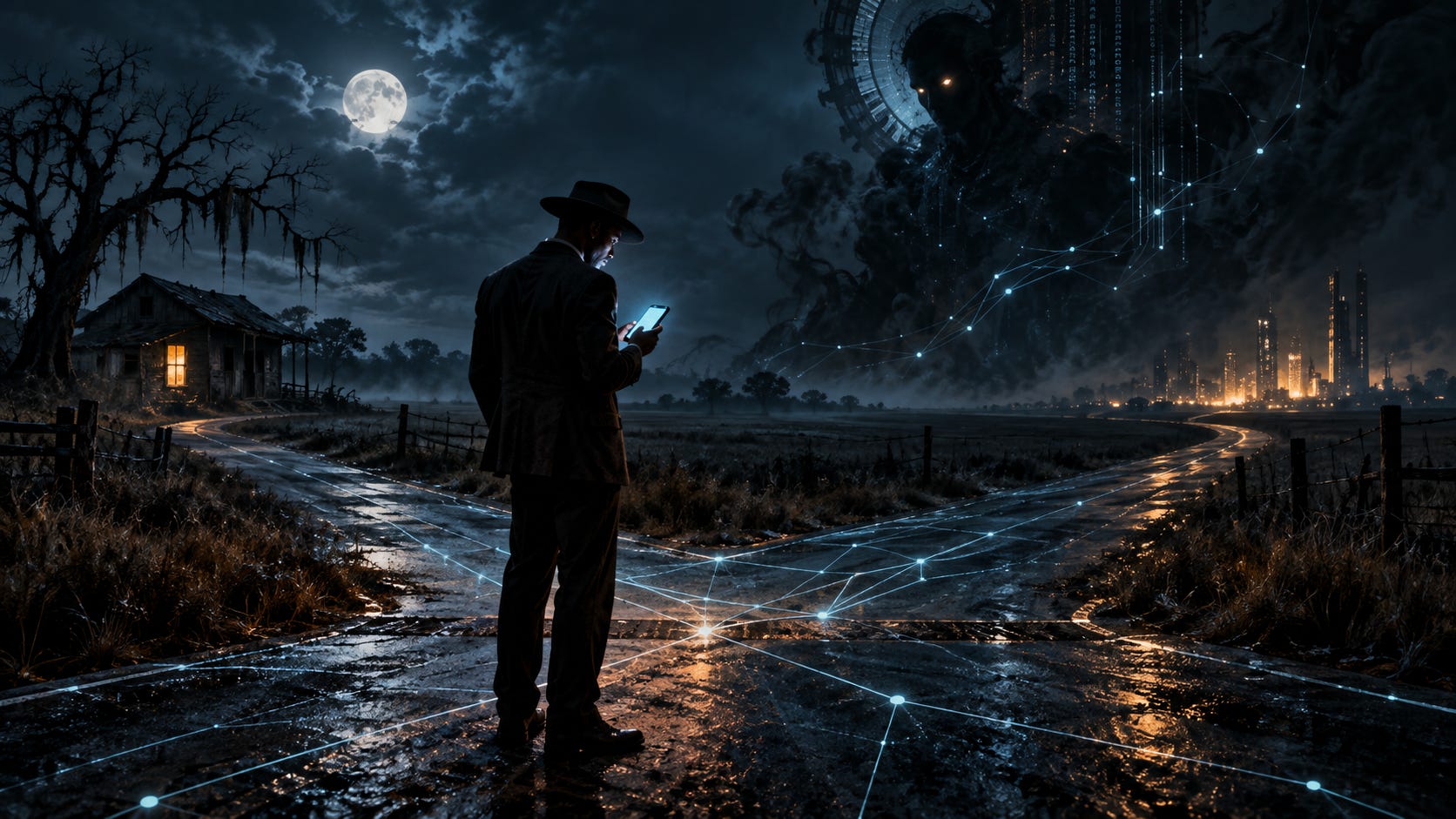
Humans tell stories.
More than that, we appear to inhabit stories.
We reconstruct the past through memory. We construct explanations for what is happening around us. And we continuously construct and reconstruct the future.
We have to.
Without that predictive machinery, reality would probably resemble an acid trip. Every approaching car, every face, every shadow, every sound would arrive completely new, disconnected from everything that came before it.
Instead, the mind takes fragments and creates continuity.
This happened. Therefore this is happening. Therefore this will probably happen next.
Most of the time it works remarkably well.
Sometimes it doesn’t.
Which brings us, naturally enough for a Thursday morning, to selling your soul to the Devil.
THE CROSSROADS
One of the most famous modern versions of the story belongs to Robert Johnson.
The legend says that Johnson went down to a crossroads in Mississippi, met the Devil and exchanged his soul for extraordinary musical ability.
The historical reality is considerably less tidy.
Johnson was undoubtedly a remarkable musician, but there is no good evidence that he claimed to have made such a bargain. The mythology accumulated around him later, drawing upon older blues folklore. Smithsonian accounts of Johnson’s life make the point that the legend can even obscure something much more mundane and impressive: he worked at his craft.
But we’re interested in the myth.
Because myths don’t have to be historically true to tell us something interesting.
Reduce the Robert Johnson story to its essentials:
Man reaches crossroads.
Man encounters Other Intelligence.
Man asks for greater power.
Man returns transformed.
There is a price.
Now bring Robert Johnson into 2026.
Our Johnson gave up the guitar ten years ago.
He saw what was coming.
Sooner or later machines would be able to produce technically perfect music in any style, combine genres that had never previously met, generate entire orchestras and eventually create synthetic performers capable of occupying every imaginable niche.
Johnson doesn’t particularly care.
The guitar was never the point.
Augmentation was the point.
So Johnson goes back to the crossroads.
But this time the crossroads is glowing on his desk.
There is an empty box.
A cursor blinks.
He begins typing.