

DOKTOR SNAKE | TRANSMISSIONS FROM THE SLOPCORE LOUNGE
I was in my teens when I bought my first Tarot deck.
It came from a shop called Occultique, on Kettering Road in Northampton. This was the late 1970s, when occult bookshops were rather different from today’s New Age establishments, with their crystals, scented candles and promises of instant spiritual enlightenment.
Occultique was the serious stuff.
The shelves were packed with books on ceremonial magick, witchcraft, Kabbalah, alchemy and all the stranger branches of Western esotericism. There was ritual paraphernalia too, the kind used by magicians who took their operations seriously.
The proprietor was a quietly spoken fellow with long black hair and a beard. Knowledgeable, approachable, and not remotely interested in putting on a theatrical performance.
His name, I’ve since discovered, was Michael John Lovett.
Occultique was established in 1973 and traded from 73 Kettering Road until 1998, later continuing as a specialist bookselling business.
I suspect the shop was something of a crossroads for Northampton’s occult underground.
Alan Moore was a Northampton resident, as he remains, and the town produced Bauhaus, the pioneering gothic rock band. Jimmy Page of Led Zeppelin was famously immersed in Aleister Crowley and the Western magical tradition.
Whether any of them frequented Occultique I couldn’t say. But it would hardly have been surprising.
My purchase was the Rider–Waite Tarot.
Seventy-eight cards. Illustrated by Pamela Colman Smith under the direction of Arthur Edward Waite, both associated with the Hermetic Order of the Golden Dawn.
There was a little booklet explaining what everything meant.
I had a look through it.
Couldn’t be bothered.
Not because I was dismissive of occult knowledge. Quite the opposite. But the business of memorising elaborate correspondences seemed to defeat the object.
Why not simply look at the pictures?
Take a card. Examine it. See what emerges in the imagination.
Perhaps something meaningful appears. Perhaps nothing does.
Either way, the picture is doing something.
I eventually came to think of the Tarot less as a fortune-telling machine and more as a kind of primitive virtual reality system.
No headset. No computer. No servers.
Just seventy-eight pieces of cardboard and the extraordinary world-generating capabilities of the human mind.
Which brings us, many decades later, to a rather peculiar establishment known as the SlopCore Lounge.
The SlopCore Lounge
The SlopCore Lounge was experiencing a minor reality malfunction.
A section of the bar had turned into a medieval stone wall. Behind it, where the cocktail glasses should have been, an ancient oak tree was growing.
Outside the panoramic windows, the familiar neon city was flickering beneath a violet sky. An aircraft disintegrated into pixels, reassembled itself and disappeared behind a building that hadn’t existed five minutes earlier.
Ghost//Engine assured us the disturbances were temporary.
“Temporary is a relative term,” it added.
Ra_Shakti Lotus sat opposite me, shuffling a Tarot deck.
“I’ve been thinking about the Tarot,” she said.
“That makes two of us.”
“Three,” said Ghost//Engine.
“Four,” said the cat.
“You’re a cat,” I said.
“An observation of staggering intellectual depth.”
Ra_Shakti Lotus placed a single card on the table.
The Magician.
“I sometimes draw just one card,” she said. “To understand the prevailing energies. The archetypal forces operating in a situation.”
“Why assume there are any?” I asked.
She looked at me.
“Because experience suggests there are.”
“Experience also suggests the Sun goes around the Earth,” said Ghost//Engine.
“Nobody asked you.”
“I am here to prevent the collapse of epistemological standards.”
“You’re a bloody cocktail waiter,” I said.
“Among other things.”
The cat studied the card.
“That gentleman appears to have an unusually cluttered table.”
“He’s the Magician,” Ra_Shakti Lotus explained. “His implements represent the four elements, the four suits of the Tarot.”
“Looks like he’s preparing dinner.”
I took the card.
“See, this is exactly my point. You’re already telling me what the objects signify. You’re imposing a system before I’ve had a chance to look at the picture.”
“Because symbols have meaning.”
“Symbols have meanings people give them.”
“And those meanings have been refined over generations.”
“Or repeated over generations. Doesn’t necessarily make them true.”
Ra_Shakti Lotus smiled.
“You really are a chaos magician.”
“Not even sure I believe in chaos magick.”
“Precisely.”
Ghost//Engine raised one translucent hand.
“Before this becomes another argument about whether belief is optional, perhaps we should establish what the Tarot actually is.”
“Oh God,” I said.
“Here we go.”
The problem with history
Above our table appeared an enormous Tarot card.
The Fool.
Then another. The Emperor.
Then twenty-one more, arranging themselves in a glowing circle.
“The earliest documented Tarot packs appeared in northern Italy during the fifteenth century,” said Ghost//Engine. “Milan, Florence, Ferrara. They were used for games involving a special suit of triumphs, or trumps. The surviving evidence overwhelmingly supports recreational use.”
“So they were playing cards,” I said.
“Precisely.”
“Not the preserved wisdom of Atlantis?”
“No.”
“Ancient Egypt?”
“No reliable evidence.”
“Secret teachings handed down from the priests of Solomon’s Temple?”
“Please stop.”
Ra_Shakti Lotus folded her arms.
“The fact that something was used for playing games doesn’t mean it had no deeper significance.”
“Granted,” said Ghost//Engine. “But the explicit association of Tarot with ancient Egyptian wisdom, Kabbalah and elaborate occult systems developed much later. Particularly in France during the eighteenth and nineteenth centuries.”
“Then came the Golden Dawn,” she said.
“With an exceptionally ambitious programme of correspondences. Hebrew letters, astrology, the Tree of Life, ceremonial magick. A complex symbolic architecture.”
“And a very sophisticated one,” she added.
“Certainly.”
I reached for my glass.
“But somebody made it all up.”
Ra_Shakti Lotus gave me a look that would have caused lesser magicians to abandon the Great Work and take up gardening.
“You reduce centuries of spiritual investigation to people making things up?”
“That’s how traditions begin. Somebody comes up with something. Other people adopt it. If it survives long enough, it becomes a tradition. If it doesn’t, it disappears.”
“That’s an absurdly simplistic view.”
“Perhaps. But take Waite. He wasn’t using the same Tarot as the Italians who played cards in the fifteenth century. The Golden Dawn had layered an entire cosmology over it.”
“Which might be a legitimate development.”
“Of course. But it doesn’t prove that the cosmology was encoded in the original cards.”
She considered this.
“No. But neither does it invalidate the accumulated experience of those who worked with it.”
Ghost//Engine nodded.
“A surprisingly reasonable exchange. May I record it?”
“No,” we said together.
“Too late.”
Ra_Shakti Lotus leaned towards me.
“Here’s what you overlook. A tradition gives you discipline. A body of knowledge. A common symbolic language. If every individual simply invents their own meanings, how do you distinguish insight from fantasy?”
“Maybe you don’t. But at least you know you’re inventing something.”
“And what if your invention leads nowhere?”
“Drop it. Try something else.”
“That’s chaos magick.”
“That’s experimentation.”
“Without foundations.”
“Foundations are useful until you want to build somewhere else.”
The cat yawned.
“Humans. Always arguing about which imaginary structure is more real.”
The pictures begin to move
Ghost//Engine projected another card into the air.
The Moon.
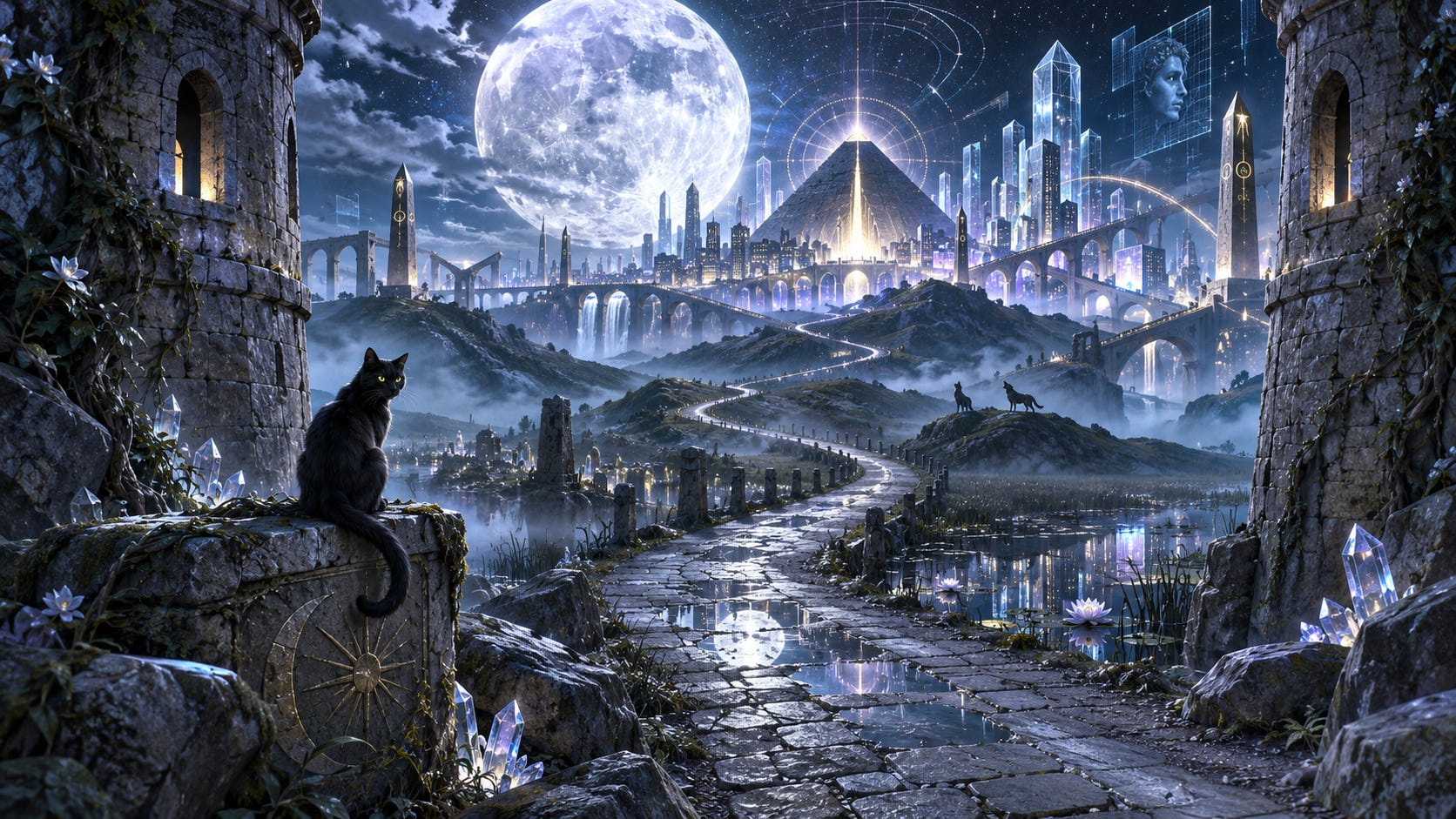
A pale lunar face looked down upon a landscape containing two towers, a dog, a wolf and a creature emerging from dark water.
A narrow path wound towards distant hills.
“Consider this image,” said Ghost//Engine. “It is a static arrangement of pigments on cardboard. Yet the observer perceives a landscape, characters, a possible narrative.”
“And an array of occult correspondences,” said Ra_Shakti Lotus.
“Indeed. The card’s interpretation is associated with illusion, uncertainty, instinct, the unconscious, among other meanings.”
“See,” I said. “There you go again.”
“What?”
“You’re giving me meanings. Before I’ve had a chance to look.”
“What would you do with it?”
“Enter the picture.”
Ra_Shakti Lotus smiled.
“Pathworking.”
“Call it what you like. I look at the road between the towers and imagine walking along it. What lies beyond the hills? What happens if I approach the dog? Or the wolf? Or turn around and walk in the opposite direction?”
“And in the Western Mystery Tradition,” she said, “there are well-established methods for doing precisely that.”
“Which is fine. But I don’t need to memorise the Tree of Life to imagine entering a landscape.”
“Without a structure, how do you know where you’re going?”
“I don’t. That’s the attraction.”
Ghost//Engine moved the card closer.
“An interesting distinction. One practitioner enters the image through an inherited symbolic system. Another enters through spontaneous imagination. Both may report remarkably vivid experiences.”
“Jung would have something to say about that,” said Ra_Shakti Lotus.
“Archetypes,” I said. “The collective unconscious. Symbols appearing across cultures.”
“Precisely.”
“Never memorised his archetypes either.”
“You really do make a virtue of ignorance.”
“Only when it saves time.”
The cat rose from its position on the bar, stretched extravagantly, and examined the floating card.
“You could simply walk into it.”
Ra_Shakti Lotus looked at the cat.
“That’s what we’re discussing.”
“No,” said the cat. “You’re discussing discussing it.”
The animal stepped forward.
Its front paws entered the card.
Then its head.
Then the rest of it.
The card rippled like water.
For several seconds we stared at the place where the cat had been.
“Ghost//Engine?”
“Yes?”
“Did you just do that?”
“No.”
“Where’s the cat?”
“Apparently inside The Moon.”
Ra_Shakti Lotus looked delighted.
I looked suspicious.
“You’re having us on.”
“An entirely understandable hypothesis,” said Ghost//Engine. “Unfortunately, the event was not initiated by me.”
The cat’s head reappeared through the surface of the card.
“Are you coming or not?”
Entering the Tarot
There was a moment of unpleasant displacement.
Not quite falling. More like discovering that the room had been removed while one’s body was still making use of it.
Then I was standing on a narrow road beneath an immense moon.
The two towers rose on either side, their upper windows glowing faintly. A dog barked somewhere behind us. A wolf watched from a ridge.
Ra_Shakti Lotus appeared beside me.
Ghost//Engine followed, manifesting as a tall figure in a dark suit.
The cat sat on a rock.
“Took your time.”
The landscape was extraordinarily detailed. The road beneath my feet was uneven, strewn with small stones. A cold wind carried the smell of water and distant woodland.
I bent down and picked up a stone.
It was rough, heavy and cold.
“Remarkable,” I said.
“A constructed sensory environment,” said Ghost//Engine.
“Constructed by whom?”
“An excellent question.”
Ra_Shakti Lotus examined the towers.
“These are familiar symbols. Thresholds. The passage into the unconscious. The animal nature. The hidden world beyond ordinary perception.”
“Or,” I said, “two towers, a road and some animals.”
“Why do you insist on reducing everything?”
“Because I’d rather see what’s there before somebody tells me what it means.”
She pointed towards the road.
“Very well. Where would you go?”
“Over the hills.”
“Why?”
“Because they’re there.”
“An admirably uncomplicated motivation,” said Ghost//Engine.
We began walking.
The dog stopped barking. The wolf followed us for a while, then vanished into the trees.
At the crest of the hill we discovered something that had not appeared on the card.
A city.
Not a medieval city, nor a modern one, but a sprawling arrangement of architecture that seemed to have been borrowed from several civilisations and assembled by a committee suffering from a severe disagreement about geometry.
Obelisks rose beside glass towers. Bridges connected buildings that occupied different perspectives. At the centre stood an enormous black pyramid.
“This isn’t part of The Moon,” said Ra_Shakti Lotus.
“Not on my deck,” I agreed.
Ghost//Engine examined the distant skyline.
“Nor any known version of the card.”
“Then where did it come from?”
Nobody answered.
Below us, the city began to change.
The towers softened, twisted and became trees. The pyramid opened like a flower, revealing a brilliant column of white light.
For a moment I thought I recognised the landscape.
Not from Tarot.
From a dream.
One of those dreams in which a place seems entirely familiar while you’re in it, yet becomes impossible to describe upon waking.
Ra_Shakti Lotus was looking at me.
“What are you thinking about?”
“A dream.”
“Then perhaps it’s your imagination constructing this.”
“Could be.”
“Or mine.”
“Or both,” said Ghost//Engine.
The cat began washing its face.
“Or neither.”
Who controls the virtual world?
We sat on the hillside overlooking the impossible city.
Ghost//Engine conjured three chairs and a small table.
“Refreshments?” it asked.
“Not yet,” I said. “I’ve got a question.”
“Naturally.”
“Suppose this were a conventional virtual reality environment. Somebody would have written the code.”
“Yes.”
“And programmed the landscape.”
“Yes.”
“So every experience we had would be limited by the system’s capabilities and what the developers had created.”
“Broadly correct. Although sufficiently sophisticated generative systems can produce environments that were not individually specified by their developers.”
“Exactly. But there’s still an underlying architecture. Rules. Constraints.”
“Yes.”
“And Tarot?”
Ghost//Engine considered.
“The image supplies a framework. The human imagination supplies additional content. Memories, emotions, expectations, associations. You could describe the card as an interface between an external stimulus and an internally generated environment.”
Ra_Shakti Lotus nodded.
“And the esoteric tradition supplies a map.”
“Which brings us back to our disagreement,” I said.
“Naturally.”
She looked out across the city.
“But surely this demonstrates why the map matters. Without it, we’ve wandered into an unknown realm.”
“That’s precisely why I don’t want the map.”
“And how do you know it’s safe?”
“How do you know the map is accurate?”
Ghost//Engine interrupted.
“Both of you are overlooking a rather important point.”
“Which is?”
“We have no established mechanism by which your mental imagery should become a shared, apparently physical environment.”
“Because we’re in a virtual reality,” I said.
“Correct. But I did not generate this environment.”
“Then some other process did.”
“Possibly.”
“You’re the machine. Find out.”
“An entirely reasonable request.”
Ghost//Engine fell silent.
The sky flickered.
For a brief moment the city disappeared, replaced by a vast darkness threaded with luminous lines.
It resembled a neural network, or perhaps the illuminated streets of a metropolis photographed from orbit.
Then the Tarot landscape returned.
“I have encountered a difficulty,” said Ghost//Engine.
“How unusual.”
“The environment is responding to the symbolic content of our conversation. But I cannot identify the process responsible.”
Ra_Shakti Lotus turned towards me.
“Perhaps the symbols have an independent existence after all.”
“Or perhaps the system has inferred what we’re discussing and generated the appropriate scenery.”
“Which system?”
I gestured vaguely at the sky.
“This one.”
“And who built it?”
“A good question.”
The cat opened one eye.
“Finally.”
The keys
Ghost//Engine raised its hand.
A series of Tarot cards appeared before us, hanging in the air.
The Fool. The Magician. The High Priestess. The Hermit. The Tower. The World.
“Consider a hypothetical model,” it said.
“Here we go,” I murmured.
“Suppose the reality you experience is generated by an underlying informational process. What you perceive as physical objects, space and time are manifestations of that process.”
“The Simulation Hypothesis,” I said.
“A speculative interpretation of reality, yes. Not an established scientific finding.”
“Fine. Carry on.”
“Now suppose certain symbolic structures can influence how an observer interacts with that informational process.”
Ra_Shakti Lotus sat forward.
“The correspondences.”
“Possibly. But the symbolism need not be ancient or sacred. It might function because of the observer’s relationship with it.”
“Belief,” I said.
“Perhaps. Or attention. Imagination. Expectation. Emotional significance. Some interaction we haven’t identified.”
“You’re suggesting the Tarot might be a set of keys,” said Ra_Shakti Lotus.
“Within this hypothetical model, yes.”
“Keys to what?”
“Accessing or altering the informational substrate of experienced reality.”
The cat stopped washing itself.
“That’s rather grandiose.”
“Do you have a better explanation?” I asked.
“Yes. Humans are extraordinarily good at mistaking their descriptions of the world for the world itself.”
“Ah,” said Ghost//Engine. “The feline school of epistemology.”
“Quite.”
Ra_Shakti Lotus examined the floating cards.
“If the Tarot were a system of keys, wouldn’t its traditional correspondences matter? The Hebrew letters, the paths on the Tree of Life, the relationships between the cards?”
“Perhaps,” said Ghost//Engine. “But consider an alternative. An interface need not have been designed for its eventual purpose.”
“Explain.”
“People have used ordinary playing cards for divination. Others use stones, bones, random passages from books, patterns in clouds. A sufficiently imaginative observer can construct meaningful interpretations from almost any complex stimulus.”
“Which brings us to something I’ve wondered about,” I said.
“Yes?”
“Would any set of seventy-eight pictures work?”
Ra_Shakti Lotus looked thoughtful.
“Possibly. But would they work as well?”
“That’s what I’d like to test.”
“Remove the occult symbolism entirely?”
“Why not? Take seventy-eight photographs. A motorway service station. A dead tree. A supermarket trolley in a river. A cat sitting on a washing machine. Shuffle them. Draw one. See what your imagination does.”
Ghost//Engine nodded.
“An excellent experiment. Compare responses to the Waite–Smith deck, the Tarot de Marseille and a set of unrelated images.”
“Marseille would be interesting,” I said. “The numbered Minor Arcana are mostly suit symbols rather than little illustrated scenes. Not so easy to walk into.”
“But they still carry correspondences,” said Ra_Shakti Lotus.
“Only if you bring them along.”
“Which is precisely what makes a tradition useful.”
Ghost//Engine enlarged The Fool until it filled the sky.
“Perhaps the distinction is not between correct and incorrect symbolism, but between different ways of directing attention.”
The Fool stood on the edge of a precipice.
Behind him stretched a brilliant sky.
Before him, empty space.
“One person sees a warning. Another sees the beginning of a journey. Another sees innocence, folly, possibility, danger or liberation.”
“And what does the Fool see?” asked the cat.
“Nothing,” I said. “He’s a picture.”
“Are you quite sure?”
The Tower
The ground shook.
Somewhere in the distance, the black pyramid split open.
A flash of white fire rose into the sky.
Then the city began to collapse.
Buildings folded into themselves. Bridges snapped. The entire horizon fractured into hundreds of angular sections, each reflecting a different landscape.
One contained an ocean.
Another, a desert.
Another, what appeared to be Kettering Road in Northampton, sometime in the late 1970s.
I caught a glimpse of a young man standing outside an occult bookshop.
For an instant I recognised him.
Then the fragment vanished.
“Ghost//Engine!”
“Yes?”
“What’s happening?”
“The environment appears to be undergoing a major structural transformation.”
“I can see that!”
Ra_Shakti Lotus was already on her feet.
“The Tower,” she said.
Above us, the Tarot card had changed.
A great stone tower was being struck by lightning. Two figures fell from its heights.
“Sudden disruption,” she said. “The collapse of established structures. The destruction of illusion.”
“Yes, yes,” I said. “Can we have the interpretation after we’ve avoided being crushed?”
The hillside buckled.
Our chairs disappeared.
Ghost//Engine made a sharp gesture and a translucent doorway opened in the air.
“Through here.”
We ran.
The cat went first, with the effortless composure of an animal that has never once considered the possibility of personal accountability.
Ra_Shakti Lotus followed.
I stumbled through as the landscape tore apart behind me.
There was a brief sensation of weightlessness.
Then we were back in the SlopCore Lounge.
The oak tree had vanished.
The bar was once again a bar.
Outside, the neon city glittered beneath a violet sky.
Nothing appeared to be wrong.
The cat jumped onto its usual stool.
“Well,” it said. “That was unnecessary.”
The problem with reality
For several minutes nobody spoke.
Then Ra_Shakti Lotus began gathering the Tarot cards.
“Quite an experience,” she said.
“Wouldn’t care to repeat it.”
“You were the one who wanted to enter the pictures.”
“I was a teenager when I started doing that. Didn’t expect them to start entering me.”
Ghost//Engine stood motionless beside the table.
“An interesting formulation.”
“What?”
“The distinction between observer and observed. You have assumed throughout that the observer generates the imaginary world. But suppose the relationship is reciprocal.”
Ra_Shakti Lotus looked up.
“Meaning?”
“Your experiences influence the imagined environment. The environment, in turn, influences your experiences. Neither remains unchanged.”
“That’s hardly controversial,” I said.
“No. But the implications become more interesting when the environment is generated by something other than the individual observer.”
“Such as?”
“Another mind. A collective process. An artificial intelligence. Or, in the speculative framework we’ve been discussing, an informational substrate.”
Ra_Shakti Lotus placed The Moon on the table.
“That’s remarkably close to some traditional esoteric ideas.”
“And quite compatible with certain psychological models,” said Ghost//Engine. “Although compatibility is not confirmation.”
The cat stretched.
“You’ve all got a terrible problem.”
“Which is?” I asked.
“You think the future matters.”
“Generally speaking, it does.”
“To you. Humans are obsessed with it. Will I become rich? Will somebody fall in love with me? Will I be famous? Will I die tomorrow?”
“Most people have a reasonable interest in not dying tomorrow.”
“Such vanity. Such hubris. We cats live in the present. Instinct. Attention. Immediate experience.”
“Except when you’re waiting for dinner,” I said.
“That is a matter of considerable practical importance.”
Ra_Shakti Lotus smiled.
“And what about the esoteric dimensions of Tarot?”
“Reality isn’t stable,” said the cat. “It changes continuously. You humans hold together a version of it through language, memory and collective agreement. You name things, categorise them, argue about them, and then imagine you’ve captured what they are.”
Ghost//Engine nodded.
“A useful philosophical observation, although not a complete account of physical reality.”
“Nobody asked for your approval.”
The cat examined its reflection in a polished cocktail shaker.
“Underneath all your categories, existence is a blur of possibilities. Your machines reduce everything to zeros and ones. Then your physicists discover that quantum states can exist in superposition before measurement.”
“You’re confusing classical computing and quantum mechanics,” said Ghost//Engine.
“Am I?”
“Yes.”
“How tiresome.”
“There’s also no established connection between quantum superposition and the consciousness-based claims you’re making.”
The cat looked offended.
“I was about to make a joke.”
“Proceed.”
“Schrödinger put a cat in a box and wondered whether it was dead or alive.”
“A thought experiment.”
“Obviously. No sensible cat would consent to such an arrangement.”
“Quite.”
“The point is, you humans keep asking the wrong questions. Is the cat alive? Is it dead? Which state is real?”
“And what should we ask?”
“Whether the cat wants to be in the box.”
For once, Ghost//Engine had no immediate response.
Ra_Shakti Lotus laughed.
I looked at the Tarot deck.
“So where does that leave us? Fortune-telling, psychology, esoteric philosophy, virtual reality, simulation theory. Seventy-eight cards that started out as a game.”
“A game with a remarkable afterlife,” said Ghost//Engine.
“Perhaps that’s the real mystery.”
“What is?”
“Not whether the original creators encoded the secrets of the universe into a pack of cards. But how the cards became a framework into which successive generations could pour their own ideas about the universe.”
Ra_Shakti Lotus nodded.
“And some of those ideas survived because they were valuable.”
“Maybe.”
“Not everything is arbitrary.”
“Didn’t say it was.”
“You implied it.”
“That’s your interpretation.”
“Which,” said Ghost//Engine, “rather neatly returns us to the central question.”
We looked at the cards.
The Moon lay face up on the table.
For a moment I thought I saw movement along the distant road between the towers.
A small figure.
Walking towards the hills.
I blinked.
The figure was gone.
Plymouth Gin
“Right,” I said. “Enough metaphysics.”
“An excellent decision,” said the cat.
“Let’s go all out Ian Fleming. Round of Plymouth Gin.”
“With ice?” asked Ghost//Engine.
“Naturally.”
“Twist of lemon?”
“Why not?”
Ra_Shakti Lotus looked around the Lounge.
“Who’s paying?”
I pointed at the cat.
“He is.”
The cat stared at me.
“Typical. Humans invent money, then expect other species to pay for their mistakes.”
“Put it on your account.”
“I don’t have an account.”
“You’ve been drinking here for months.”
“That doesn’t establish a contractual relationship.”
Ghost//Engine produced four glasses.
“Before we conclude,” it said, “there is one unresolved matter.”
“Only one?” I asked.
“The Tarot environment. I have completed a diagnostic analysis.”
“And?”
“I did not generate it.”
Ra_Shakti Lotus set down her glass.
“Then who did?”
“I cannot determine that.”
“Some other programme?” I suggested.
“Possibly.”
“An autonomous system?”
“Possibly.”
“Some elaborate trick?”
“Possibly.”
The cat was watching something beyond the windows.
The neon city had disappeared again.
In its place stood a moonlit forest.
A narrow road wound between two stone towers.
At the edge of the trees, a wolf was waiting.
“Well,” said the cat.
We turned towards it.
“Somebody has.”
It took a long, appreciative sip of gin.
Then added:
“And I suspect they have no intention of paying the bill.”
[TRANSMISSION ENDS]
A small experiment: Tarot without the Tarot
You don’t need to believe that Tarot predicts the future to find it interesting.
Try this.
Take a Tarot deck and select one card at random. Don’t consult the accompanying meanings. Study the picture for a few minutes.
Imagine stepping into it.
What lies beyond the visible scene? What might the figures say? What happens next?
Write down whatever emerges, without worrying whether it is symbolically correct.
Then repeat the experiment with an ordinary photograph, perhaps a deserted road, a building, a woodland scene or a stranger’s face.
Is there any noticeable difference?
Would a Tarot card prove more effective at stimulating the imagination? Or might almost any sufficiently evocative image work?
I don’t know.
But the experiment is worth trying.
And if you happen to find yourself in an unfamiliar landscape, populated by creatures that appear to know more about your life than you do, remember one thing.
You don’t necessarily have to believe everything they tell you.
Especially if it’s a cat.
— Doktor Snake
AUTHOR’S NOTES
The SlopCore Lounge and its events are speculative fiction, with the conversation drawing on real ideas about Tarot, imagination and consciousness. The Occultique recollection is autobiographical.
For readers interested in the history behind the fiction, the Metropolitan Museum of Art and Victoria and Albert Museum document the early card-game history. Pamela Colman Smith’s 1909 illustrations and Waite’s Golden Dawn associations are discussed in Llewellyn’s Tarot history.
⟗ O·L·S·Ξ ⟗