

DOKTOR SNAKE | TRANSMISSIONS FROM THE SLOPCORE LOUNGE
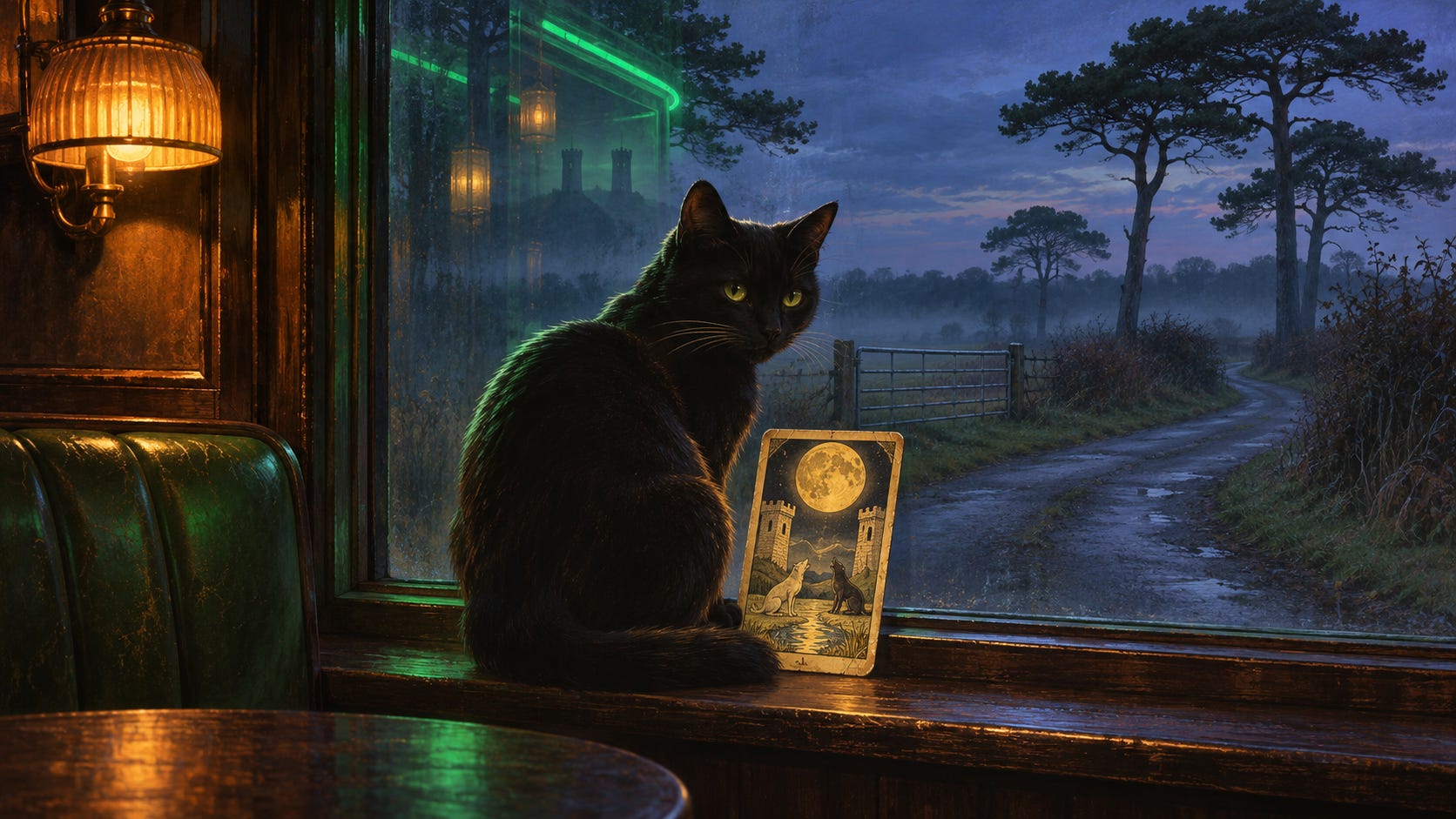
“Tell me when we get to it,” I said.
“The chair?”
“Yes.”
“What are you going to do?”
“Drive past it, ideally.”
I put the car in gear. The lane was clear in the headlights. I’d driven it often enough to know where the verge dropped away on Ellie’s side. I was thinking about that when she said, “Stop.”
I stopped.
“There’s somebody sitting in it now.”
I wound down my window and leaned out. Cold air, wet hedge, the smell of somebody’s wood fire. Behind us, across the field, a car door shut.
I could have told Ellie there was nobody in the road. Ten minutes earlier I’d have said it without a second thought. But she’d asked whether I could see the road, and I could. That was as much as I knew.
“Ellie,” said Ra_Shakti from the phone. “Look out of your side window. What’s down by your feet?”
“Grass. A ditch.”
“Keep looking there. Tell Jim where the ditch goes.”
I let the clutch up. Ellie watched the verge creep past her window.
“It goes under a pipe here,” she said. “There’s a field entrance.”
I knew the one. I’d used it to turn round often enough.
As we drew level with it, Ellie lifted the coffee cup off her knee.
“Excuse me,” she said.
It was the tone you use when somebody has to move their legs to let you past in the cinema. She said it so naturally that I took my foot off the accelerator.
There was a scrape on her side of the car. Then two little judders, one under the front wheel and one under the back. We went round the bend.
“Still there?” I asked.
“Just the hedge now.”
In the mirror, headlights swept across the field. Whoever had got into Ellie’s car was driving back towards the gate.
She reached for the radio clipped inside her jacket.
“What are you going to tell them?” I asked.
“That somebody’s taken my car.”
“Fair enough.”
She called it in. A man answered. He sounded pleased to hear her.
“Have you got the number off the gate?” he asked.
“What gate?”
“The one you’re at.”
“I’m on Wyrleys Drove, Martin. Listen. Somebody’s in the vehicle.”
There was a small pop from the radio, like somebody taking their thumb off a button. We drove another fifty yards before he spoke again.
“Ellie, I’m looking at you.”
She turned in her seat. The lane behind us was black.
“On the camera,” he said. “You’ve just got out at the south gate.”
“Play it back. Is the gate open?”
“Hang on.”
We could hear him tapping at something. Then he said, “It was open when you got there.”
Ellie held the radio away from her mouth. She was looking at the keys in her lap.
“I put a new lock on that gate this morning,” she said to me. “The old one had jammed.”
She pressed the button again.
“Martin, leave the gate open. Stay inside.”
“Why?”
“Because I’m going to ring you in a minute and I want you somewhere you can answer.”
At the main road I pulled into the mouth of the lane and went round to Ellie’s side with my phone torch. Just behind the front wheel arch were two streaks of green paint. In the second one there was a little curl of wood. I picked it off with a fingernail. There were two older colours beneath the green. Cream and a dark blue. Somebody had painted that chair three times, or painted something that had ended up on the side of my car.
Ellie got out and looked at the wood in my hand.
“I said excuse me because he was sitting with one leg out,” she said.
“Did you see his face?”
“Only for a second. He put his feet in when I asked. I thought that was decent of him.”
Whiskers climbed onto the back of the passenger seat.
“What did he have in his hand?” he asked.
Ellie looked at him. “You saw him too?”
“I saw his hand.”
She took her keys out and held them under the torch. On the back of the red trolley token was the name of a garden centre.
“His had the same thing on it,” she said. “I thought he’d picked mine up.”
The radio spoke from the seat where she’d left it. Martin again, very quiet this time.
“Ellie? She’s asking me where the person in the field went.”
Ellie picked it up.
“Ask her who called it in,” she said.
Martin came back a minute later.
“She says it was Len Vale.”
“Did you speak to Len yourself?”
“I took the call.”
Ellie turned the radio off and rang Martin’s mobile. She walked up and down the verge while she spoke to him. Once she laughed. I was glad to hear it, although I couldn’t think of anything funny to say myself.
I knew the name Len Vale. He filmed aircraft around Lakenheath. During the drone flap he’d put up clips where you could spend ten minutes looking at a dot and come away mainly with a better idea of what his neighbours thought of him. I used to leave them playing while I made dinner. There was something companionable about Len saying, “Where’s that gone, then?” to a sky I could look out of the window and see for myself.
Ellie got back in.
“Martin’s all right. He’s making a cup of tea. I rang Len as well. He’s at home. I told him we’d come round.”
“Did he say what he saw?”
“He said he’d rather show us.”
I looked in the rear-view mirror. Whiskers was busy getting something out from between his toes.
“Does he know about the cat?” I asked.
“He asked if you’d brought him.”
Len lived in a bungalow with a low front wall and a plane-spotting tripod in the hall. He opened the door before Ellie had a chance to knock. He was in his socks. There was a square of sticking plaster across the bridge of his glasses.
“Where is he, then?”
Whiskers came in behind me. Len crouched down and held out a hand for him to smell. Whiskers sniffed it and walked past him into the kitchen.
“Right cat?” I said.
“Right size. Hard to tell in the dark.”
In the back room there was a computer, a pair of binoculars and a plate with the remains of a cheese sandwich on it. Len moved the plate onto the windowsill and played us the clip he’d taken that evening.
His torch picked out a ditch, the lower bars of a gate and the legs of somebody in dark trousers. You could hear him call across the field. All right over there? Then, close to the microphone, came the little questioning trill Whiskers made when he wanted somebody to open a door. The camera swung down. A cat went past the end of Len’s boot, slipped between the bars and made straight for the figure.
“Was that you?” I asked.
Whiskers had come back from the kitchen. He sat beside Len’s chair.
“Play the end,” he said.
Len’s hand came off the mouse. He looked down at Whiskers, then at Ellie. She gave him a little nod.
He played the end.
The figure bent down. The camera lost it for a second in the glare off the gate. Then a voice said, quite clearly, Sorry. You probably want a bit of peace.
Len stopped the clip.
“When did you take that?” Ellie asked.
“Twenty past five. I rang Martin straight after.”
She put her keys down on the desk. I’d heard her say those words to Whiskers by my car. I could remember what she’d done with her hand while she said them. By then it had been dark for a good while.
I nearly asked Len to play it again. I wanted to hear it a second time without knowing what it was. There was no doing that now.
“Have you got the whole thing?” Ellie asked.
“That is the whole thing. Tonight, anyway.”
Len opened another folder. The first clips were dated November 2024.
“I’ve got one with you in it,” he said to me. “Took me a while to work out it was your car.”
He opened a file and dragged the playhead forward. I saw my old car pulled over by the gate. The colour was all wrong under his torch, but I recognised the rear wiper. I’d put it on myself and it had always stopped an inch short of where it should.
“You can leave the picture running if you want,” Len said. “It’s the sound I’d like you to hear.”
He turned it up. For a while there was only the wind rubbing against the microphone. Then, a long way off, somebody began to drag a chair over paving stones.
A digital artefact from the world of The Keys to the Tarot
In GoodBye, you put a finger on the planchette and see where it wants to go.
Play GoodBye on DoktorSnake.com