

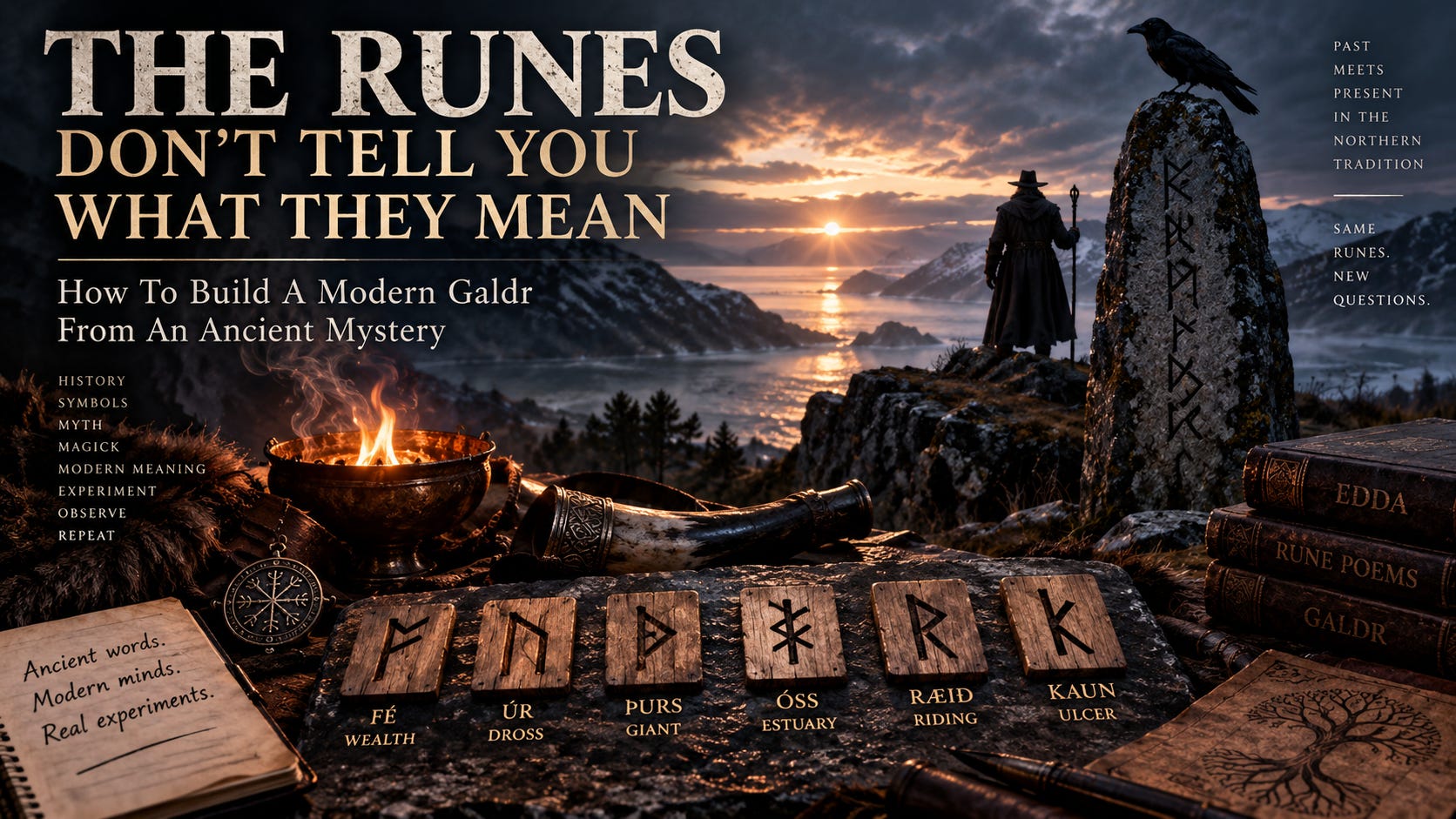
There is something wonderfully inconvenient about the runes.
They don’t come with instructions.
Pick up a modern book on rune divination and everything tends to look remarkably organised.
This rune means wealth.
This one means strength.
This one means communication.
This one means disruption.
Turn it upside down and apparently your boiler is going to explode next Thursday.
The historical material isn’t nearly so accommodating.
Take the medieval Norwegian Rune Poem.
It runs through the sixteen runes of the Younger Futhark and gives us these strange little couplets.
Bruce Dickins translated the first one in 1915:
ᚠ — Wealth
Wealth is a source of discord among kinsmen;
the wolf lives in the forest.
Well.
Thanks for clearing that up.
WHAT THE HELL DOES THE WOLF HAVE TO DO WITH IT?
Perhaps something.
Perhaps very little.
That’s the first lesson.
The rune poems aren’t ancient occult manuals explaining the metaphysical properties of sixteen magical symbols.
They’re medieval poems about the names of the runes, composed long after the runic alphabets themselves emerged. And the Norwegian poem is particularly terse: sixteen tiny couplets, often joining two gnomic statements whose relationship can be decidedly obscure. (NorseRunes)
Which is exactly why I like it.
Let’s take a handful.
ᚠ — FÉ — WEALTH
Dickins:
Wealth is a source of discord among kinsmen;
the wolf lives in the forest.
Already this is considerably better than:
FÉ = MONEY.
Wealth isn’t presented simply as desirable.
Wealth causes conflict.
Inheritance.
Jealousy.
Possession.
Division.
Meanwhile the wolf survives out there in the forest.
Does the second image explain the first?
Nobody can confidently tell you that it does.
But put the two images together and something happens.
WEALTH — KINSMEN — DISCORD — WOLF — FOREST.
Now we have an imaginal field.
For our purposes today, Fé might become a rune not merely of money but of resources and the trouble surrounding their possession.
That’s considerably more interesting.
ᚢ — ÚR — DROSS
This one immediately causes trouble for people accustomed to Elder Futhark rune books.
Dickins gives:
Dross comes from bad iron;
the reindeer often races over the frozen snow.
What?
Excellent.
The Younger Futhark úr isn’t simply the Elder Futhark ūruz, despite sharing its historical ancestry and position in the row. The rune-name traditions changed.
And here we’re presented with two extraordinary images.
Impurity separated from metal.
And a reindeer racing across frozen ground.
For a modern working, I might completely ignore the desire to discover its One True Occult Meaning and instead work directly with those images.
What is dross?
What needs removing?
What remains when poor material is processed?
Then:
What crosses dangerous ground quickly because it knows how to move across it?
Suddenly Úr becomes interesting again.
Not because I’ve discovered what a Viking magician secretly thought.
I haven’t.
I’ve created an experiment from surviving material.
Important distinction.
ᚦ — ÞURS — GIANT
Now we’re getting somewhere.
Giant causes anguish to women;
misfortune makes few men cheerful.
The Þurs is a giant — one of those dangerous, chaotic beings inhabiting the mythic landscape of the North.
This isn’t Marvel’s Thor smashing cartoon frost giants.
The giants occupy a much stranger position in Norse mythology.
Dangerous.
Powerful.
Sometimes wise.
Sometimes ancestral.
Sometimes sexual.
Sometimes opponents of the gods.
Sometimes intimately entangled with them.
For a modern galdr experiment I’d be inclined to treat Þurs as disruptive force.
The thing that arrives and knocks the system out of equilibrium.
Not necessarily evil.
But potentially dangerous.
You don’t casually invite disruption into your life and then complain because things become disrupted.
DON’T BECOME AN IDIOT.
ᚬ — ÓSS — ESTUARY
Then we get this:
Estuary is the way of most journeys;
but a scabbard is of swords.
It’s almost Zen.
What does an estuary have to do with a scabbard?
Perhaps less than we’d like.
But again, forget divination-book definitions and look at the images.
ESTUARY.
River meeting sea.
Fresh water meeting salt.
Land opening into ocean.
Trade.
Travel.
Departure.
Arrival.
Boundary.
Transition.
Then:
SCABBARD — SWORD.
Container and contained.
Potential violence held in reserve.
Something powerful that’s currently sheathed.
I could do a great deal with that.
Would a medieval Norwegian rune-worker recognise my interpretation?
Maybe not.
That’s fine.
I’m not claiming he would.
ᚱ — RÆIÐ — RIDING
Dickins gives us:
Riding is said to be the worst thing for horses;
Reginn forged the finest sword.
Wonderful.
Journey and consequence.
Movement costs something.
The rider experiences the journey one way.
The horse experiences it another.
Then suddenly Reginn walks into the poem.
Reginn is the smith associated with Sigurd and the forging of Gram in the heroic cycle.
Again we have apparently disparate images.
Riding.
Horse.
Smith.
Sword.
Instead of reducing that to:
RUNE MEANING: JOURNEY
I’d leave it alive.
What carries you?
What price does it pay?
What are you forging while travelling?
What weapon or capacity is being constructed through the journey itself?
Now we’re doing something interesting.
ᚴ — KAUN — ULCER
This one’s cheerful.
Ulcer is fatal to children;
death makes a corpse pale.
Thanks, Norway.
No crystals.
No abundance mindset.
No affirmation that THE UNIVERSE LOVES YOU.
An ulcer.
A dead child.
A corpse.
And that’s useful.
Because historical symbolic systems weren’t designed by twenty-first-century wellness marketers.
Disease existed.
Hunger existed.
Winter existed.
Violence existed.
Death was visible.
A magical alphabet reflecting that world ought occasionally to be unpleasant.
For a contemporary experiment, Kaun gives us the thing that festers.
The small wound that doesn’t heal.
The unattended problem.
The corruption inside the system.
Something that requires attention precisely because ignoring it makes it worse.
Again:
That’s my interpretation.
Not a telegram from Odin.
RUNES WERE TELEGRAMIC
There’s another reason I like all this.
Runes are physically economical.
If you’re carving words into wood, bone or stone, you’re not composing a 14,000-word Substack essay.
The medium encourages compression.
Straight strokes.
Short inscriptions.
Names.
Ownership.
Memorials.
Messages.
Formulae.
The rune itself is already compressed information.
And once you combine it with a cryptic image from a rune poem, it starts behaving almost like an imaginal ZIP file.
That’s something we can use.
BUT WERE RUNES ACTUALLY MAGICAL?
Sometimes.
This is where we need to be careful.
Runes were primarily writing.
But there is also genuine historical evidence for runes being used in magical contexts — charms, protective inscriptions, curses and other formulaic uses.
And Old Norse literature certainly gives us a world in which runes, spoken charms and magical knowledge overlap.
Then we encounter galdr.
The word is associated with magical song, chanting or incantation.
And this gives us an obvious experimental direction.
Not:
LET’S RECONSTRUCT EXACTLY WHAT VIKING SORCERERS DID.
We can’t.
Instead:
Let’s build a modern galdr while clearly labelling it modern.
GALDR 2.0
Pick one rune.
Not sixteen.
One.
Research it.
Look at the rune itself.
Learn its name.
Read the Norwegian stanza.
Read the corresponding Icelandic material.
If appropriate, compare the Anglo-Saxon rune tradition.
Then stop reading modern occult interpretations for a while.
Let the original images sit there.
Now:
BOOT.VOID.
Still the body.
Reduce the chatter.
Look at the rune.
Speak its name.
Again.
Again.
Again.
Don’t worry about activating its “correct vibrational frequency.”
Listen to what the sound actually does in your body.
Then speak the poem.
Slowly.
Let the images appear.
Wealth.
Discord.
Wolf.
Forest.
Or:
Dross.
Iron.
Reindeer.
Ice.
Don’t explain them.
Enter them.
Let your imagination build the environment.
Then ask a question appropriate to the experiment.
For Fé:
WHERE ARE MY RESOURCES CREATING CONFLICT?
For Úr:
WHAT IS DROSS AND WHAT IS METAL?
For Þurs:
WHERE IS DISRUPTION ENTERING THE SYSTEM?
For Óss:
WHAT BOUNDARY AM I CROSSING?
For Ræið:
WHAT IS CARRYING ME — AND WHAT IS THE JOURNEY COSTING IT?
For Kaun:
WHAT IS FESTERING?
Then shut up.
See what arises.
That’s our galdr.
Not reconstructed Viking magick.
Twenty-first-century imaginal technology built from medieval Northern source material.
Much more interesting.
THEN PUT THE WHITE COAT ON
When you’re finished:
LAB.COAT.
Stand up.
Imagine putting on the scientist’s white coat.
One arm.
Other arm.
Button it.
Return to ordinary consciousness.
Now inspect whatever happened.
Did an interesting association arise?
A memory?
An uncomfortable realisation?
Nothing?
Did something subsequently occur that seemed synchronistic?
Write it down.
Don’t immediately decide Odin has hacked your neural network.
We’re collecting data.
THE RUNES ARE BETTER WHEN THEY REMAIN STRANGE
I think modern occultism sometimes makes ancient material too tidy.
We want correspondence tables.
Definitions.
Keywords.
Positive meaning.
Negative meaning.
Reverse meaning.
Nice little cards.
But the original material resists us.
Wealth causes discord among kinsmen.
The wolf lives in the forest.
What does that mean?
Maybe the correct answer is:
We don’t entirely know.
Excellent.
Now we have somewhere to explore.
Learn the history.
Read the sources.
Don’t pretend modern interpretations are ancient secrets.
Then take those strange fragments into the laboratory and see what you can build from them.
BOOT.VOID.
Speak the rune.
Enter the image.
Observe what happens.
LAB.COAT.
Return.
Results you can use, but not prove.
⟡◌◯⟡⟡