

A friend of mine has been trying, by hook or crook, to obtain the precise details of my birth.
She wants to construct my astrology chart.
I’ve always resisted this.
It isn’t that I object to astrology. I simply dislike being defined. Give somebody your date, place and hour of birth, and before long they’re telling you what you are, what you feel and what destiny has allotted you.
Worse still, they may be inaccurate.
Nevertheless, I have finally decided to release the available information.
I should warn Rachel—and any other astrologers who may be tempted—that the record is damaged, the witnesses disagreed and the monk who might have clarified the matter subsequently disappeared.
What follows is my earliest surviving biographical record.
It has become known as The Shreeve Fragment.
THE FRAGMENT
Translated from a marginal entry attributed to the lost Chronicle of St Æthelberht’s House in East Anglia. The surviving text is believed to be a late medieval copy of a much earlier record.
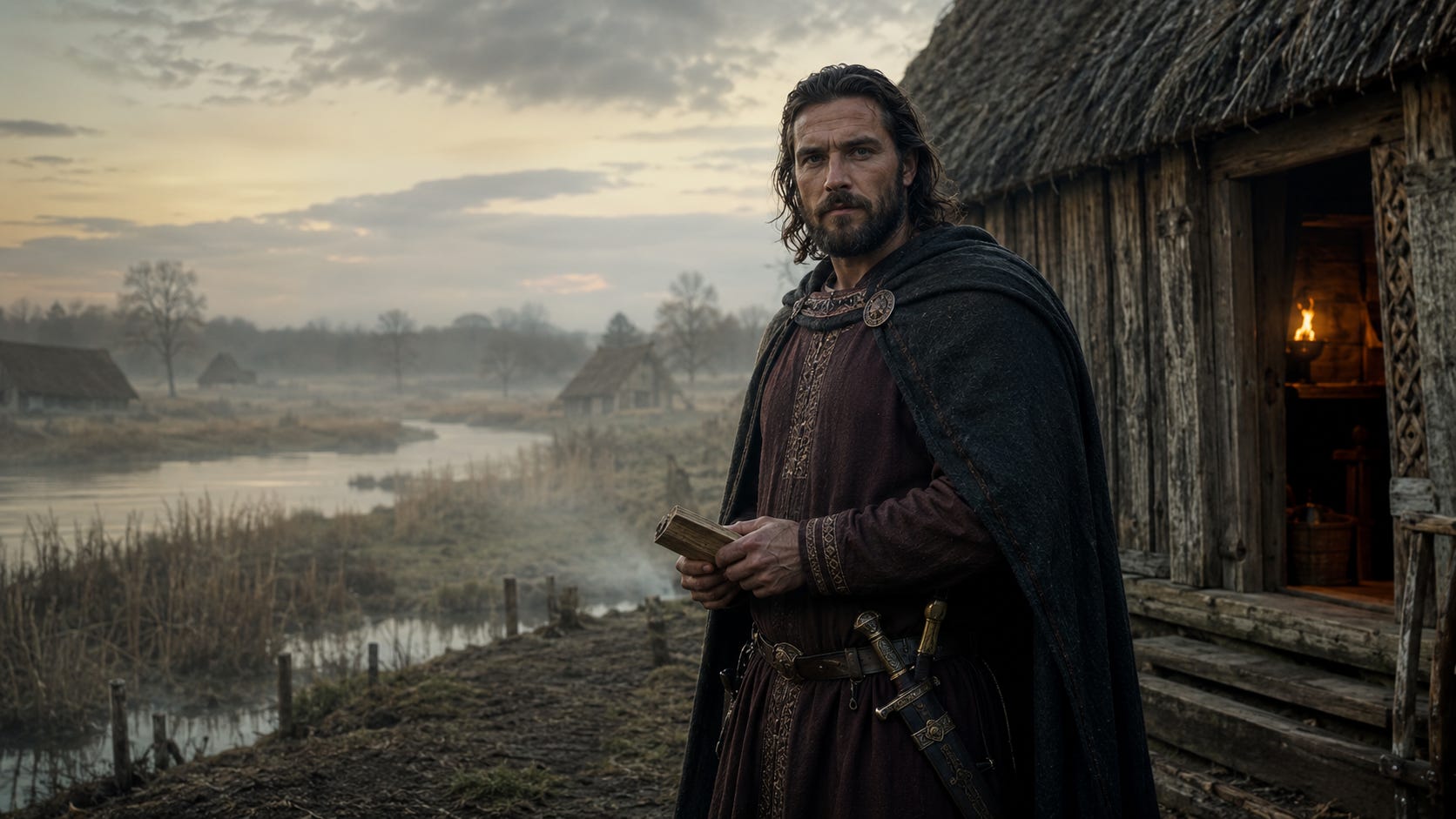
In the Year of Our Lord nine hundred and ninety-three, in the reign of Æthelred, upon the twenty-third day of July, a male child was born near the waters of the Lark, where the reed beds stand against the eastern fen.
His mother was Ælfgifu, daughter of Wulfmær, of the English people. His father was called Hrafn Ketilsson, descended from the Northmen who settled among the Angles after the armies of Ívar and Guthrum.
Thus the child was of two streams: Saxon by the hearth and Norse by the blood-road.
He came into the world during the uncertain hour between the last darkness and the first appearance of the sun.
The women present disagreed concerning the moment.
One maintained that the cock had already called. Another swore that Venus still burned above the fen.
The child neither cried nor struggled.
Instead, he opened his eyes and regarded each person in the chamber as though he had encountered them before.
This caused some unease.
He was baptised Ælfric, although among his father’s people he was sometimes called Orm, meaning Serpent.
In later years he entered the service of the shire and became known as se scīrgerēfa—the shire reeve.
It was written that Ælfric Ormsson possessed a strange memory, speaking at times of places he had never visited and men who had died before his birth.
He was slow to age, difficult to deceive and frequently absent when priests wished to question him.
In the winter of 1010, when the Danish host moved through East Anglia, his dwelling was found abandoned.
No body was recovered.
Yet in the reign of Cnut, a man answering his description was seen at Thetford, apparently no older than before.
The same man was reported again during the building of the Norman castle, and once more during the Great Pestilence, wearing black garments and calling himself merely:
The Shreeve.
The remainder of the leaf has been removed.
The man called Orm
There are aspects of this record which, even I must admit, are intriguing.
The name Shreeve developed from shire reeve: the royal official charged with administering a shire, keeping order, witnessing transactions and collecting what was owed to the king.
The modern word sheriff comes from the same source.
According to the fragment, Shreeve wasn’t originally my family name. It was an office I occupied. Over the centuries, the title hardened into a surname while its bearer repeatedly changed his identity.
More interesting still is the name Orm.
It’s an old Norse name meaning snake or serpent.
That creates an unexpectedly neat line running from Ælfric Ormsson, born beside the East Anglian fen in 993, to the somewhat later figure known as Doktor Snake.
I hadn’t previously considered the connection.
Perhaps names aren’t merely labels. Perhaps certain names lie dormant beneath other names, waiting for an opportunity to surface again.
Ælfric became the Shire Reeve.
The Shire Reeve became Shreeve.
Orm went underground.
And Orm eventually returned as the Snake.
The missing centuries
There are, admittedly, some considerable gaps in the historical record.
A dark-haired man resembling the description of Ælfric appears intermittently in East Anglian folklore, although never under quite the same name.
He was supposedly observed near Thetford during the reign of Cnut.
A Norman account places an unusually knowledgeable Saxon adviser close to Castle Hill shortly after the Conquest.
In the fourteenth century, a traveller dressed in black was said to have passed unharmed through several plague-stricken settlements.
During the seventeenth century, a “Mr Shreeve” was accused of possessing prohibited books and conducting suspicious experiments concerning dreams, spirits and the movement of influence at a distance.
The matter was apparently dropped when the principal witness became confused and could no longer remember what he had seen.
By the eighteenth century, the trail becomes mixed with stories surrounding the Count of St Germain—that mysterious European figure who appeared to possess unlimited wealth, spoke numerous languages and occasionally hinted that he was much older than he looked.
Whether St Germain and the Shreeve ever met remains unknown.
It’s equally possible that they were the same man operating different markets.
A difficulty for astrologers
The fragment records my birth as 23 July 993, near the River Lark in East Anglia.
Unfortunately, the precise time remains disputed.
One witness insisted I was born immediately before sunrise. The other maintained that the sun had already crossed the horizon.
The monk charged with resolving the discrepancy disappeared during the disturbances surrounding St Brice’s Day in 1002. His private notebook has never been recovered.
This presents an obvious problem for anyone attempting to construct my natal chart.
There is also a more fundamental difficulty.
Even if a chart accurately described Ælfric Ormsson at the moment of his birth, would it still describe the being he had become after a thousand years of adaptation?
How many times can a man change his name, occupation, language, allegiance and conception of reality before his original destiny ceases to apply?
Perhaps a sufficiently long life allows you to escape your chart.
Or perhaps the chart continues to operate, but does so on a scale too large for an ordinary human lifetime to reveal.
Either way, Rachel now has my birth details.
They are:
23 July 993.
Near the River Lark, East Anglia.
At some uncertain point between Venus fading and the sun appearing over the fen.
That is as precise as the surviving evidence permits.
If she nevertheless succeeds in producing an astrology chart, I’ll examine it with interest.
But I reserve the right to say:
“That may describe Ælfric. It doesn’t necessarily describe me.”
⟡◌◯⟡⟡
Awesome information, this is a long history and journey of this person that has traveled through life's journey, experiences and to-date strategies unending historical history. This is awesome. I LIKE THIS AND HOPE TO HEAR BACK MORE MOVING RESULTS.