

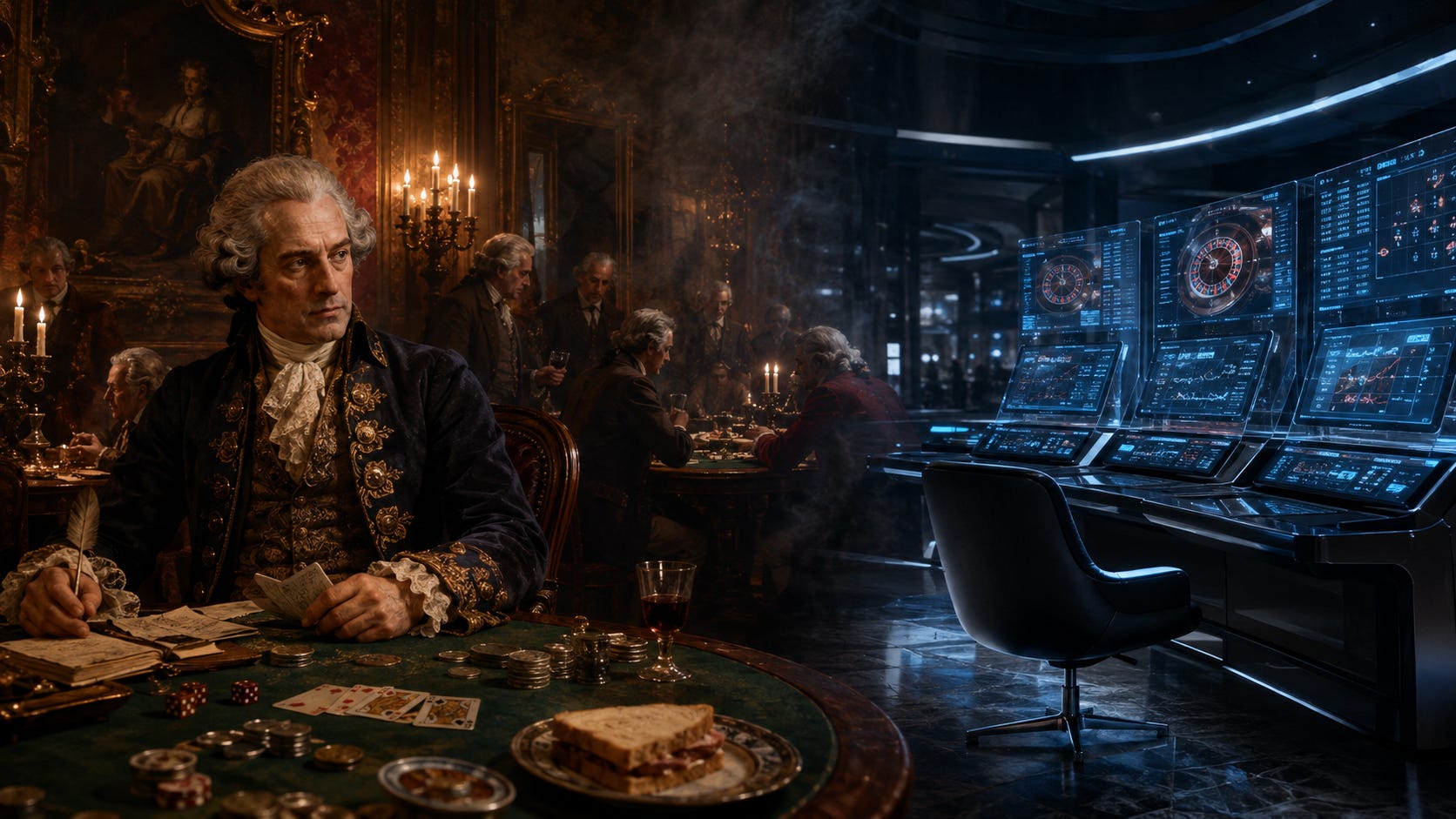
John Montagu has come down to us as a drunken gambler who neglected the Royal Navy and accidentally invented lunch. The truth is more interesting — and tells us something about how gambling itself has changed.
There is a wonderfully comic story about John Montagu, the 4th Earl of Sandwich.
Montagu was First Lord of the Admiralty, responsible for the Royal Navy at a time when Britain’s power depended upon it. He was apparently a model of diligence: first to arrive at the Admiralty in the morning, last to leave at night, forever bent over dispatches, estimates and reports.
And yet, according to the story, the Navy had never been so badly managed.
The explanation was simple. Sandwich spent his nights gambling and drinking. He would arrive at work exhausted, possibly still drunk, and labour with heroic dedication to make everything worse.
It’s the sort of historical vignette that is almost too good to question. The hardworking incompetent is always funnier than the ordinary idler. Add the Hellfire Club, marathon gambling sessions and the invention of the sandwich, and the figure is complete: an eighteenth-century aristocratic rake, ruining the Navy with one hand while holding cold beef between two slices of toast in the other.
Unfortunately for the comedy, it probably isn’t true.
Or, at least, it isn’t the whole truth.
The man called Jemmy Twitcher
John Montagu was certainly a colourful character. Born in 1718, he inherited the earldom at ten, travelled through Greece, Turkey and Egypt as a young man, and later held an assortment of important offices. He served three separate terms as First Lord of the Admiralty, the last and most controversial running from 1771 until 1782.
He was associated with Sir Francis Dashwood’s notorious fraternity at Medmenham Abbey — the group remembered as the Hellfire Club. He enjoyed gambling. He drank. He kept a long-term mistress, the singer Martha Ray, with whom he had at least five children. In 1779, Ray was murdered outside the Royal Opera House by James Hackman, a clergyman obsessed with her. Montagu was devastated and never entirely recovered.
He also possessed formidable political enemies.
The most celebrated was John Wilkes, radical politician, pornographer, provocateur and former associate of the Medmenham circle. When Sandwich helped prosecute Wilkes for obscene libel, Wilkes and his supporters branded him a hypocrite. Sandwich became “Jemmy Twitcher”, after the treacherous informer in The Beggar’s Opera.
The name stuck. So did the portrait of Sandwich as corrupt, depraved and spectacularly incompetent.
This mattered because Britain subsequently lost its American colonies. During the war the Royal Navy suffered serious failures, and Sandwich made an excellent villain. Opposition politicians accused him of corruption, favouritism, mismanagement and allowing the fleet to decay. Charles James Fox called for his removal. The charges passed into later history as though they had been an impartial audit rather than weapons fired during a savage political war.
Modern naval historians have been less certain.
N. A. M. Rodger, in his major biography The Insatiable Earl, argued that Sandwich had been grossly misrepresented. Far from neglecting his responsibilities, he was a conscientious and extremely hardworking administrator. More importantly, he had repeatedly warned that the Navy was underfunded, its dockyards inadequate and its ships unprepared for the demands likely to be placed upon them.
The sorry condition of the fleet wasn’t a problem he had quietly created. It was a problem he inherited, recognised and struggled to repair while the government resisted the necessary expense.
Sandwich championed the coppering of ships’ hulls, an innovation that protected vessels against marine growth and shipworm and substantially improved their speed and endurance. He supported Captain Cook’s voyages and arranged the funding and naval backing behind them. Cook returned the compliment by giving Sandwich’s name to islands across the globe — most famously the Hawaiian Islands, originally called the Sandwich Islands by Europeans.
None of this proves that Montagu was a saint, or even that every accusation against him was false. Patronage was built into eighteenth-century government. Political and personal interests were rarely separated according to modern standards. The Royal Navy did experience grave failures during his administration.
But the delightful picture of a drunken fool industriously destroying the Navy now looks suspiciously like propaganda that outlived the people who produced it.
History had given the house edge to Sandwich’s enemies.
Did gambling invent the sandwich?
The story of the sandwich itself rests upon similarly uncertain foundations.
In 1772 the French traveller Pierre-Jean Grosley published an account of a minister who allegedly remained at a public gaming table for twenty-four hours. Rather than abandon the game for dinner, he ordered beef between two slices of toasted bread, allowing him to eat without putting down the cards. The convenient meal became fashionable and took the minister’s name.
The minister was understood to be the Earl of Sandwich.
It’s perfectly possible. The story appeared during Montagu’s lifetime, and he was known to gamble. But Grosley offered gossip, not eyewitness testimony. Rodger suggested an alternative possibility: the famously diligent Sandwich may have eaten the meal at his desk while working.
The Royal Museums Greenwich now describes the gambling-table origin as ill-founded and considers the working-lunch explanation more likely.
Once again, the rake made a better story than the administrator.
There is also a pleasing irony here. Sandwich may not have been invented to help an aristocrat gamble through the night. It may have been invented to help a government minister continue working.
Could a Georgian gambler actually win?
Montagu’s reputation opens a more interesting question.
Gambling is now a global, technologically sophisticated industry. Casinos and betting companies employ mathematicians, behavioural specialists, data analysts and advanced software. AI can help identify suspicious play, predict customer behaviour, personalise promotions and determine precisely when a gambler is likely to stop.
The underlying principle, however, requires no artificial intelligence.
The customer may win. The business must win.
A casino doesn’t need to control the fall of every card or spin of every wheel. It needs games with a small mathematical advantage, large numbers of customers and sufficient time. An individual can leave with more money than he brought. But if everybody did so consistently, there would be no marble foyers, free drinks or shareholders.
Casinos are businesses. Their extraordinary achievement is persuading customers to interpret occasional payouts as evidence against this obvious fact.
Was it different in the eighteenth century? Could a man like Sandwich genuinely have won?
The answer is yes — under certain conditions. But not because probability behaved differently.
Georgian Britain was saturated with gambling. Aristocrats played hazard and faro for immense stakes. People wagered on horses, cricket, elections, court appointments, marriages, deaths and military events. Gaming took place in private houses, taverns, coffee houses, clubs and commercial gaming rooms. Lotteries extended the dream of sudden wealth much further down the social order.
Recent scholarship describes this not simply as aristocratic decadence but as a culture in which gambling became entangled with honour, masculinity, commerce and social mobility. Britain in the long eighteenth century was, in some respects, a gambler’s paradise. The Cambridge history of the subject shows just how thoroughly wagering penetrated society.
The crucial difference is that much of this gambling wasn’t conducted against a permanent institutional house.
Lord A might bet Lord B that a particular ministry would collapse before Christmas. Two men might wager on a horse race, a cricket match or the sex of an unborn child. At White’s, gentlemen recorded wagers on almost anything that could produce two opposing opinions.
In such a bet, there need be no built-in house advantage. One participant’s expected loss was the other’s expected gain.
That created opportunities which barely exist when a solitary customer plays an online slot machine.
Information, calculation and cheating
The first advantage was information.
A man close to the government, the court, the Navy or the racing world might possess knowledge unavailable to his opponent. A wager that appeared to concern chance could actually concern access. If one man knew that a minister was about to resign, a horse was unwell or a military dispatch had arrived, he wasn’t necessarily gambling in the ordinary sense. He was trading information.
The second advantage was calculation.
The mathematics of probability was understood, but unevenly distributed. A numerate player who could estimate the true likelihood of an outcome — and compare it with the odds on offer — could exploit someone guided by excitement, superstition or intuition. He wasn’t defeating mathematics. He was using mathematics against a man who understood it less well.
The third advantage was temperament.
Memory, judgement, bluff and observation matter in games played against other people. At four in the morning, the sober player may have held a sizeable advantage over the exhausted aristocrat attempting to recover the family estate after several bottles of claret.
And then there was cheating.
Loaded dice, marked cards, false shuffles, colluding players, bribed servants and manipulated equipment offered a much more dependable route to profit than good fortune. Regulation was weak and enforcement inconsistent. Gaming houses proved resourceful, wealthy and remarkably successful at evading attempts to close them. The historical record of gambling legislation is largely a record of authorities failing to suppress an established industry.
It was therefore possible to win consistently if you possessed superior information, superior calculation, superior control — or superior dishonesty.
Everyone else faced an environment far more dangerous than a regulated modern casino. Debts could destroy families. Games might be crooked. Credit encouraged men to continue long after their ready money had gone. Honour compelled gentlemen to pay gambling debts even when other creditors remained unpaid. If someone cheated you, there was no gambling commission waiting to investigate.
The old world wasn’t fairer. Its unfairness was simply less organised.
The human face of chance
The Georgian gambler faced a room full of dangerous human beings.
The modern gambler faces a system.
An eighteenth-century player might study his opponent, negotiate the odds, acquire privileged information or recognise that the man across the table was drunk, desperate and making poor decisions. The contest remained asymmetrical and often corrupt, but the weaknesses were human weaknesses.
Modern casino gambling has eliminated much of that disorder. In doing so, it has eliminated most of the gambler’s possible advantages.
There is no drunken lord on the opposite side of an online roulette wheel. No political secret will change the probability of a slot-machine result. The software doesn’t become tired, lose its nerve, feel compelled by honour or decide to wager the family estate in one final effort to recover its losses.
It merely continues.
The casino doesn’t have to beat you tonight. It can wait until tomorrow, next weekend or three months from now. Its advantage is embedded in the game and multiplied by repetition. The gleaming interface, triumphant noises and momentary wins exist within a structure designed to survive every individual stroke of luck.
In the eighteenth century, a gambler might defeat another man.
Today, he must defeat a business model.
John Montagu belongs to that earlier, disreputable and curiously intimate world. Perhaps he really did eat beef between toast at the gaming table. Perhaps he ate it over Admiralty papers while trying to persuade an unwilling government to pay for the Navy it expected him to maintain.
The second image may be closer to the truth.
But the first survived because it was more vivid — and because Sandwich’s enemies understood something every casino understands perfectly:
The story surrounding the game is often more powerful than the odds concealed beneath it.


⟡◌◯⟡⟡
Could a man like Sandwich genuinely have won?
The answer is yes — under certain conditions. But not because probability behaved differently.
Ah- but what are the conditions? Perhaps that is the game....finding or perhaps creating the right conditions.
There is a message in this code...will need a re-read.