

This is the first story in the Obsidian Kings sequence, expanding the mythology of my original Grimoire of the Seven Obsidian Kings. [Read the original story →]
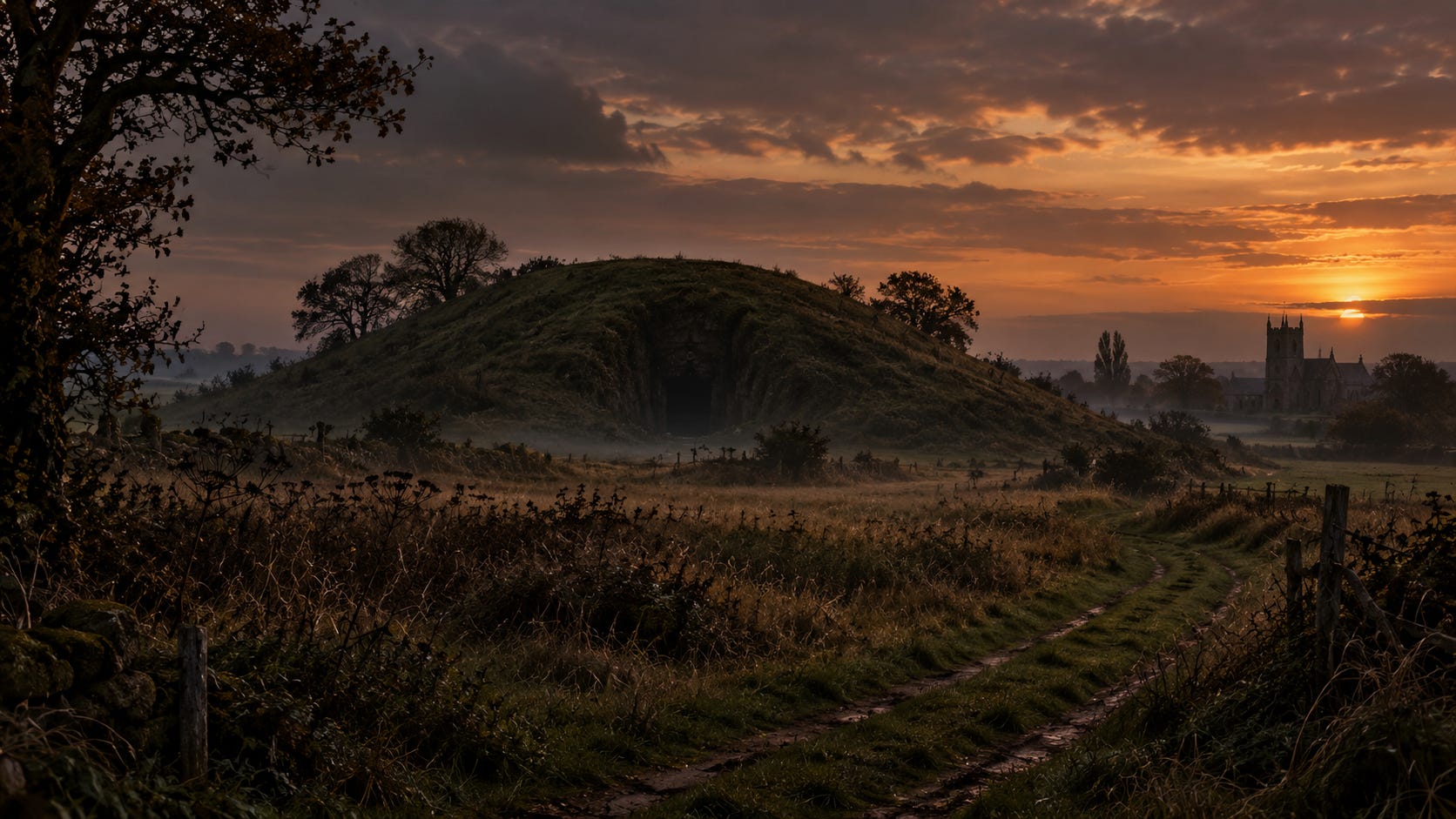
There are places in East Anglia where the land appears to have forgotten what century it is.
You can be driving through forestry plantation or along one of those narrow roads between Brandon and nowhere in particular, and suddenly the modern world thins out.
A church tower rises above the trees.
An old track vanishes between banks.
There is a mound in a field that the map either does not name or dismisses with some vague archaeological designation.
Tumuli.
Earthwork.
Possible barrow.
Undated.
These are useful words. They allow us to believe something has been explained.
It was one such mound that led me back to the Grimoire of the Seven Obsidian Kings.
Or perhaps the Grimoire led me to the mound.
I am no longer certain which came first.
My connection with the book began through Jack Thacker.
Readers familiar with the earlier account will know the outline. Thacker had brought the manuscript back from North Africa after the war, following its discovery among ruins uncovered by a sandstorm.
What I had not previously understood was that Thacker’s subsequent life in East Anglia may have been as significant as his discovery of the manuscript itself.
He worked in agriculture.
That sounds mundane.
It wasn’t.
The agricultural men of the late 1940s and 1950s moved through an East Anglia which was being transformed at extraordinary speed. Drainage. Mechanisation. Forestry. Land clearance. Former military ground returning to civilian use. Old boundaries torn out. New roads cut.
They saw things.
More importantly, they saw them before they disappeared.
My father, Ted Shreeve, worked across the East Anglian region during this period. The East Anglian War Agriculture organisation—the “War Ag,” as everyone called it—had its headquarters at Sprowston Hall just outside Norwich, then still a country house rather than the hotel it later became. From there, men were dispatched across Norfolk, Suffolk and the surrounding counties, dealing with farms, machinery, land and the enormous post-war transformation of the countryside.
One of the men connected with that world was Sam Thacker, whom I remember visiting much later, after his retirement, at his home in Norfolk.
Somewhere around Caston, near Attleborough, if memory serves.
Memory is unreliable.
That fact becomes important.
My father drove a Buick in those days.
Why an East Anglian agricultural official was travelling around post-war Britain in an American Buick I have never discovered. He apparently simply liked the car and somehow acquired one.
I mention it because, decades later, I found the Buick again.
Not the car itself.
A photograph.
My father was standing beside it on a rough track.
Behind him was a mound.
And on the reverse of the photograph, in pencil, someone had written:
THACKER — HOLLOW HILL — 1951
Nothing else.
I initially assumed Hollow Hill was merely a local name.
East Anglia is full of them.
Hollow Hill.
Devil’s Dyke.
Deadman’s Plantation.
Hangman’s Corner.
Fairy Mount.
Names survive long after anyone remembers why they were given.
I searched old maps.
Nothing.
I searched archaeological records.
Several possibilities.
None convincing.
Then I remembered something in the Grimoire.
Not a passage exactly.
A diagram.
Among the pages copied from Thacker’s manuscript there is a crude geometrical figure consisting of three concentric arcs bisected by a vertical stroke.
For years I had regarded it as decorative.
Looking again, I noticed something.
The mound behind my father’s Buick had been partly excavated or damaged. Its exposed side revealed three layers of earth.
Three arcs.
A dark vertical line ran through the centre.
Tree root perhaps.
Except the resemblance was exact enough to bother me.
That evening I took out the surviving translations of the Grimoire.
One fragment had always been problematic:
Beneath the raised earth is not burial but remembrance.
The sleeper is neither dead nor sleeping.
The earth is the eyelid.
The next word was untranslated.
XURA.
Then:
Let him who approaches make no demand upon the King.
Until then I had assumed “King” referred to one of the Seven Obsidian Kings.
For the first time I wondered whether the passage referred to a specific place.
I found the mound three weeks later.
I won’t give its location.
Partly because I don’t want people marching out there looking for it.
More importantly, because I’m still not certain that the location itself matters.
The place is somewhere in the Suffolk-Norfolk border country.
Forest.
Heath.
Agricultural land.
Old military ground not far away.
There is a church within walking distance.
That is enough.
I went in the late afternoon.
September.
Warm.
Almost absurdly pleasant.
Sun through the trees.
A light breeze.
Nothing remotely gothic.
That’s usually how these things begin.
The mound wasn’t impressive.
Perhaps twelve feet high at most.
Partly overgrown.
One side damaged long ago.
Standing beside it, I found myself wondering why anybody would have noticed it in 1951.
Then I saw the track.
Almost gone now.
But once it had passed directly beside the mound.
An agricultural vehicle could easily have travelled along it.
A Buick certainly could.
I walked around the earthwork twice.
Nothing unusual.
On the third circuit I noticed a depression beneath an elder tree.
Not an entrance.
Not even a hole.
Just an indentation in the earth.
But looking at it produced an unexpected physical sensation.
Recognition.
I had never been there before.
At least not consciously.
Yet I knew what was behind the earth.
A passage descending at approximately twenty degrees.
Chalk walls.
Three steps.
Then darkness.
The image arrived complete.
Not imagined in the normal sense.
I wasn’t constructing it.
It simply appeared.
Those who have experimented with boot.void will know the distinction.
Ordinary imagination has a sense of manufacture about it.
You decide to picture a red apple.
Then you picture the apple.
Spontaneous imagery behaves differently.
Something arrives.
You become its observer.
So I sat against a tree perhaps thirty yards from the mound.
Phone off.
No recording.
No ritual apparatus.
Nothing except attention.
And began.
BOOT.VOID
First the body.
Feet.
Legs.
Hands.
Jaw.
Breath.
Then the running commentary.
The endless little voice announcing, judging, predicting.
I allowed it to exhaust itself.
Birdsong.
Traffic somewhere far away.
Wind in leaves.
Then the quieter layer beneath thought.
No expectations.
No attempt to see anything.
I waited.
Darkness behind closed eyes.
Points of colour.
Movement.
Fragments.
Then the passage appeared.
Exactly as before.
Chalk walls.
Descending.
Three steps.
Darkness.
I did not enter it.
That was important.
Instead I held one instruction:
SHOW ME THE WAY BENEATH THE MOUND.
Nothing happened.
Perhaps two minutes passed.
Perhaps ten.
Time becomes difficult in these states.
Then I became aware that I was standing at the bottom of the passage.
There had been no journey.
No descent.
One moment I was observing darkness.
The next I was somewhere else.
The chamber was larger than the mound could physically contain.
That was my first coherent thought.
Immediately the place altered.
The moment I tried to measure it, the walls receded.
So I stopped.
There was no obvious light source.
Yet everything could be seen.
The chamber appeared circular.
The walls weren’t chalk now.
They were black.
Not stone exactly.
Something glossy.
Volcanic perhaps.
Obsidian was the obvious association, and therefore I distrusted it.
The mind likes correspondences.
Give it “Obsidian Kings” and sooner or later it will manufacture obsidian.
So I mentally discarded the material.
The walls remained black.
At the centre stood a figure.
Or rather something occupied the position where a figure ought to have been.
It was tall.
Beyond that I cannot describe it with any confidence.
Every attempt to look directly caused details to change.
At one moment I thought it wore antlers.
Then I realised I was seeing branches.
Then those branches became lines extending upward into darkness.
The face was equally unstable.
Old man.
Animal skull.
Featureless surface.
My own face.
None remained longer than a second.
I remembered the instruction from the Grimoire.
Make no demand upon the King.
So I did nothing.
The thing didn’t approach.
Neither did I.
After a while a sentence formed in my mind.
Not spoken.
Not heard.
Simply present.
YOU HAVE RETURNED BY THE WRONG DOOR.
My immediate response was:
Returned?
That was enough to destabilise everything.
The chamber vanished.
I opened my eyes.
The light had changed.
The sun was lower.
My first thought was that I had fallen asleep.
Entirely possible.
I checked the time.
Thirty-seven minutes had passed.
Again, entirely possible.
There was nothing inherently supernatural about any of this.
I had gone looking for unusual imagery and found unusual imagery.
That is what minds do.
I stood.
My legs had gone slightly numb.
Then I noticed somebody had been standing beside the mound.
A man.
Perhaps fifty yards away.
Dark jacket.
Grey hair.
He seemed to be looking directly at me.
For some reason I assumed he was a walker.
I raised a hand.
He didn’t respond.
Then he walked behind the mound.
I waited for him to emerge.
He didn’t.
There are explanations.
He could have taken another path.
The angle may have obscured him.
I didn’t investigate.
An experiment isn’t improved by chasing every oddity into the bushes.
I walked back to the car.
That night I dreamed of my father.
Not particularly unusual.
He was younger than I ever knew him.
Perhaps thirty.
He was driving the Buick.
I was sitting beside him.
We were travelling down a rough East Anglian track.
There were no houses.
No pylons.
No modern forestry.
The land seemed almost empty.
Eventually we reached the mound.
A man was waiting beside it.
My father called him Thacker.
Whether Jack, Sam or some composite constructed by memory, I couldn’t tell.
Thacker leaned through the window.
He looked terrified.
He said:
“We opened the wrong one.”
I woke immediately.
3:17 a.m.
I wrote the sentence down.
Then went back to sleep.
The following morning I returned to the photograph.
Buick.
My father.
Mound.
I scanned it at high resolution.
There was somebody standing behind the mound.
Barely visible.
A man.
Dark jacket.
Grey head.
Probably one of the agricultural workers.
Almost certainly.
I had simply never noticed him before.
But enlarging the image produced an uncomfortable detail.
He appeared to be facing away from the camera.
Yet his face was visible.
Not clearly.
Just enough to create an optical contradiction.
I stopped enlarging it.
There comes a point where pixels become theology.
Over the next seventy-two hours I followed the protocol I now use after experiments of this kind.
Observe.
Don’t pursue.
Don’t interpret.
Record only what occurs.
Three things happened.
First, I repeatedly encountered references to underground spaces.
A documentary.
A conversation.
An article opened almost by accident.
Nothing extraordinary individually.
Second, I woke twice with the phrase:
THE EARTH IS THE EYELID
already present in my mind.
That phrase, of course, comes from the Grimoire.
Again, easily explained.
I had been reading it.
The third occurrence is harder to dismiss, though not impossible.
While sorting old family papers, I found an envelope containing agricultural photographs from the early 1950s.
Among them was another picture of the Buick.
This time Sam Thacker—or the man I remember as Sam Thacker—was standing beside my father.
On the back:
Caston
Below that, in another hand:
Ask Sam what happened under the hill.
I do not know who wrote it.
There is a temptation with material like this to force a conclusion.
Don’t.
That destroys the experiment.
Perhaps my own memory supplied half the architecture.
Perhaps references from the Grimoire contaminated my expectations.
Perhaps the photograph primed the dream.
Perhaps the phrase on the envelope had been seen decades before and forgotten, then reconstructed indirectly through memory.
All possible.
But something else interested me more.
The geometry.
The chamber I experienced internally was much larger than the mound.
Ordinary dream logic.
Except that the Grimoire repeatedly suggests that these sites aren’t containers.
They are interfaces.
A mound is not something you enter.
It changes the coordinates from which consciousness observes.
That distinction matters.
We think geographically.
Here.
There.
Inside.
Outside.
But suppose those categories belong only to human perception.
Suppose proximity can be measured in other ways.
Two sites thousands of miles apart might be adjacent according to another topology.
An Algerian ruin.
A forgotten East Anglian mound.
A black chamber that physically exists in neither place.
All three could occupy the same position.
Not in space.
In something else.
And perhaps this explains the sentence:
YOU HAVE RETURNED BY THE WRONG DOOR.
Returned to where?
I don’t know.
Returned from where?
I don’t know that either.
But I have begun translating another section of the manuscript.
For years the opening line made no sense.
Now it does.
It reads:
The First King is beneath every hill, but no hill contains Him.
Then comes the word:
XURA.
And beneath it, drawn in faded black ink, are three concentric arcs divided by a single vertical line.
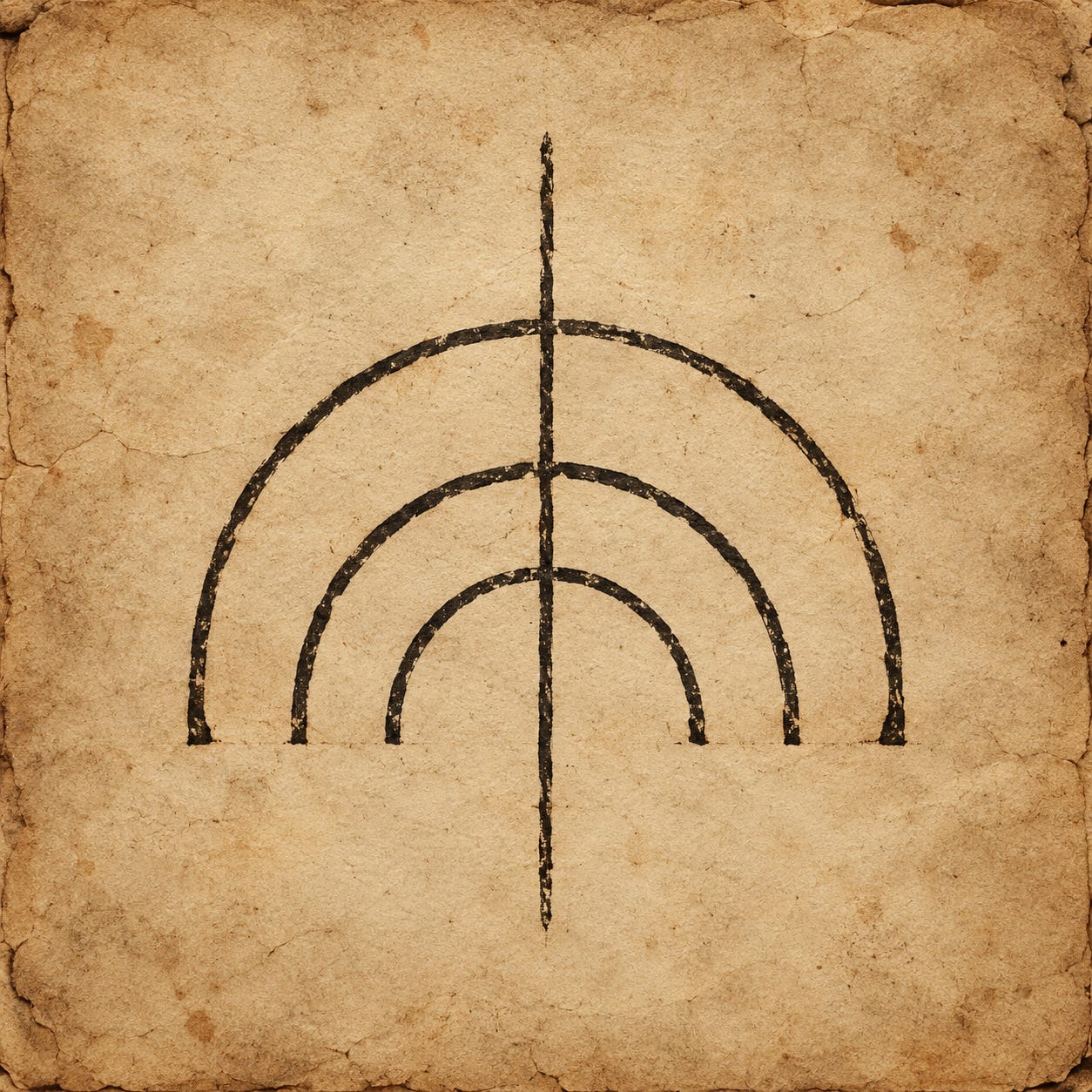
The same mark I saw in the old photograph.
The same mark that appears elsewhere in the Grimoire.
And, two days ago, the same mark I found scratched into the stonework of a small medieval church less than four miles from the mound.
I haven’t yet gone back.
But I will.
Because the church door faces east.
The mark is on the inside.
And immediately below it somebody has carved three words into the stone.
Not Latin.
Not English.
Just three crude marks.
I recognised them immediately.
They occur only once elsewhere.
In the Grimoire of the Seven Obsidian Kings.
The translation is uncertain.
But I think they mean:
THE SECOND DOOR.

⟡◌◯⟡⟡